

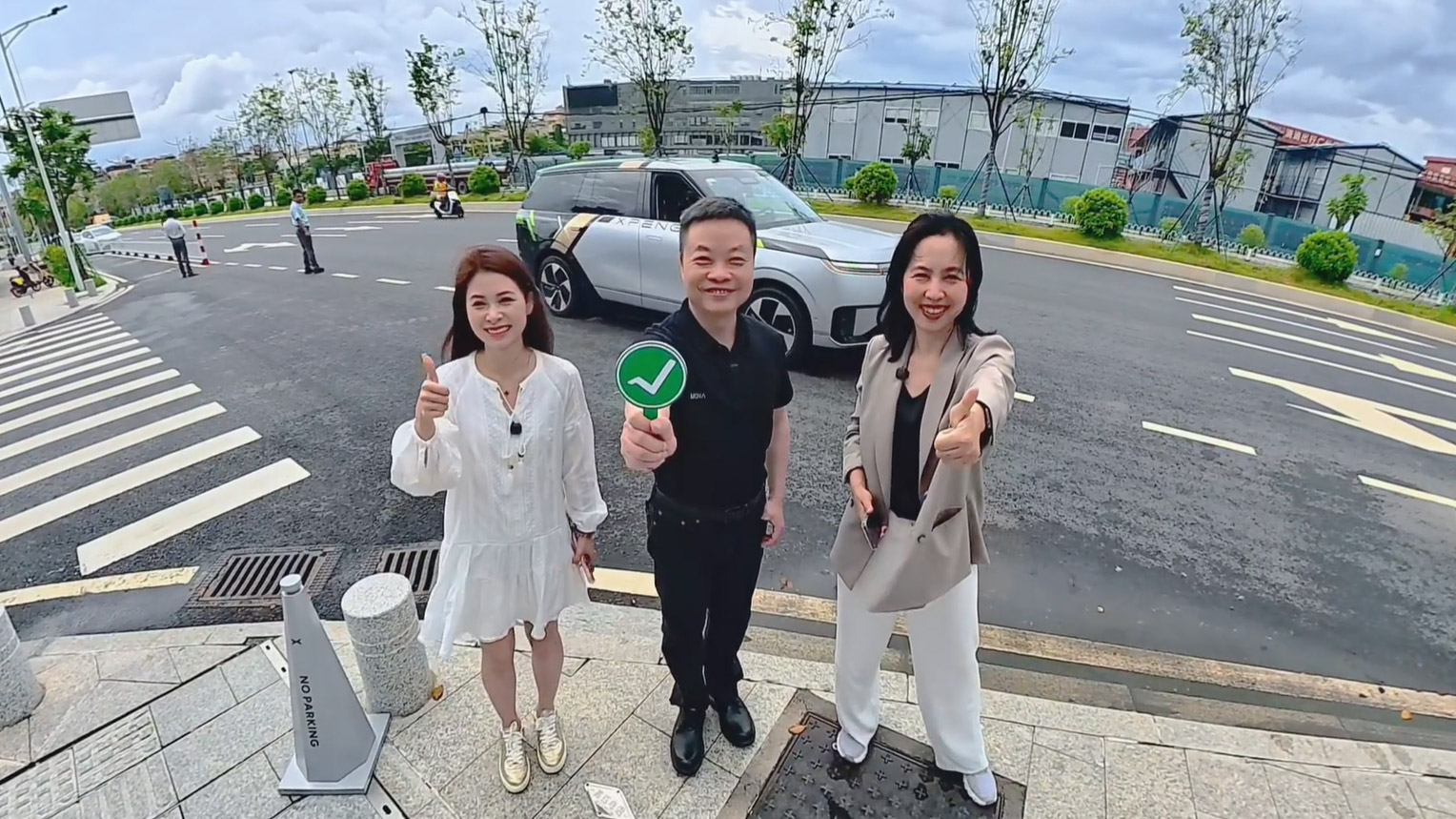
He Xiaopeng (center), chairman and CEO of Xpeng, completed the first ride in the company’s robotaxi internal test.
- Xpeng has completed the first order of its robotaxi closed beta, with chairman and CEO He Xiaopeng becoming the first user.
- The company plans to let internal users, as well as local Guangzhou residents and out-of-town visitors, hail an Xpeng robotaxi for a ride soon.
Xpeng (NYSE: XPEV) has completed the first order of its robotaxi closed beta, with chairman and CEO He Xiaopeng becoming the first user, marking a key step toward commercializing the Chinese electric vehicle (EV) maker’s autonomous mobility service.
“Very happy to be the first user in our robotaxi closed beta,” Mr. He said in a Weibo post on Thursday. “Downstairs from the office, I placed the order, got in, took my seat, and set off — the whole process was seamless.”
This was the first time the company has connected the full chain of hailing a ride online and taking it offline, according to Mr. He.
A screenshot from a video shows an Xpeng robotaxi arriving at the Xpeng headquarters in Guangzhou.
From officially announcing the robotaxi plan last November, to starting regular road testing in January this year and rolling the production vehicle off the line in May, and now getting the full chain up and running and launching the closed beta, Xpeng took only eight months, Mr. He said, adding that this pace exceeded initial expectations.
“We look forward to soon having our internal users, friends here in Guangzhou, and everyone visiting Guangzhou as tourists all being able to open their phones, hail an Xpeng robotaxi, and get in for a ride,” he said.
That said, Mr. He also acknowledged that the true large-scale roll-out of robotaxis is a long-term process. The company will continue to make steady progress on safety, experience, and generalization capabilities going forward, he said.
As China’s first full-stack, in-house-developed robotaxi that is factory-installed and mass-produced, the vehicle is built on Xpeng’s flagship SUV (sport utility vehicle) model, the GX, and is engineered to L4 autonomous driving standards.
The robotaxi is equipped with four of Xpeng’s in-house-developed Turing AI chips, delivering effective computing power of 3,000 TOPS — the highest onboard computing power of any mass-produced vehicle globally.
The robotaxi forgoes LiDAR and high-definition maps, adopting a pure-vision autonomous driving solution, with its decision-making powered by the company’s second-generation Vision-Language-Action (VLA 2.0) large model.
Inside the cabin, the vehicle comes standard with privacy glass, zero-gravity seats, and a rear in-car entertainment screen.
Passengers can view trip information, watch shows and listen to music during the ride, and adjust the air-conditioning temperature via a voice assistant.
Xpeng obtained a Guangzhou intelligent connected vehicle road testing permit in January this year, formally entering regular L4 public road testing.
In March this year, the company established a robotaxi business unit to coordinate the full chain of product definition, R&D and testing, and operations, in order to accelerate the commercialization process.
Xpeng plans to launch robotaxi pilot operations in the second half of this year to validate technical feasibility, user acceptance, and business model, and aims to achieve fully autonomous daily operations without on-site safety operators in early 2027.
The company has opened up the SDK (software development kit) for its robotaxi, with Amap having become its first global ecosystem partner.
As the flagship product of Xpeng’s physical AI ecosystem, the robotaxi shares the same VLA 2.0 large model foundation as the company’s humanoid robot, Iron.
In the conventional passenger vehicle segment, the GX that serves as the basis for the robotaxi officially went on sale in China on May 20.
The full-size SUV carries a limited-time starting price of 269,800 yuan ($39,690), marking Xpeng’s further expansion into the premium luxury market.
Xpeng’s robotics center has added nine second-tier departments, with chairman He Xiaopeng concurrently heading the product department.
($1 = 6.7986 yuan)
