

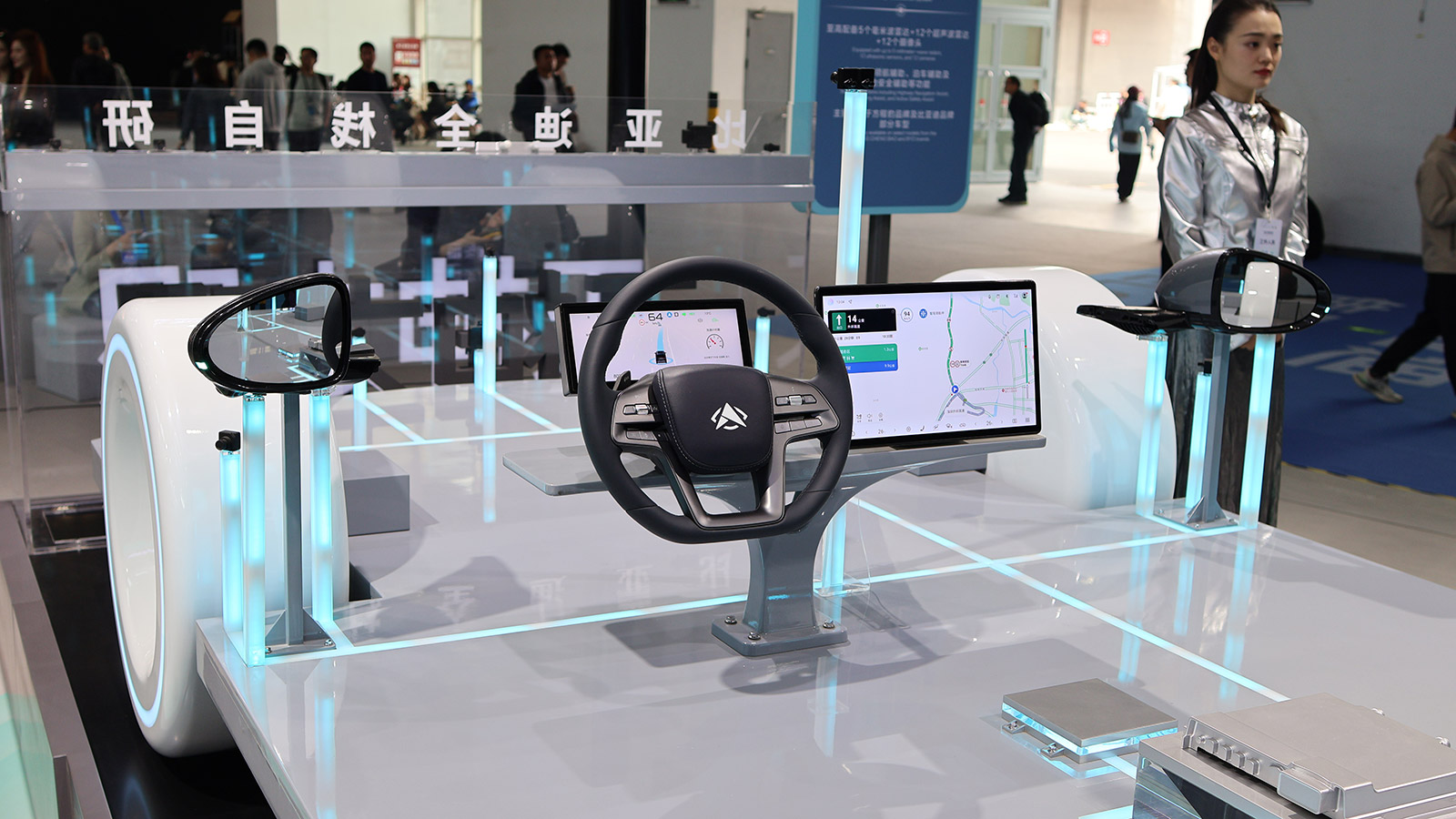
BYD displayed an assisted-driving system at the 2026 Beijing Auto Show in April 2026. Credit: CnEVPost
- China’s draft revision to its road traffic safety law proposes that manufacturers handle traffic violations in fully autonomous driving mode.
- The draft draws a clear distinction between autonomous driving and assisted driving, with the latter continuing to be regulated as non-autonomous driving.
China is proposing that automakers assume responsibility for handling traffic violations committed while vehicles are operating in fully autonomous mode, further defining the legal boundaries for the technology’s commercialization.
The draft revision to the Road Traffic Safety Law was submitted on Tuesday for an initial review by China’s top legislature, the Standing Committee of the National People’s Congress, according to a report by the China Central Television (CCTV).
The draft contains 9 chapters and 170 articles. It adds a dedicated chapter titled “Special Provisions for Autonomous Vehicles,” covering requirements for operating autonomous vehicles on public roads, the handling of traffic violations and insurance arrangements.
Under the draft, manufacturers or importers would handle road traffic safety violations committed while fully autonomous driving functions are activated.
Based on the information currently available, the arrangement applies to the entity responsible for handling traffic violations. It does not mean that liability for compensation in all traffic accidents would automatically shift to automakers.
Vehicles whose autonomous driving functions are not activated, as well as vehicles equipped only with assisted-driving features, would continue to be regulated as non-autonomous vehicles.
The distinction excludes today’s widely used assisted-driving systems from the provision requiring companies to handle violations. Drivers using such features would remain subject to the rules governing conventional vehicles.
Determining whether an autonomous driving function was activated will be critical to enforcement. The publicly available summary does not explain how vehicle operating data would be accessed or what evidentiary rules would apply in disputes.
The proposed revision complements China’s recently introduced mandatory technical standard for L3 and L4 autonomous driving.
The Ministry of Industry and Information Technology (MIIT) announced on August 4 that the Safety Requirements for Autonomous Driving Systems of Intelligent Connected Vehicles will take effect on July 1, 2027.
The standard requires autonomous driving systems to achieve a level of safety at least equivalent to that of a qualified and attentive driver. L3 systems must also be able to monitor whether the driver is capable of taking control.
China granted its first L3 market-access approvals for conventional passenger vehicles in December 2025. The approved models came from Deepal, a brand of Changan Automobile (SZSE: 000625), and Arcfox, a brand of BAIC Group.
MIIT said last month that the penetration rate of L2 combined driver-assistance features in passenger vehicles had reached 70.5% this year, while navigation on autopilot (NOA) had reached 34.2%.
That means the provision requiring companies to handle traffic violations will primarily affect higher-level autonomous vehicles approved for public roads in the near term, rather than most existing vehicles with intelligent-driving features.
Beyond autonomous driving, the draft strengthens restrictions on using handheld phones and watching videos while driving. It also limits unauthorized non-traffic activities that occupy public roads.
The draft revision is undergoing its initial review. Its provisions may still be amended during subsequent deliberations and have not yet taken effect.
The standard requires autonomous driving systems to be at least as safe as a competent and attentive driver performing the dynamic driving task.
