

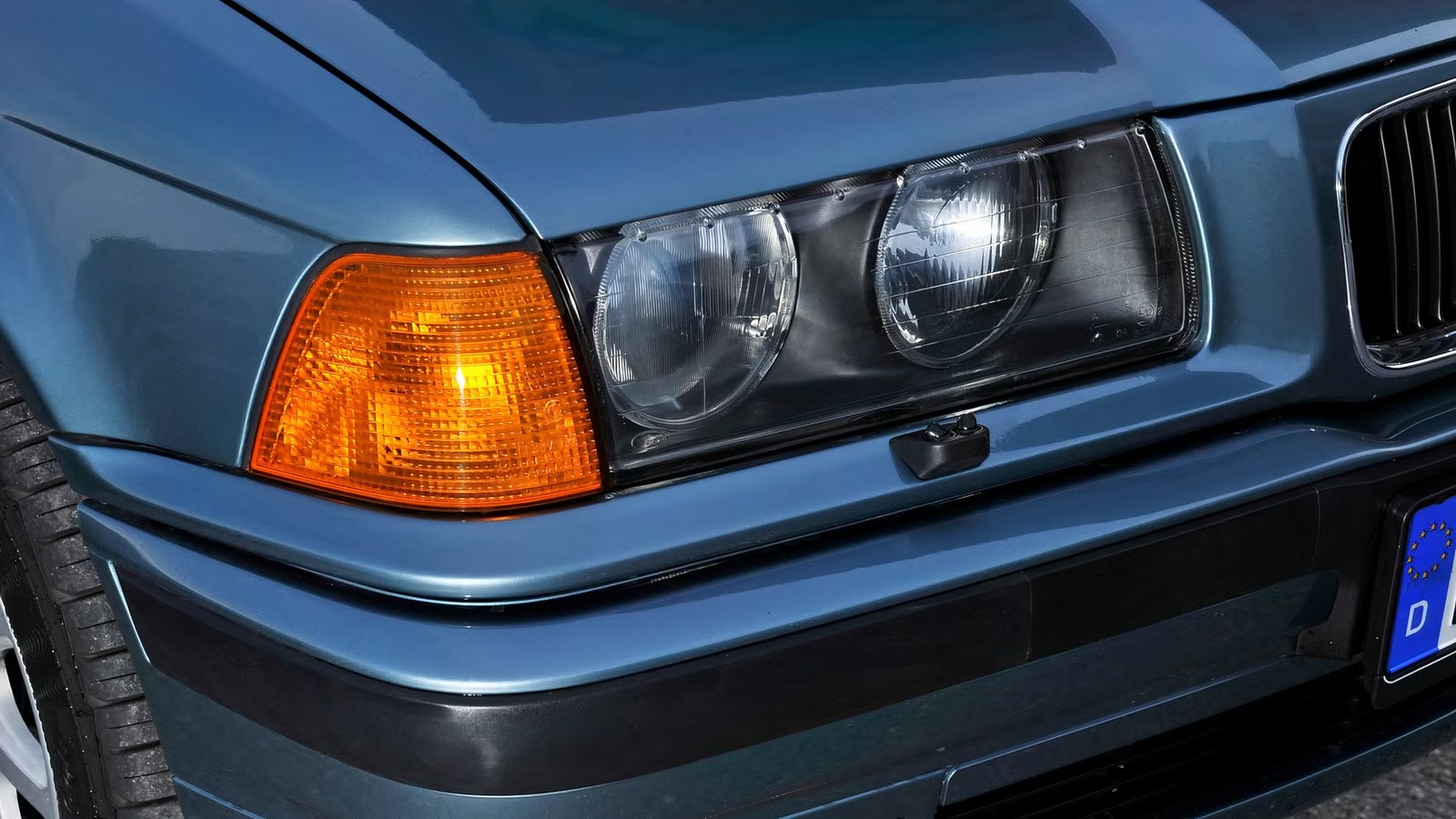
In the world of used BMW models, a few champions of the flock rise above the rest in terms of popularity. Typically, enthusiasts of the Bavarian automaker desire models such as the original E30 M3 and other M-branded offerings. However, in doing so, these folks may be overlooking one of the brand’s best engines of the 20th century.
BMW calls the engine in question the M50. It’s a family of inline-six powerplants from vehicles that include the third-generation (E36) 325i and the third-gen (E34) 525i. As it currently stands, pricing for these M50-equipped models is relatively affordable.
The mill itself is no screamer. It’s simple and boasts an uncanny ability to live a long life, with many examples reaching 200,000 and even 300,000 miles with just regular maintenance.
BMW Built An Extremely Tough Engine
BMW M50 inline-sixBMW Group Classic
When the M50 engine first hit the market in 1990, it was a huge leap forward for BMW inline-six powerplants. It was destined for use in the two aforementioned models, and was slated to replace the outgoing BMW M20 inline-six engine family. However, both the M20 and the M50 were produced concurrently for several years. BMW poured a lot of money into the M50 to give it a technological edge by early 1990s standards.
For starters, the engine came standard with a cast-iron block and an aluminum cylinder head. The cast-iron bottom end made the M50 robust and able to take a beating, while its aluminum head reduced overall weight. It was a wholly naturally aspirated engine, designed without turbocharging in mind. Many folks consider the M50 as one of BMW’s final, simple engines.
BMW E36 frontBMW
One of the most prominent versions of the M50 was the M50B25, a 2.5-liter variation produced between 1990 and 1992. The powerplant found its home in the E34 525i and the E36 325i, producing 189 horsepower and 181 pound-feet of torque. While average in its stock form, the M50B25 is preferred by enthusiasts for its extreme tuning potential, with several anecdotal reports indicating the engine can safely handle up to 400 horsepower, provided upgraded cylinder head studs or bolts are installed.
As for getting the most life out of the engine, one particular system needs to be paid attention to. The M50’s cooling system is known to be slightly finicky. However, so long as that is done, the rest of the engine is, reportedly, rather easy to handle. Some folks say the M50B25 requires an overhaul every 150,000 to 200,000 miles for neglected or beat-on examples. Although just because this unit is durable doesn’t fully explain why the cars it’s found in are such bargains.
Its Biggest Failing Isn’t Actually That Bad
1992 bmw e36 325i blue frontBMW
As mentioned above, the M50B25’s greatest weakness lies in its cooling system. From the factory, BMW outfitted the M50B25 with a whole host of plastic components that make up the cooling system. Its water pump impellers and thermostat housing are plastic. Over time, plastic degrades, which can lead to unexpected failures of these parts, even if a visual inspection before failure looks all clear.
Because these issues involve cooling, if any of these components fail, the primary symptom is overheating. Because the M50B25 uses an aluminum cylinder head, overheating can warp it, which in turn can damage the head gasket. Once a head gasket fails, coolant can slip into the combustion chamber and begin to mix with the mill’s air-fuel mixture, along with the engine oil itself, which can potentially result in catastrophic failure, namely engine seizure if left unchecked.
BMW E36 front redBMW
However, because the engine is rather simple in its make-up, preventative cooling system maintenance can largely be undertaken by someone with little DIY experience. Going out and buying a water pump with a metal impeller and a good-quality, metal thermostat housing is relatively cheap. For example, a new metal-impeller water pump goes for just under $50, and a metal thermostat housing runs about $30. So, an afternoon and $80 is all you need to spend to give the M50B25 a much better chance at a long life.
This simple, DIY-able maintenance runs contrary to newer BMW engines, which employ far more complex systems. Servicing things like turbochargers, inboard water pumps, and BMW’s VANOS system is difficult for the average home mechanic, especially without the proper tools or software. The M50B25, though, asks that you have just a simple socket set, a couple of hours, and a little patience to fix it right.
Easy To Keep Running
1991 bmw e34 525ix cutaway diagramBMW
If you’re starting on a classic BMW hunt as an enthusiast, your attention would likely fall on an M model. It’s no surprise, either, as models like the M3 or M5 have held steadfast to their places as performance benchmarks for decades. The trouble is, these cars are usually more expensive than their 3 Series or 5 Series siblings, putting them out of reach for many average Joes. Luckily, though, the E34 525i and E36 325i are much cheaper and easier to run.
Both were produced at a time when BMW wasn’t focusing too harshly on technological prowess. They both employ traditional, hydraulic power steering, which helps tremendously with road feel. They also use a much simpler rear-drive chassis and have strong aftermarket support, even more than three decades after they went out of production. Parts are cheap, too, and working on them yourself is relatively simple.
BMW E36 side blueBMW
Because more and more people are discovering the M50B25’s hidden gems in the E34 and E36, market pricing for both models is just starting to creep upward. For example, over the past year, the E36 325i has averaged $12,098 at auction. However, over the last six months, that number has shot up to $13,914. As far as the E34 525i is concerned, its average value sits right around $10,815 and is currently climbing. On the other hand, the E30 BMW M3 carries a much higher sale price, averaging $97,235 over the six months—quite a big difference.
For those who want an analog, tunable BMW that doesn’t require parting with both an arm and a leg, either the E34 or E36 M50B25-equipped models look to be substantially better value than, say, an E30 BMW M3. Sure, there’s less prestige and performance prowess, but you can kit out your M50B25 with some upgrades and performance parts, and still have a whale of a time for substantially less money.
There are several instances of the M50B25 engine lasting well over 300,000 miles. One such example, an E34 525i found on BimmerForums.com, claims to have 426,000 miles on the odometer. Another E34 on the same site reportedly has 313,000 miles and is still running strong, as well.
Get One While You Can
BMW E34 525i silver rearBMW
The M50-powered models currently occupy a unique sector of the classic car market. Yes, they’re aging and are now well over 30 years old, but they haven’t entered old age yet. That means they can, largely, still be driven every day. If you’re willing to put up with the cooling issue and/or repair the system to reduce the likelihood of issues cropping up, any M50-powered Bimmer may very well be reliable enough to drive every day.
For folks who simply want some sort of entry into the classic car market, the M50B25-equipped E34 or E36 offers a low-priced alternative to owning a BMW M3 or M5, which, should pricing trends hold, will continue to appreciate in value over time. Both models have also simply aged enough to look cool rather than tired on the road, giving them an edge in the value department as well.
1991 bmw e34 525ix silver sideBMW
As BMW’s halo M cars continue to climb in price, leaving more and more folks in the dust, we, as a collective of enthusiasts, must adapt. The E34 or E36 M50B25-powered BMWs offer an exceptional solution to the issue. Of course, nobody can guarantee exactly what the classic market will do in the future, and prices could very well come tumbling down or rise sharply, as any sort of investment is, in essence, a gamble.
However, both the E34s and E36s equipped with the M50B25 offer a unique blend of classic appeal, performance, simplicity, and bargain pricing, making them quite attractive to the right buyer. Both have been ignored for decades, and as people start to wake up to them, the “cheapness” window may not be open for much longer.
Sources: BMW, BimmerWorld.com, Classic.com, NotEnoughCylinders.com, BMWBlog.com.
