

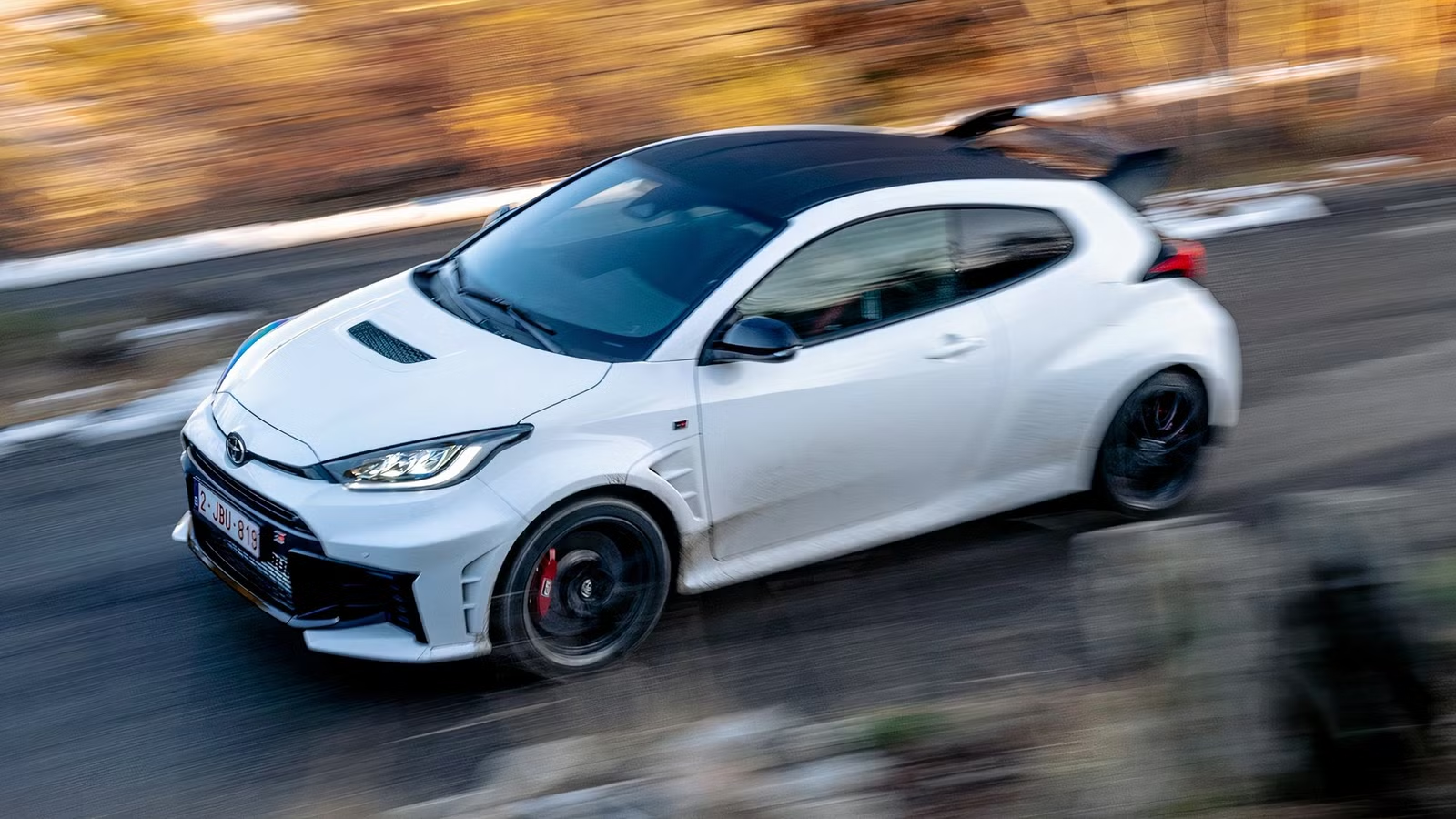
Staring at Toyota Motor North America’s headquarters in Plano, Texas, as an American gearhead, it is hard not to feel gratitude mixed with a biting frustration. On the one hand, Toyota is one of the few legacy automakers still actively pumping lifeblood into the enthusiast community, giving us genuine driver’s cars in an era of sanitized, digitized crossovers. On the other hand, those offices in Plano are where executives made the calculated business decision to block the GR Yaris from American shores.
The rest of the world gets to play with a rally-bred homologation special, while the United States was handed the heavier sibling in the GR Corolla. The justified anger emanating from hot-hatch purists and JDM aficionados isn’t just supposed internet outrage; it’s a genuine mourning for an uncompromising automotive philosophy. The GR Yaris is the ultimate forbidden fruit for Americans—a raw, featherweight alternative that embodies everything they want in a mechanical sports car but legally cannot own.
GR Corolla A Huge Success Stateside
GR Corolla Winning All The Way
2026 Toyota GR Corolla Premium Plus front 3/4 top viewToyota
For the United States, the consolation prize was the GR Corolla, and by all traditional automotive metrics, it has been a resounding, unmitigated success. Arriving as Toyota’s premier performance flagship stateside (aside from the GR Supra), it filled the massive void left by the absence of the smaller Yaris. Toyota recognized the pent-up demand for an all-wheel drive (AWD), manual-transmission hot hatch and responded by injecting its Gazoo Racing DNA into a five-door compact platform. The result is a highly capable, muscular machine that delivers an incredibly engaging driving experience.
I had the GR Corolla on test recently, and the sheer capability of this car is undeniable. Flicking the car’s drive mode into GR TRACK, engaging Sport Mode, and deactivating the electronic stability control uncovers its true character. The digital gauge cluster flashes a small, almost daring pop-up that simply reads “EXPERT,” and instantly, the car feels lighter on its feet. Weaving a series of tight corners together becomes an exercise in absolute precision.
It is genuinely shocking how effortlessly the GR Corolla reaches triple-digit speeds on an open stretch, and it is even more astonishing how composed the chassis remains when carving through wide, sweeping bends at those elevated paces. The 8-speed automatic I tested is a sign of the times—highly capable, but it inherently lacks the ultimate engagement of a manual. Nothing quite matches the enthusiast’s thrill of wringing a car’s neck, knowing that maintaining momentum requires the skill of timing your gear changes perfectly.
!!!MODEL TAG!!! Listing Carousel 2026 Toyota GR Corolla
/cars/toyota/gr-corolla/2026/
Similar Specs, But Weight Plays A Role
2026 Toyota GR Yaris front 3/4Toyota South Africa Motors
Fast Facts: 2026 GR Corolla vs GR Yaris
GR Corolla
GR Yaris
Engine
1.6L 3-Cyl Turbo
Horsepower
300 hp
281 – 300 hp
Torque
295 lb-ft
273 – 295 lb-ft
Transmission
6-Speed Manual
8-Speed Auto
Drivetrain
AWD
Curb Weight
3,306 lbs
2,921 lbs
However, when you start comparing the architecture and raw specifications, the differences between the GR Corolla and the forbidden GR Yaris become glaringly obvious to any knowledgeable enthusiast. The GR Corolla is powered by the exact same 1.6-liter G16E-GTS turbocharged three-cylinder engine found in the Yaris, but it has been tuned to produce a stout 300 horsepower to compensate for its significantly larger footprint. The unavoidable metric here is curb weight. The GR Corolla tips the scales at 3,306 lbs. The GR Yaris weighs in at 2,921 lbs while delivering between 281 and 300 hp, depending on the market.
To the driving purist, that 385-lb weight penalty alters the driving dynamics and the overall mechanical character of the vehicle. During my few days with the GR Corolla, I noticed a bit of turbo lag at the bottom end of the rev range, but once you hit the upper half, the car lunges forward with an endless supply of power. The extra width of the Corolla actually gives you incredible confidence to lay on the throttle mid-corner, trusting the car’s inherent stability.
Yet, having driven the updated GR Yaris a few days before the Corolla arrived, the contrast was stark. The Yaris is lighter, narrower, and lacks the dialed-back, mature stability of the Corolla. The Yaris was conceived from the ground up to conquer the World Rally Championship, and as a result, it feels like a bespoke weapon.
Base Trim Engine
1.6L I3 ICE
Base Trim Transmission
6-speed manual
Base Trim Drivetrain
All-Wheel Drive
Base Trim Horsepower
300 HP @6500 RPM
Base Trim Torque
295 lb.-ft. @ 3250 RPM
Base Trim Fuel Economy (city/highway/combined)
21/28/24 MPG
Infotainment & Features
9 /10
Why The Rawer Yaris Was Denied
2026 Toyota GR Yaris front 3/4Toyota South Africa Motors
To truly understand why the more visceral GR Yaris never graced American shores, you have to look past the emotional appeal of a great chassis and examine the federal automotive regulations. The barrier to entry for the United States market is notoriously steep, and it’s governed by incredibly stringent safety and emissions standards that require tens of millions of dollars in testing and validation. Because the standard subcompact Yaris sold globally utilizes a platform that is not federalized for the US market—the US “Yaris” sold here previously was actually a rebadged Mazda 2—bringing the GR Yaris stateside would mean homologating an entirely new chassis from scratch.
Toyota Motor North America’s Executive Vice President of Sales, Bob Carter, addressed this harsh reality directly, shedding necessary light on the prohibitive economics of importing the vehicle.
“The U.S. and North America have the harshest crash tests in the world, so [the GR Yaris] is not homologated for the US.” – Bob Carter, Executive Vice President of Sales, Toyota Motor North America
The word we’re getting from corporate is simple: crash-testing multiple units of a bespoke, low-volume sports car requires a massive upfront financial investment. And for a massive conglomerate like Toyota, the projected sales volume of a niche, manual-only subcompact in a market dominated by pickup trucks and crossover SUVs simply could not justify the multi-million dollar federalization costs.
The decision made in the Plano boardroom was not an act of cruelty or censorship against American enthusiasts; it was an unavoidable corporate reality. The astronomical costs associated with passing the National Highway Traffic Safety Administration (NHTSA) crash tests would have inflated the MSRP of the GR Yaris to a point where it would be entirely unsellable. So by utilizing the already-homologated Corolla platform, Toyota bypassed the most expensive regulatory hurdles, allowing it to deliver that glorious GR powertrain to the US market at a viable, competitive price point. Yet, for purists, it’s still a bitter pill to swallow, and the business logic still offers very little solace.
The Global Market Picture Here
2026 Toyota GR Yaris side profile viewToyota South Africa Motors
While Americans sit and lament the regulatory blockades that keep the GR Yaris at bay, the car has absolutely flourished virtually everywhere else, cementing its status as an international automotive icon. In places like Europe, Japan, South Africa, and Australia, the car was met with universal critical acclaim and immediate, overwhelming commercial success. Originally intended for a highly limited production run of just 25,000 units strictly to satisfy FIA World Rally Championship homologation requirements, demand was so unprecedented that Toyota was forced to expand production and even introduce a heavily updated second-generation model for 2024.
The international sales performance of the GR Yaris proves unequivocally that there is still a ravenous global appetite for uncompromising, mechanical performance cars. In markets where small footprints and agile, razor-sharp handling are prized over outright size and cup-holder count, the GR Yaris is the undisputed ruler. Having experienced the raw energy of the GR Yaris firsthand, I completely understand why Australian dealership allocations famously sold out in a matter of days, and why European buyers practically clamored for the optional Circuit Pack. The car is alive—always—especially at ridiculous speeds. It possesses that unpredictable, feral edge of legacy hot hatches that the highly competent but slightly clinical GR Corolla simply lacks.
The vehicle’s runaway success overseas only serves to amplify the deep frustration felt by US buyers. It is a frustrating reminder that Toyota is fully capable of building the uncompromised car that enthusiasts are begging for, but geographical borders and regulatory red tape keep it perpetually out of reach.
Underground Gray Market Routes
2026 Toyota GR Yaris rear 3/4Toyota South Africa Motors
When a highly desired vehicle is deemed illegal by federal regulators, a subset of the automotive community will inevitably search for loopholes. The US exclusion of the GR Yaris has spawned a fascinating, albeit legally precarious, underground gray-market ecosystem. Determined buyers are going to extraordinary lengths to circumvent the ban, leveraging international connections, foreign registrations, and complex import strategies to bring the car across the border.
The most notable loophole appeared briefly when Toyota Mexico secured a highly limited allocation of 300 GR Yaris units in 2021. In a staggering display of demand, the entire Mexican inventory sold out in less than 24 hours. Almost immediately, whispers began circulating online regarding the logistics of buying a Mexican-market GR Yaris and physically driving it across the border. Forums absolutely exploded with heated discussions on state-level registration loopholes—like the infamous Montana LLC trick—the severe risks of federal vehicle impoundment, and the highly restrictive “Show and Display” exemption criteria.
The prevalence of these gray imports shouldn’t be overstated—it remains a niche, incredibly risky workaround rather than a mass-market solution. But the sheer lengths to which buyers are willing to go highlight the profound desire for this specific vehicle, even six years after it first debuted.
Don’t Be Tempted By The Allure Of The Gray
2026 Toyota GR Yaris interior steering wheelToyota South Africa Motors
While the allure of finding a loophole is incredibly strong, trying to cheat the system is a massive gamble. If you are tempted to go the gray-market route to get your hands on a GR Yaris in the States, here are five simple reasons why it just isn’t viable:
The 25-Year Waiting Game: Federal law blocks non-compliant cars from American streets until they reach the 25-year mark. For the GR Yaris, that means Americans must wait until 2045 before it is legally importable under the NHTSA exemption.
The Threat Of The Crusher: If Customs and Border Protection catches an illegal import, they don’t just politely put it on a boat back to Mexico or Japan. They will seize the vehicle, issue federal fines, and often literally crush the car at a scrapyard.
No “Show and Display” Loophole: The exemption that wealthy collectors use to bring in rare hypercars or early R34 Skylines doesn’t apply here. The GR Yaris is simply too new and hasn’t earned the strict “historical or technological significance” required by the government to qualify.
Registration & Insurance Nightmares: Even if you somehow successfully bring one across the border, securing a legitimate state title, obtaining license plates, and finding an insurance company willing to cover an illegal vehicle without committing outright fraud is virtually impossible.
Massive Financial Ruin: Between paying vastly inflated secondary-market prices, dealing with unscrupulous import brokers, and risking the total loss of the vehicle upon impoundment, you are essentially incinerating a massive sum of money for a car you cannot legally drive to the local grocery store.
What This Means For True Fans
The exclusion of the GR Yaris from the American market is more than just a sad footnote in Toyota’s North American history. It symbolizes a broader shift away from niche, purist sports cars. The harsh truth of modern automotive manufacturing is that bespoke platforms and lightweight engineering are increasingly incompatible with the safety regulations, emissions standards, and consumer preferences of the United States.
The executives in Plano made the correct decision—both from a federal and financial standpoint. The GR Corolla is an excellent, phenomenally fun machine that successfully democratized Gazoo Racing for the American public. During my time with it, hearing the engine work and feeling the noticeable thud with every gear change proved that it offers thrilling performance wrapped in a practical, legally compliant package that you can actually buy at a local dealership. Yet, I understand and empathize with the American audience’s persistent yearning for the GR Yaris, which serves as a constant reminder of exactly what is being lost in the modern pursuit of mass-market viability.
The Toyota GR Yaris is a raw car built purely for motorsport excellence, completely devoid of the compromises required by focus groups and federal crash tests. The GR Corolla may thrive stateside as a genuinely brilliant consolation prize, but for the true JDM enthusiast who knows what it feels like to wring a car’s neck and exploit every last ounce of a chassis’s potential, the absence of the smaller, rawer GR Yaris will always sting.
And for that, I am sorry.
Sources: Toyota, NHTSA, JDM Drives
