

Most of us are required, to a certain extent, to be cautious with our money. For example, lots of folks would love to live in mansions with garages chock-full of go-faster cars and a pantry filled with various, expensive delicacies. However, in the real world, money is a limiting factor, and it must be managed intelligently. That means buying that bucket-list sports car might not be in the cards right now. However, in some ways, buying a sports car could be a smart financial decision, so long as it’s the right one.
The model in question is the Porsche 911 due to its excellent ability to fend off depreciation. According to most sources, the most recent 992-gen 911 loses just 17 to 20 percent of its value over the course of five years. Contrast that with your average luxury flagship sedan, which can lose significantly more of its original value in that same timeframe. Bearing this in mind, the 911 seems to behave much more like an actual, hard asset, rather than a luxury vehicle. Why?
The Math Favors The Porsche
To begin, let’s take a look at the depreciation rates of some popular luxury models across a few segments. For starters, the QX80, Infiniti’s flagship luxury SUV, plummets in value after five years of ownership. According to CarEdge.com, the SUV loses a staggering 69 percent of its original value after just five years. That means that someone who spent an average of $99,476 on a brand-new QX80 would only get about $30,857 back when it came time to sell.
2025 Porsche 911 Carrera T FormosaPorsche
The BMW 7 Series, for example, doesn’t fare that much better. In just its first year on the road, the BMW 7 Series will lose about 30 percent of its original value. Broken down, that’s the equivalent of taking roughly $81.62 — assuming a purchase price of $99,300 before any fees or taxes — and throwing it out the window every day over the course of a year. After five years on the road, the 7 Series will only retain 38 percent of its original value. That’s slightly better than the aforementioned QX80, but still poor enough to give new 7 Series buyers pause.
With the Porsche 992 911, however, it’s more like buying a car outright rather than paying to drive one, as the latter two models would effectively force buyers to do. The 911’s penchant for value retention is apparent anywhere you look. According to current pricing trends, the average 2021 Porsche 911 Carrera sells for around $94,992 in today’s used market. For contrast, the model’s MSRP in 2021 was $99,200 before any fees or taxes were factored in. So, while the official CarEdge.com report says the 911 loses between 17 and 20 percent of its value over five years, the real-world sales data says it’s closer to just a 4.3 percent loss.
2025 Porsche 911 Carrera T FormosaPorsche
Related
A Twin-Turbocharged Porsche 911 Is Much Cheaper And More Reliable Than You Think
If you have the craving for a twin-turbocharged Porsche 911, but are worried about how much it’ll cost to run, alleviate your fears.
The 911’s Value-Retention Mastery Isn’t An Accident
2025 Porsche 911 Carrera T FormosaPorsche
Porsche didn’t wake up one day to find the 911’s used values at higher-than-average levels. In reality, the Stuttgart-based automaker deliberately built its residual value prowess into its production formula through limited availability. There is a behind-the-scenes business strategy at Porsche that helps the 911 keep its values high.
Higher-volume models, such as the Cayenne and Macan, help absorb sales volume across the entire nameplate. In turn, this helps the 911 maintain a relative amount of exclusivity in the new car market as a whole. It’s a win-win for Porsche, as the company is able to produce those higher-volume, lower-cost models on a larger scale, helping to expand its customer base. At the same time, the 911 permanently retains its extreme levels of value retention.
2025 Porsche 911 Carrera Nose Side ProfilePorsche
When it comes to buying a new 911, you can’t simply walk into a showroom, pick your preferred configuration, and walk back out with the keys in hand. You need to be granted an allocation slot from the dealer, who needs to get it from Porsche itself. The amount of these slots is only granted based on dealer performance, so one dealer might be able to help you, while another, lesser-performing one might not. Not to mention, these dealers have, historically, heavily favored repeat and multi-car customers.
So, if you’re a first-time buyer, you might have an even harder time securing an allocation than buyers who have been through the process before. At the same time, Porsche purposely limits the number of 911s that hit the road in any given model year. This creates artificial scarcity — a condition manufactured deliberately by the automaker.
2025 Porsche 911 Carrera front 3/4 viewPorsche
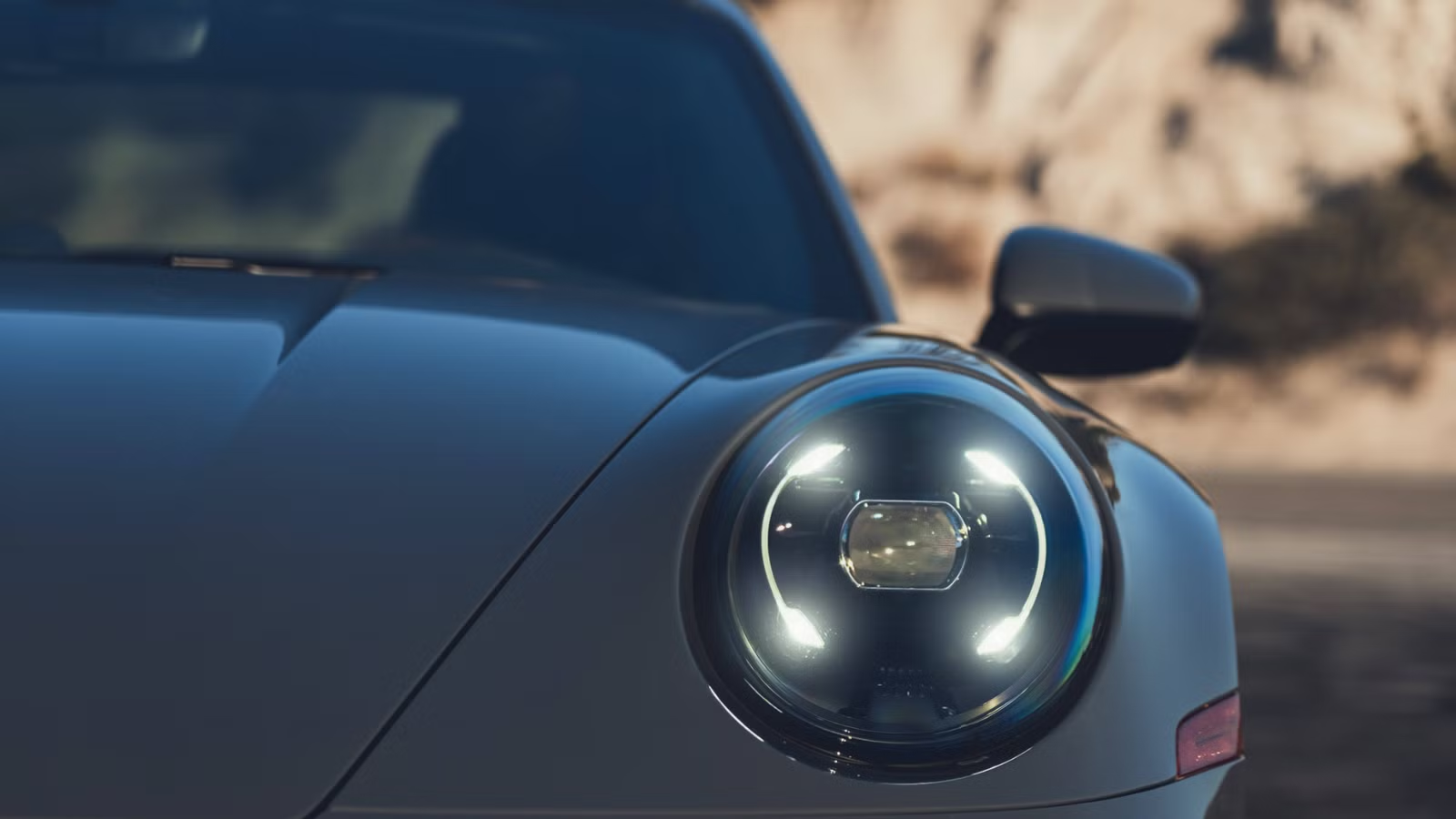
Another factor contributing to the 911’s value retention is its design. Since the 911’s inception in 1964, its look hasn’t changed all that much. This is especially the case over the last couple of decades. By keeping its design relatively unchanged, Porsche allows previous-generation models to appear current and in style even after their respective generation exits production. Because older-generation models still look remarkably close to the current iteration of the 911, more people want them, driving their values up. Couple that with built-in artificial scarcity and the demand outweighs the supply, driving used prices up even further.
Related
Why Porsche Currently Builds The Ultimate Daily Supercar
The market for usable supercars has grown at a pace over the past couple of decades, but the king of the hill is still the Porsche 911 Turbo.
Luxury Flagships Are Designed To Lose Value
Now, we’ll revisit our BMW 7 Series and Infiniti QX80 examples from earlier to discuss why luxury flagships shed their values so quickly. One of the most glaring reasons for this unfortunate phenomenon is a lease-dominant new sales climate. Most brand-new BMW 7 Series owners, for example, lease their car rather than buy one. It’s reported that around 70 percent of customers go for the lease rather than a purchase. It’s roughly the same story for the Infiniti QX80, although its lease percentage falls to around 40 percent.
On top of the leasing issue, flagship luxury models are also subjected to extreme, frequent redesigns to try and keep them on the cutting-edge of technological advancements, as well as design trends. Much like designer clothes, once they’re out of style, the luxury flagship loses much of its value, hence its poor resale figures. Manufacturers also use heavy incentives to move flagship luxury inventory off of dealer lots if they sit too long, further driving prices down.
2024 Porsche 911 Carrera T Flat 6Flat 6
The 911, however, doesn’t have to suffer through design-related obsolescence, nor does it need to weather technological advancements. Its look is timeless, with only minor tweaks made over the majority of its life to keep it lightly refreshed. Its artificial scarcity and enthusiast excitement also work to keep it highly desirable long after its new-car smell has faded.
Related
The Fastest-Depreciating SUV Loses $52,000 In Five Years, Making It A Used Bargain
A new study finds this luxury SUV to be the fastest-depreciating vehicle in its class.
The 911 Lets You Be Sensible With Your Emotions
For most sports cars on the road, buying one isn’t the best move financially, especially if you purchase new. You’ll most likely end up taking a significant hit on depreciation when it comes time to sell. However, in the Porsche 911’s case, its extremely low depreciation means you can make an emotionally driven purchase with your hard-earned money while still truthfully positioning it as an investment to your spouse.
At press time — and as has been the case for quite a long time — the 911’s used market pricing trend looks bright and stable. Of course, the post-pandemic used car market has finally softened, driving used prices back down somewhat, but the 911’s value has managed to maintain its higher-than-typical standing. Good news for the financially-conscious enthusiast.
Sources: Porsche, BMW, 7Post.com, CarEdge.com.
