

Some Porsche 911 fans have historically been resistant to any sort of change. One of the largest examples of this came about in 1998, when the water-cooled Porsche 996 911 was launched. Purists were beside themselves in protest of Porsche switching the 911 from air-cooled to water-cooled engines, but the Stuttgart-based company plowed on with the new mills anyway.
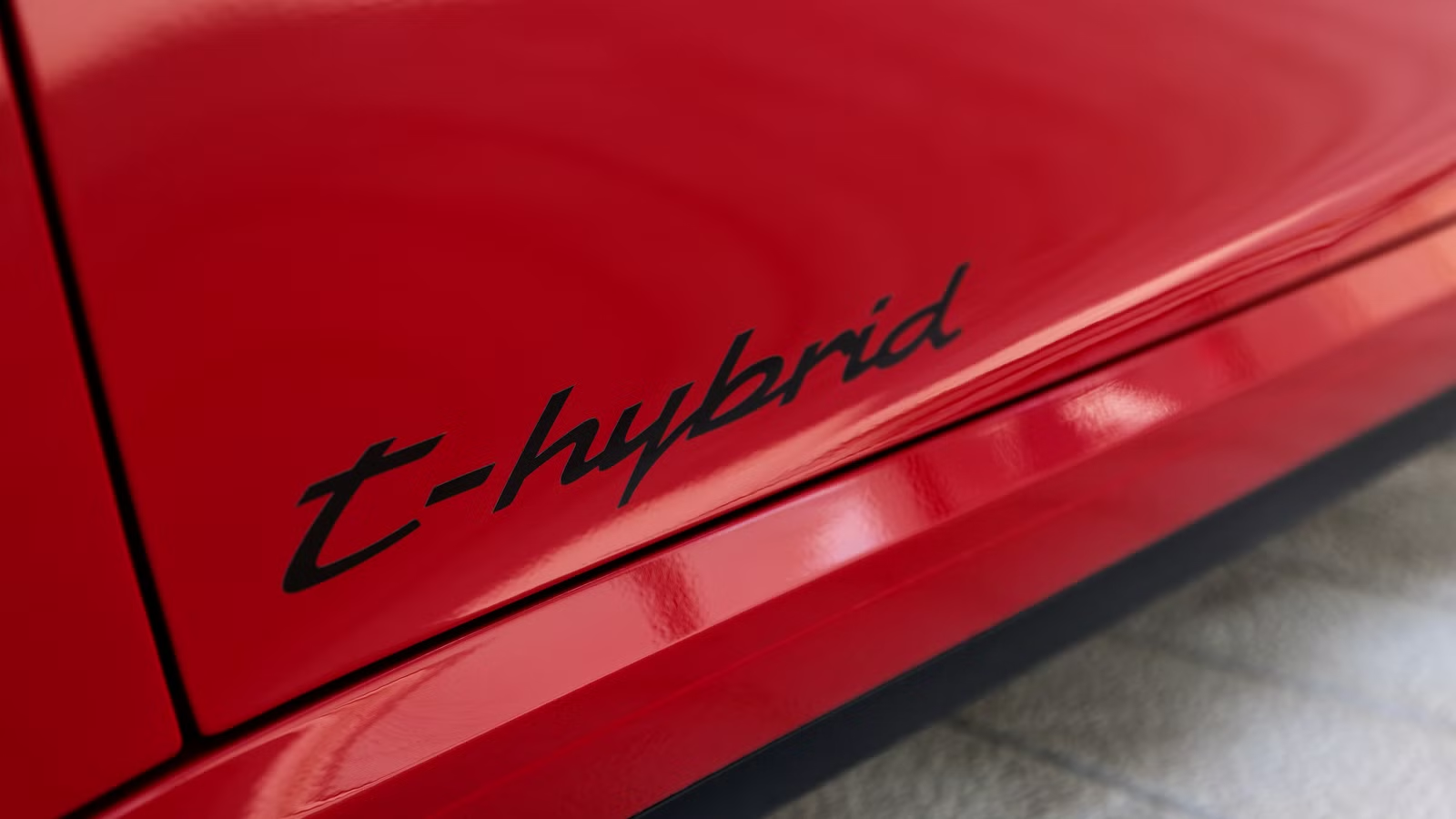
Now, a level of resistance close to what the automotive world saw nearly 30 years ago has resurfaced as Porsche introduced a new hybrid powertrain to the 992.2 911 called the Carrera GTS T-Hybrid. Whether the Porsche fandom will eventually celebrate the change, or if it will go down as a historical mistake to switch to hybrid power, is yet to be revealed.
Saving Fuel Isn’t The Hybrid 911’s Goal
Porsche 911 GTSPorsche
The Porsche 911 Carrera GTS T-Hybrid doesn’t use the same sort of hybrid system found in, say, your brand-new Toyota Camry. The T-Hybrid system operates in a manner that does not increase fuel economy, or offer a small amount of electric-only driving range. Instead, the system is used as a performance enhancement measure. Calling it a hybrid, while technically true, can lead some to think Porsche has gone fully eco-friendly.
What the T-Hybrid system actually does is eliminate turbo lag and sharpen throttle response. A small electric motor is bolted directly to the 911’s turbocharger, which spools the turbo faster than average, providing instant acceleration. In doing so, throttle response becomes near-instant. Another electric motor is situated within the T-Hybrid’s eight-speed automatic PDK transmission, which helps to boost low-end power and also recovers and stores normally wasted kinetic energy.
2025 Porsche 911 HybridPorsche
Thanks to the dual-motor assistance, the 911 Carrera GTS T-Hybrid boasts a combined output of 532 horsepower alongside 449 pound-feet of torque. The engine mated to the hybrid system is Porsche’s new 3.6-liter turbocharged flat-six. Performance testing has proven the 911 Carrera GTS T-Hybrid can sprint from 0-60 mph in less than three seconds.
The Porsche 911 Carerra GTS comes with a T-Hybrid system, combining a powerful turbocharged flat-six engine with plenty of Volts.Porsche
It’s apparent that Porsche wasn’t in the business of making the 911 more palatable to certain environmental groups with the introduction of the T-Hybrid back in 2024. Instead, the “hybrid” components are purely there to increase performance without having to add power to its internal combustion engine or create a brand-new transmission. But the performance case for the T-Hybrid is almost beside the point – because for 911 purists, the real complaint isn’t about power. It’s about what Porsche had to add to get there.
For The 911, Weight Is A Matter Of Philosophy
While the T-Hybrid system does fundamentally increase the 911’s performance, it comes with one major drawback: weight. Overall, the setup adds roughly 110 lbs, or 50 kilograms, to the 911’s curb weight. Two body styles are available as GTS T-Hybrids, a coupe and a Targa variant, which weigh around 3,627 lbs and 3,847 lbs, respectively. In its Targa-roofed configuration, the 911 T-Hybrid manages to be the heaviest stock 911 ever built.
Porsche added several electronic aids to help manage the extra weight introduced by the T-Hybrid system. For starters, it utilizes an active rear steering system, which takes advantage of computer control that tailors the amount of rear-axle steering to vehicle speed and road conditions. Its suspension was upgraded over the outgoing 911 GTS, as well, which is a lowered Porsche Active Suspension Management (PASM) system. It also employs a 400-volt, electronic version of Porsche’s Dynamic Chassis Control (PDCC), which can make chassis adjustments on the fly far quicker than the outgoing hydraulic version.
Porsche 911 GTSPorsche
Thanks to the introduction of those helpful pieces of tech, the 911 Carrera GTS T-Hybrid actually manages to be faster around a track than the outgoing GTS model. For example, it managed to beat the older GTS’ time around the Nürburgring by 8.7 seconds, even with its extra weight. However, while faster is generally better, purists still lament the hybrid system and its electronic changes. Not to mention, the GTS T-Hybrid loses the fabled 911 analog tachometer, along with a push-button ignition.
But Porsche has been here before. In fact, the last time fans were this angry, the controversial feature became the 911’s defining advantage. Here’s what that precedent means for the T-Hybrid.
This Isn’t Porsche’s First Rodeo
1999 Porsche 911 Carrera Coupe front 3/4BaT
Every time Porsche has added complexity to the 911, purists have cried foul — and every time, the numbers eventually silenced them. The water-cooled 996, the PDK, electric power steering: each became a symbol of betrayal before becoming a benchmark.
The air- versus water-cooled debate was a major sticking point for many Porsche purists in the late 1990s. The argument wasn’t so much about a preferred level of performance that was lost with air-cooled engines. Rather, it was simply because the move was seen as Porsche abandoning its roots.
The Porsche Doppelkupplungsgetriebe, or PDK transmission, was also the source of a large backlash when it was introduced in 2008. The gearbox itself has its roots firmly planted in motorsport, and was brought over to the civilian market as a way to give drivers the options to shift gears much faster than they could with a standard manual transmission. However, purists initially argued that the PDK would diminish the mechanical connection found with a traditional manual transmission. Not to mention, the early PDKs were reportedly a bit clunky to use, further alienating some drivers from the pursuit of driving feel.
2012 Porsche 911 Club Coupe front three-quarter view.Gooding & Co
Some time later, yet another major controversy emerged. Porsche switched the 911 over to electric power steering beginning in 2012, which coincided with the introduction of the 991 generation. Purists argued that, not only was Porsche abandoning heritage, but electric power steering removes some of the raw driving feel that the 911 was known for. It can’t be argued that electronically controlled power steering doesn’t make certain models feel a bit vague on the road, either.
The PDK Was Once Hated Too – And Now It’s The 911’s Best Feature
Porsche Panamera PDK TransmissionPorsche
Now, in 2026, things like the 911’s water-cooled engine and PDK transmissions are widely accepted by many of the same purists that once cried foul. For example, PDKs have improved over the years, and are now the transmission of choice within new 911 models. Porsche has also spent a great deal of time and money perfecting its electric power steering system to provide a greater sense of feel without needing to install an old-school, potentially leaky hydraulic system.
Bearing that in mind, it’s reasonable to assume that those who are resisting the new 911 GTS T-Hybrid may, at some point, accept it and even celebrate it.
Porsche’s Choice: Benchmark Every Era Or Become A Museum Piece
The real question isn’t whether the T-Hybrid system works. Instead, it seems to be what the 911 should end up becoming. Porsche has proven time and again that it’s willing to prioritize performance and capability over pure, unadulterated driving feel. Such was the case with the introduction of the T-Hybrid system in 2024. It’s a fine line for Porsche to walk, trying to keep the 911 as old-school as possible, but also allowing it to move with the times and retain its popular driver’s car status.
For some Porsche fans, the 911’s role is to uphold the traditional philosophy when it comes to performance. In their view, hydraulic power steering, analog gauges, air-cooled engines, and other such features should never have been tampered with in the pursuit of performance. However, if Porsche hadn’t moved away from these, the model may very well have fallen into obscurity, not to mention inferiority.
The Porsche 911 Carerra GTS comes with a T-Hybrid system, combining a powerful turbocharged flat-six engine with plenty of Volts.Porsche
Instead, Porsche made the decision to keep the 911 current with the times, while also retaining some of the traditional touches that keep purists coming back, such as its rarely changing exterior. Porsche wants the 911 to be the sports car performance benchmark of whichever era it’s in, even if it means really making some folks angry.
Of course, the air-cooled purists aren’t without choices. One famous company, Singer, restores and reimagines old-school Porsches, most of which do come with air-cooled engines. These models command a premium, with the most affordable examples typically fetching around $400,000 when new. They are out there, and those who are set on buying a new-old Porsche 911 can do so, provided they have the means.
The GTS T-Hybrid Might Just Be Another Air-Cooled Dilemma
Porsche 911 GTS T-Hybrid Powertrain X-RayPorsche
In the end, the introduction of the T-Hybrid system marks another point in the Porsche 911’s long lifespan where fans of the model are forced to contend with changing times. More often than not, the change is eventually accepted and even celebrated for bringing the 911 forward into the future, rather than leaving it in the past.
Sources: Porsche,DriverReviews.com,StuttCars.com,AutoCar.co.uk.
