

When war is over and the world has found peace for a short while, another battle still rumbles among each of the superpowers – the engine superpowers, that is. Germany, America, and Japan have each been intertwined in an automotive war for decades, but only one country appears more times on WardsAuto’s list of engines with the greatest impact, from 1924 to 2024.
Japan has given us high-revving 4-pots and hybrid powertrains, Germany perfected the 6-cylinder in both flat and inline configurations, and America has doled out V8s and electric motors like they’re candy. Each of these countries found their niche and continues to perfect them to this day, hoping to stay among the top for the next 100 years to come. Let’s see what engines WardsAuto thinks have been global staples throughout the decades.
5 Countries, 22 Different Powertrains, 100 Years of Influence
Close
In deciding what engines were considered ‘most important’ from the 1920s to the 2020s, WardsAuto editors and contributors discussed what made the chosen powertrains most significant. Each of these engines harvested a following through their reliability, power, efficiency, or having served as the benchmark that others strived to meet. Each decade was granted a winner and a runner-up, highlighting the engines that built entire brands, the engines that put names on the tongues of many, and the ones that are still being perfected today.
Only one country is named more times than any other. Five distinct brands helped it pull ahead of others for the breadth of powertrains developed to get its citizens in automobiles, give tire-burning power to its people, and propel the world into the next century with high-output electric motors. Need we say more, or has that given it away? Some of our favorites make an appearance on this list, and some we have to agree with despite their boring economical intentions.
The Results
The winners and runners-up are each deserving of their own place in history, whether it be for their impact overall or just on a small community. Electric powertrains, racing engines, and easily-tunable ones all appear on this list. Each has their own claim to fame, and rather than highlight the most impactful vehicles, discussing only their engines allows us to highlight the engineering and mechanics that make the world spin faster or more efficiently. It also saves us from harsh ridicule when readers disagree, so really it’s a win-win for us all.
America Takes Home The Most Awards
Close
No list of important engines would be complete without any mention of the Ford Model T and its 20-horsepower 2.9-liter inline-4 that put America on wheels. Despite only having a handful of horsepower, the Model T became the benchmark for those that followed, after its first year of production in 1909. By the mid-to-late 20s, it was already at its end after 18 years of service and 15 million examples produced.
At the end of the decade, Chevrolet built the Stovebolt Six for use in many vehicles. It got its name from its simple construction and the fasteners used to bolt the cylinder heads to the block. This became a well-known engine in the hot rodding community, just as the next engine to be honored was, too. The Ford Flathead V8 was produced from 1932 until 1953, arguably the first low-cost mass-produced V8 engine.
By the 1940s, Europe was ablaze in war, and the US military needed a vehicle that could forge rivers, traverse fields, and be dropped from planes onto battlefields. That last one was just a bonus feature, but it still needed to be durable. Willys-Overland answered with its Jeep that packed the mighty ‘Go Devil’ 2.2-liter inline-4 that made 60 horsepower. That same decade, Dodge was turning out T-137 inline-6s for its Power Wagon trucks, one of the first 4-wheel-drive pickups built for civilian use.
Close
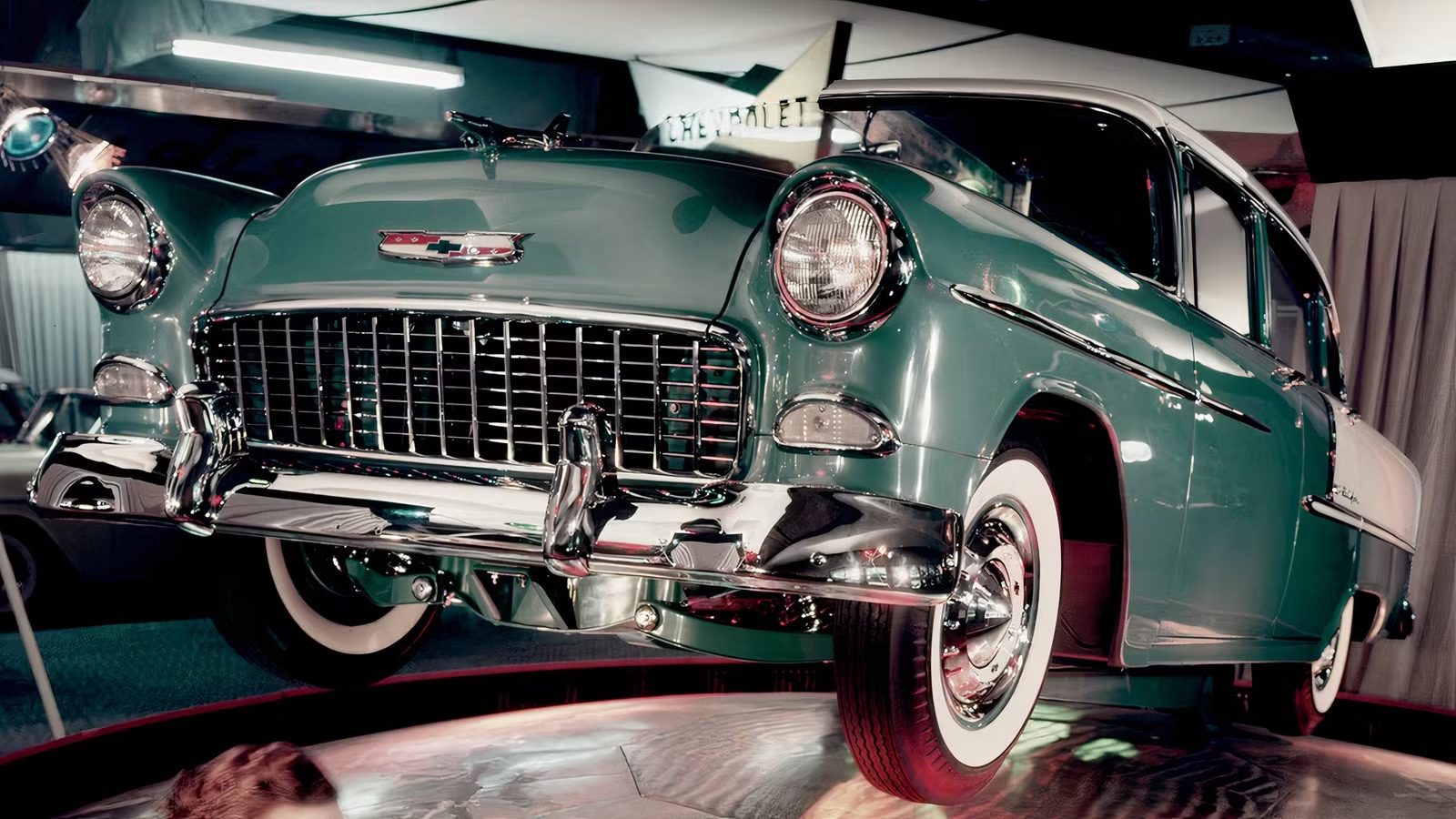
Later, in the 1950s and 60s, V8s were all the rage, and Chevy’s Small Block was leading the charge. Ranging from 283 to 469 cubic inches (4.6–7.7 liters), these were put to work in everything from the Corvette to family sedans to wagons. After this point, America wouldn’t be topping any lists when it came to internal combustion engines, not because it peaked in the 1960s, but because the world was plunged into an oil crisis that bred a new wave of gas-burning engines. Tesla’s electric motors scored America two extra wins on the list for the 2010s and 2020s, paying homage to the early American idea of providing new means of mobility to the rest of the world.
USA Awards
Decade
Placement
Powertrain
1920s
Win, Runner-Up
Ford Model T I4,
Chevrolet Stovebolt Six I6
1930s
Win
Ford Flathead V8
1940s
Win, Runner-Up
Willys-Overland Go Devil I4, Dodge T-137 I6
1950s
Win
Chevrolet Small Block V8
1960s
Runner-Up
Chevrolet Small Block V8
2010s
Win
Tesla Electric
2020s
Win
Tesla Electric
Source: WardsAuto
Japan Dominates From The 1970s to 2000s
Not until the 1970s would any other country dominate as relentlessly as America on WardsAuto’s list. The first Honda CVCC engine was a glimmer of hope at a time when gas was being rationed. It used what felt like drops of fuel compared to the garden-hose flow of gas in larger engines, something that was a foreign concept to Detroit at the time. This became the touchstone for all small, efficient engines built anywhere, but Japan (specifically Honda) stayed on top with its 4-cylinder engines.
The D Series earned the winning spot for the 1980s, along with the B16A 1.6-liter 4-cylinder in the 1990s. The D Series helped build the Civic’s reputation for easy tunability and the B16A introduced the world to VTEC, changing the way we think about performance and fuel efficiency across the industry. The runner-up for the 1990s was Toyota’s 1GZ-GTE, the 2.5-liter straight-6 that lived in the shadow of its bigger sister, the infamous 3.0-liter 2JZ. The 1GZ, however, would go on to power the Chaser, Cresta, Mark II, and the Soarer to name a few.
2001-2003 Toyota Prius Mk1 XW10 1.5L NA 1NZ-FXE I4 Hybrid EngineToyota
With the birth of the Prius came Toyota’s Hybrid Synergy Drive, a system that Toyota would continue to develop following the success of the first two generations of the Prius. The system switched from gasoline to electric power seamlessly, changing the way hybrid systems were integrated into all vehicles that followed. The third generation of the system earned Japan another point in the 2010s as a runner-up. Honda’s K Series family of engines was launched in 2001 for use across Civics, Accords, and the Acura RSX. It used both intelligent variable valve timing and lightweight internals to achieve high horsepower ratings in both stock and modified forms.
Japan Awards
Decade
Placement
Powertrain
1970s
Win
Honda CVCC I4
1980s
Win
Honda D Series I4
1990s
Win, Runner-Up
Honda B16A I4, Toyota 1JZ-GTE I6
2000s
Win, Runner-Up
Toyota Hybrid Synergy Drive I4, Honda K Series I4
2010s
Runner-Up
Toyota Hybrid Synergy Drive (Gen 3)
Source: WardsAuto
Germany Places Third With Iconic Nameplates
Close
The third-place winner was Germany, with all but one of the engines mentioned still going strong today in one form or another. The runner-up for the 1950s was Volkswagen’s Beetle and its flat-4 engine. The same engine would power over 20 million Beetles produced around the world, proving its durability and reliability for nearly 60 years. Another popular flat engine made its way onto the list, too: Porsche’s 901 flat-6, developed for the first 911 in 1963. That engine survived through the years by getting with the times. It made the jump from being air-cooled to water-cooled, had turbos bolted to it, and even gained some hybrid technology. At its core, it was still the Porsche flat-6 engine that we know and love. This was Germany’s only win, with the last two being runners-up for the 1970s and 1980s.
The iconic BMW 2002 Turbo was the first European production car with a turbocharger.BMW
Those awards are owed to BMW for its M10 inline-4 and M20 inline-6 engines, the former of which was used in the 1800 sedan and delivered a whopping 90 horsepower. By the time the 2002 came around, the final count was 130 horses after swapping the dual carburetors for fuel injection. The 2002 Turbo offered both fuel injection and turbocharging technology, the first production vehicle to offer the two together. The straight-6 M20 replaced the larger-displacement M30 in a handful of vehicles, making a name for itself after being put to work in the 1970s E21 and 1980s E30 3 Series, as well as the E34 5 Series.
Germany Awards
Decade
Placement
Powertrain
1950s
Runner-Up
Volkswagen Type 1 Flat-4
1960s
Win
Porsche Flat-6
1970s
Runner-Up
BMW M10 I4
1980s
Runner-Up
BMW M20 I6
Source: WardsAuto
Italy And South Korea Make Surprise Appearances
Close
In the 1930s, Alfa Romeo built a straight-8 racing car that dominated each time it showed up to contest a title. Powering both the 8C 2300, 8C 2900, and a few race cars, the engine proved to be one of the most mechanically superior at the time with dual overhead cams, a supercharger, and a single-unit block and cylinder head with no gasket. It might have been two 4-cylinder blocks joined together, but it proved itself in more ways than one. It brought Alfa Romeo across the finish line first at Le Mans four years in a row (1931-1934), the 1931 and 1932 Targa Florio races, and the Mille Miglia four times.
Neither Italy nor South Korea earned wins for their powertrains, but both took second place for their respective decades with venerable competition. Hyundai and Kia have developed electric propulsion systems to go toe-to-toe with the best in the business, garnering them the runner-up spot for the 2020s. The Ioniq 5, Kia EV6, and the Genesis GV60 are three examples of the system developed by the South Korean powerhouse that proved Tesla wasn’t the only one out there with a secret recipe to make an excellent electric vehicle.
Italy & South Korea Awards
Decade
Placement
Powertrain
1930s
Runner-Up
Alfa Romeo 8C I8
2020s
Runner-Up
Hyundai/Kia Electric
Source: WardsAuto
Sources: WardsAuto, Jalopnik, Engine Labs, Hemmings, Simeone Museum
