

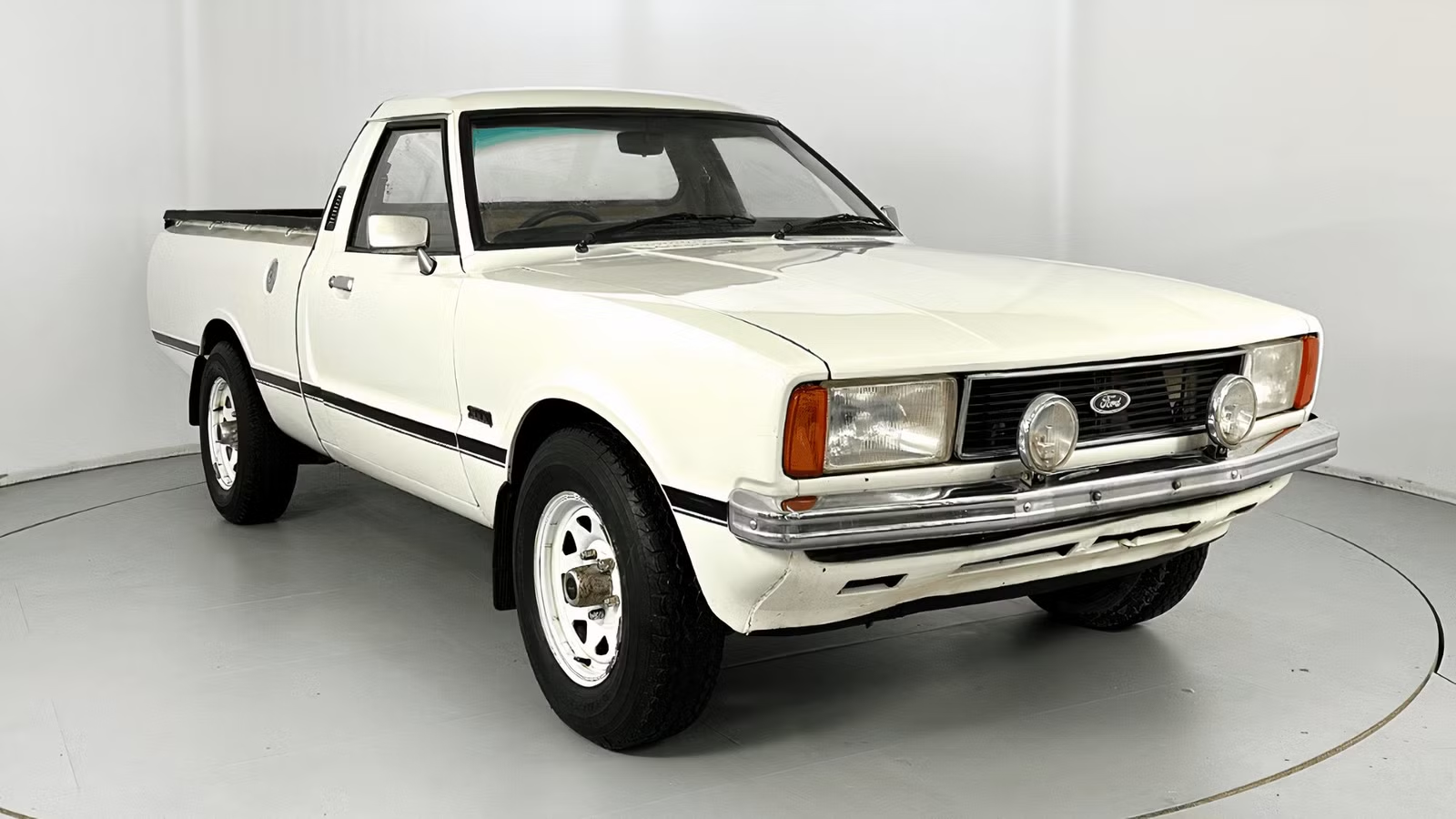
Everyone knows the Ford F-Series — it has dominated American truck sales for decades and shows no sign of slowing down. But buried in Ford’s history is a completely different kind of pickup success story: a compact, sedan-derived workhorse that quietly racked up impressive sales numbers across Europe, South Africa, and beyond. It never hauled as much as an F-150, and it certainly never turned heads at a stoplight — but the P100 earned its place in the Blue Oval’s legacy through sheer, unpretentious utility. Here’s everything you need to know about it.
An Introduction To The Ford P100
This humble little pickup truck is known as the P100 — a name previously used for a small panel van sold throughout the late 1950s and 1960s in North America. However, it’s the sedan-based P100 that really took the world by storm, enjoying considerable success through the 1970s, 1980s, and even into the 1990s.
Earlier P100 Pickups Were Based Upon The Ford Cortina
Initially, the P100 was sold in South Africa, based upon the achingly cool MK III Ford Cortina. Originally, it wasn’t known as the P100 at all — it was simply called the ‘Cortina Pickup’, and the name would continue to evolve, being dubbed the 1-Tonner in South Africa before the P100 designation finally took hold in the early 1980s. Throughout the decades, the P100’s styling evolved in step with the standard Cortina sedan, with MK IV and MK V variants following in turn.
The Sierra-based P100 Models Proved To Be Great Sellers In Europe
For the 1988 model year, Ford updated the P100 by basing it upon the Sierra — and it was during this period that the truck really took off throughout Europe, particularly in the UK, where the standard Sierra was among the best-selling models on the market. After enjoying strong sales across much of the western world, Ford retired the P100 in 1995.
Unlike today’s market, where there’s a pickup variant for virtually every buyer — including luxury and performance models — Ford always intended the P100 to be a pure tool. Interiors were sparse, and the engines were largely modest, though thoroughly hard-working.
Here’s How The P100 Differs From Its Sedan Base
Rear quarter shot of a 1987 Ford Sierra 2.0iSCar & Classic Auctions
The earliest examples of Ford’s diminutive pickup were built upon the MK III Cortina two-door chassis, and they stand out from later models due to their longer front doors — when the design moved on to mirror the MK IV and MK V Cortina, four-door models were used as the base instead. Throughout the P100 and Cortina Pickup’s production lives, Ford also offered fiberglass canopy covers, which transformed both the look and the security of the load bed.
In the early 1980s, Ford began exporting the P100 from South Africa, where it was assembled, into Europe. Despite South Africans benefiting from a range of short and long wheelbase designs, European buyers only received the longer variant at the time.
Aside from the obvious body differences, there was relatively little to separate the P100 from the sedan models it was based upon. The sedans were available in a wide range of specifications — including luxury Ghia trims and a multitude of engine and transmission options — but as the P100 was built for work, such refinement was deemed unnecessary, and most left the factory with a very basic interior. What they could do, however, was deliver on the hard-working promise of a proper pickup truck, with a payload capacity peaking at 970 kg (2,139 lbs) for Sierra-based models and a maximum towing capacity of 1,180 kg (2,601 lbs) — both figures more than respectable for a truck of this size and price point.
A Closer Look At The P100’s Powertrain
Ford P100 2.0L Pinto engineFairmont Sports And Classics
Ford P100 Engine Comparison
Engine
3.0-liter Essex V6
2.0-liter Pinto four-cylinder
1.8-liter turbo-diesel four-cylinder
Generations available
MK III Cortina-based and South African MK IV/MK V 1-Tonner models
Sierra-based models
Sierra-based models
Power
138 horsepower
73 horsepower
74 horsepower
Torque
173 lb-ft
91 lb-ft
112 lb-ft
Fans of Ford’s current range of high-performance trucks need not get too excited here, as back when the P100 was in production, the word ‘Raptor’ meant little to all but paleontologists. The most exciting engine to ever appear under the hood of a P100 was the 3.0-liter Essex V6, which produced a thunderous soundtrack despite peak power reaching only 138 horsepower.
The latter Sierra-based models were barely powerful enough to pull the skin off a rice pudding. However, they were hard-working and durable, making them well suited to the task at hand. The 2.0-liter Pinto engine powered the vast majority of P100 models in Europe, as did the 1.8-liter turbo-diesel — both producing just shy of 75 horsepower. One genuine benefit of such modest outputs in the relatively lightweight P100 was strong fuel efficiency; Ford quoted 33 mpg as achievable in the diesel model.
Ford’s P100 Is Now A Coveted Collectible
Close
As is the fate of many work-focused vehicles, most P100s were driven hard and then either scrapped, broken for parts, or simply left to rot. A fortunate few escaped such miserable ends, and it’s these cherished survivors that are now hot property in Blue Oval circles. Low-mileage examples in exceptional condition can fetch sums in the region of $30,000 at auction, while well-maintained, good-condition trucks typically command considerably less — more often than not south of $10,000.
A good strategy is to seek out a solid example in South Africa, where P100s are still found at prices well under $2,000. Importing one under the 25-year rule is straightforward enough — the main caveat being that South African-market trucks are right-hand drive.
Related
25-Year Import Rule: Everything You Need To Know
Officially, it’s the Imported Vehicle Safety Compliance Act, but we all know it as the reason we have to wait 25 years to own our JDM dream cars.
Ford Enthusiasts Also Love Customizing The P100
Despite offering very little to gearheads during its production life, the Ford community has recognized the P100’s potential, and some remarkable builds have emerged over the years as a result. Many owners have opted to drop V8 engines under the hood, while more ambitious builders have gone further still, creating full Cosworth P100 conversions. Under the hood of such examples you’ll typically find either the iconic YB turbocharged inline-four or the Cosworth-developed V6, while Sierra Cosworth bumpers are grafted onto the otherwise understated exterior. Inside, Cosworth seats, dashboards, and steering wheels fit perfectly, completing the transformation.
Sources: Ford, Fairmont Sports & Classic, Anglia Car Auctions, Historics Auctioneers, Professional Van, Car and Classic.
