

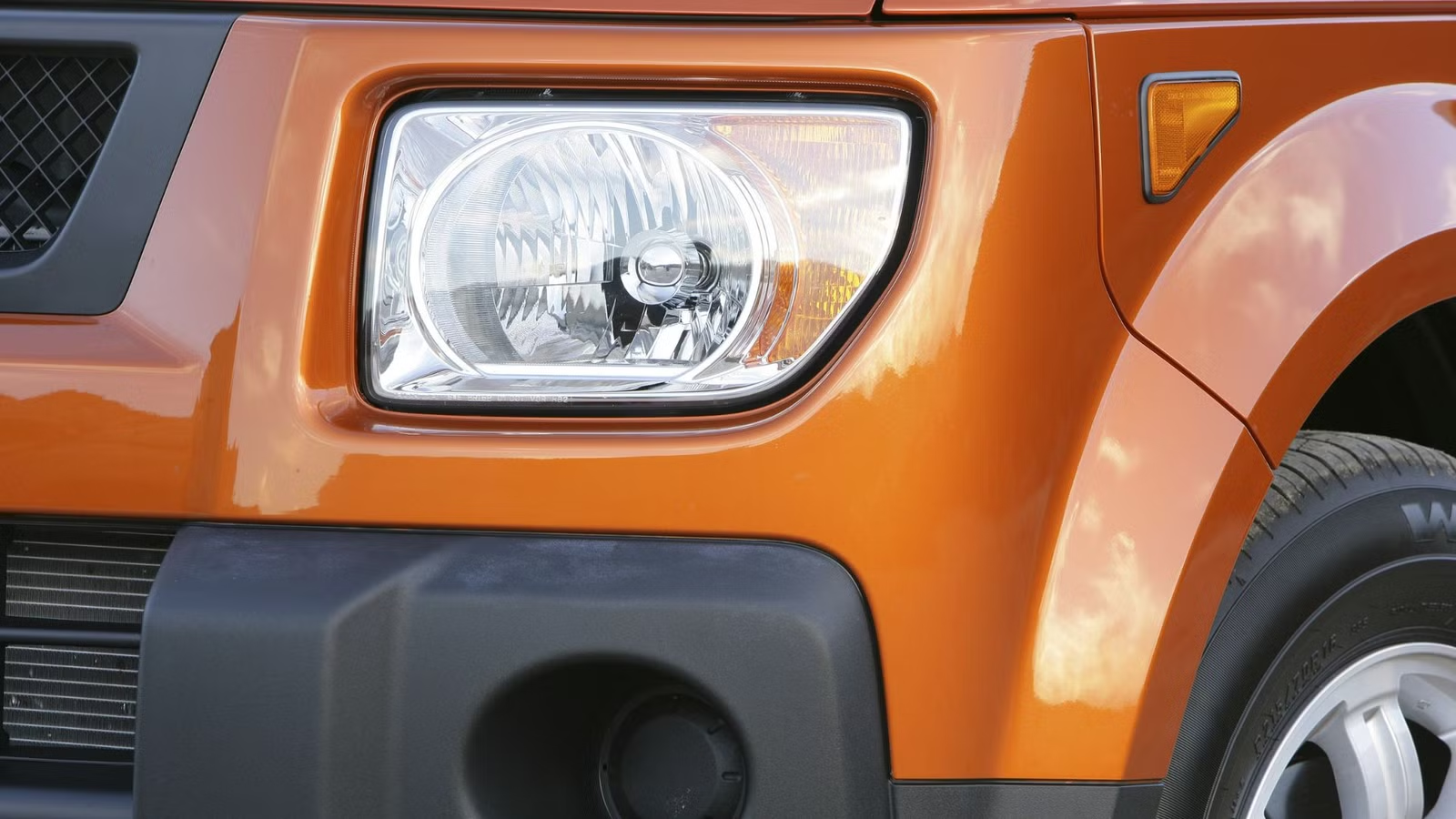
In 2003, Honda thought that it would test popular perception and come up with a different take on the family car formula. The result was quite practical, although rather dull and very square, and it became too easy to mock instead of turning into a lovable object. So, it’s interesting if Honda is indeed thinking about a future product that might return to this very theme. In 2029, the Japanese company might launch an affordable hybrid compact SUV, potentially building it in Ohio and positioning it between the HR-V and the CR-V. So, could Honda possibly be recreating the Element, one of its strangest creations, more than 20 years after the original?
The Rumor Matters When New Cars Have Become Too Predictable
2003 – 2006 Honda Element – front 3/4 angleHonda
2003 Honda Element Specifications
Engine
2.4-liter DOHC i-VTEC inline-four
Transmission
Five-speed manual or four-speed automatic
Drivetrain
Front-wheel drive or 4WD
Power
160 hp
Torque
161 lb-ft
Today’s crossover market features one example after the next where they may all be brutally competent but eminently forgettable. Mainstream SUVs are also more efficient, quieter, safer, and better equipped than their predecessors, but they all seem to address their challenge in the same way. For example, they’ve got those tablet-style screens, rounded rooflines, sensible cargo spaces, and predictable trim packages. Some of them may even sport an outdoor version that comes with chunky tires. Manufacturers mostly opt for neutral colors as well, so it’s no surprise that these vehicles all tend to blend into one another.
If Honda does decide to focus on its old Element and re-create that type of turn-of-the-century strangeness, it could be doing more than just dusting off an old badge. Rational Honda could be reaching back for one of its least rational-looking products and trying to bring it into the modern-day world. If so, the new Element might show up in a parking lot where compact SUVs tend to be the default. It may arrive in a world where outdoor culture is everywhere and while buyers may not all be setting off into the mountains every weekend, they still want vehicles that look as if they could manage that lifestyle.
The Original Element Was Weird In The Right Ways
2003 – 2006 Honda Element – rear 3/4 angle in orangeHonda
Back in the day, Honda didn’t make any effort to present its 2003 Element as something sleek or luxurious. Instead, the Element tended to look like a piece of equipment with a very squared-off body, clamshell tailgate, rear-hinged rear side doors, plastic body cladding, and an impossibly tall cabin. The early models had a 2.4-liter DOHC i-VTEC inline-four, turning out 160 hp and 161 lb-ft of torque. They came with either a four-speed automatic or a five-speed manual, front-wheel drive, or Honda’s Real Time 4WD system.
Inside, buyers would find a urethane-coated utility floor that Honda said could resist dirt scratches or water. The seats featured stain-resistant materials, and you could fold the rear seats against the sides or remove them. Its wide side opening made it quite easy to load awkward gear.
Somehow, Honda had been able to borrow useful ideas from several categories to make the Element a little bit of a soft-roader, van, wagon, and minivan. The end result was a compact and very odd-looking Honda that people didn’t know what to make of. But while it was never universally admired at its launch, many people can still remember it quite clearly today.
The Market Didn’t Fully Understand The Element Until It Was Gone
2003 – 2006 Honda Element – cargo space, with folded back seatsHonda
The Honda Element confused the public for about nine years until Honda pulled the plug. Sales gradually declined during that time and Honda felt that customers were moving more towards models like the CR-V instead. The company felt that the CR-V was easier to position, and it was certainly more conventional as a family crossover. But those that actually bought an Element tended to fall in love with it and, in some circles, it became a cult car.
Owners would use their Elements for camping trips, small business hauling, weekend adventures, dog-carrying, bike transportation, and daily errands. This was a car that could deal with all of that and more while owners wouldn’t need to worry about muddy paw prints, scuffs, or dings.
In the end, the Honda Element became the type of vehicle that didn’t need extreme capability, cutting-edge tricks, a huge engine, or a premium badge in order to have a personality. Instead, its headline came from its packaging, as it was easy to load or clean and certainly easy to spot in some sprawling multi-story parking lot. For its owners, it was hard to replace, but as it really didn’t have much mass market appeal, its life was relatively short.
A Hybrid Element Would Fit Honda’s New Strategy Better Than An EV
2003 – 2006 Honda Element side viewHonda
Rumor has it that the 2029 vehicle could be a hybrid, and if it were to be a revived Element, that might fit the new business environment quite nicely. After all, Honda has been backing away from any commitment to full EVs. In 2026, it said that it would cancel the development and market launch of the Honda 0 SUV, the Honda 0 Saloon, and the Acura RSX EVs. It noted slower US EV market growth and said that the company would now allocate extra resources to hybrids instead.
Honda might be about to use the memory of the Element to add some impact to its hybrid plans. It knows that consumers are still worried about infrastructure, charging questions, and general EV prices, and a new hybrid compact SUV might just hit the mark. The old Element was about practical usability and not technology theater, and a new hybrid Element could create that original mission far more effectively than a heavy and expensive EV.
There also seems to be space between the HR-V and the CR-V for a logical Element. After all, the HR-V is the compact and affordable one without being particularly adventurous, and the CR-V fits the role of a roomy, polished, and mainstream family SUV. A new Element could occupy the emotional space in between, as something cheaper and smaller than a large adventure SUV but with more purpose and a bit more zing than a staid city crossover. The market is not necessarily looking for a new rock-crawling trendsetter, but it may yet be seeking something usable, durable, efficient, and different. And that could suit the idea of a revived Element down to the ground.
Revived Nameplates Work When They Mean Something
2026 ford bronco badlands wildtrakFord Motor Company
Recent history suggests that revived nameplates can hit the ground running. For example, Ford brought back the Bronco to become a serious off-road SUV. Toyota reintroduced the Land Cruiser to the US market as a smaller hybrid-powered model with heritage-inspired design. Acura also breathed life into its Integra and Jeep performed similar miracles with its Wagoneer and Grand Wagoneer models.
Related
Best Honda Element Model Years For Reliability
Here’s everything you need to know about how reliable the Honda Element really is, and which years to avoid.
Perhaps the most relevant comparison is the planned Xterra comeback from Nissan. The Xterra was also a little bit different compared to the average SUV and, in its own way, built a loyal following as well. Nissan will now attach the Xterra name to a proper body-on-frame SUV with hybrid and gas V6 versions to come. And Honda could start to reclaim some of the compact utility space with a bold new Element without worrying too much if it looks unusual.
The Payoff Is Permission To Be Interesting Again
2003 – 2006 Honda Element – front seats, steering wheel, dashboard, back seatHonda
Honda doesn’t necessarily need to be as bold with any new Element project as it certainly was with the original. The details will matter, but they won’t become the whole story, so long as Honda builds a vehicle that doesn’t look like everything else. To be honest, Honda probably needs to go down that road, as its mainstream lineup today isn’t particularly exciting to behold. Certainly, the Civic Type R and Prelude add personality in their own ways, but the core Honda lineup all circles around efficiency, dependability, and intelligent engineering.
Related
Why The Honda Element Was Ahead Of Its Time
The closer you look at the Honda Element, the more impressive and interesting it gets.
For a revised Element to actually work, Honda could approach its task from a practical perspective. It could include a low and usable cargo area, clever rear seat flexibility, durable interior materials, and strong hybrid economy. It should ensure that the newbie clearly stands apart from its HR-V and CR-V offerings while being affordable enough to feel like a proper Honda instead of a boutique lifestyle accessory.
Above all, Honda should remember that people may well be tired of boring cars, but they’re still looking for practicality and reason. And while the old Element was clearly odd to look at, it was certainly useable and interesting. This could set the stage for a revived Element that might represent more than just a simple comeback. Such a vehicle might even remind the waiting world that family cars don’t always have to be dull in order to make sense.
Sources: Honda, Stellantis, Ford.
