

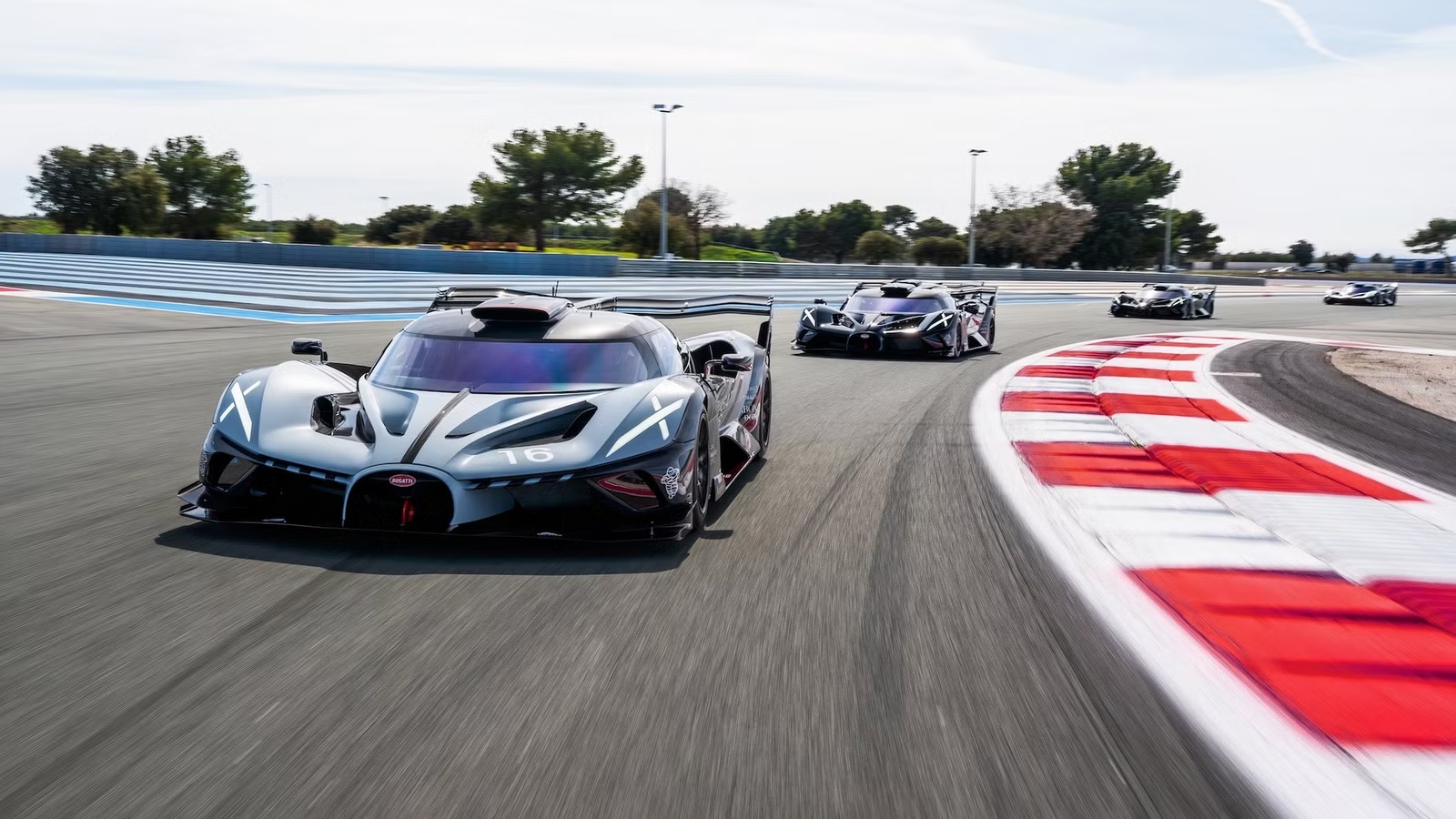
Some hypercars earn their reputation over time. Others seem destined for success from the moment they’re announced. The Bugatti Bolide belonged firmly to the latter. With just 40 examples planned and Bugatti’s legendary W16 beneath the bodywork, it was one of the most anticipated hypercars of its generation. But if selling out was almost inevitable, was that ever really the Bolide’s greatest achievement?
Can A Hypercar Really Be Called A Success If It Was Always Going To Sell Out?
Limited Production Doesn’t Always Tell The Full Story
Shutterstock
In the rarefied world of hypercars, a sold-out production run is often paraded as the ultimate badge of honor. Build slots often disappear before the first customer car is even completed. But the truth is more complex. With limited production, stratospheric wealth among buyers, and the gravitas of storied marques, demand is often a foregone conclusion—long before any engine ever fires to life.
For brands like Ferrari, Pagani, and Koenigsegg, scarcity is strategy. Their rarest machines are manufactured in such tiny numbers that exclusivity itself becomes the car’s greatest power.
Front 3/4 action shot of Bugatti Bolide in blue driving on racetrackBugatti
By August 2021, Bugatti confirmed that all 40 production slots had been allocated, years before customer deliveries began. The announcement reinforced what many enthusiasts already suspected: the Bolide wasn’t a difficult sell—it was a car collectors couldn’t afford to ignore.
Side action shot of Bugatti Bolide driving on racetrackBugatti
So the real question becomes: What does a hypercar offer beyond its order book? Does it push the boundaries of engineering? Rewrite the rules? Etch its name into automotive history? These are the questions that separate fleeting collector’s items from genuine milestones. The Bugatti Bolide certainly arrived with enormous expectations, but did it become more than just another sold-out limited-production hypercar?
Related
20 Years Old And Still One Of The Fastest Cars Ever
In 2005, the automotive world witnessed a seismic shift with the debut of the Bugatti Veyron 16.4.
The Bugatti Bolide Was Built To Shock
When Bugatti Removed Every Limitation
Close-up shot of Bugatti Bolide rear and topBugatti
The Bolide isn’t simply a Chiron redesigned for the racetrack. Every part of the car was developed with one goal in mind: extracting the maximum performance from the legendary quad-turbocharged W16. One look at the Bolide tells you it means business. Its low-slung stance, massive front splitter, towering rear wing, and aggressive aerodynamic bodywork make it look more like a Le Mans prototype than a traditional Bugatti. Despite its track-ready aesthetic, the Bolide still carries the fit, finish and craftsmanship that have become hallmarks of the brand.
As Bugatti’s CEO Mate Rimac explains, the real challenge lay in fusing race-car performance with Bugatti’s trademark attention to detail. Where pure race cars are built to be light and functional, the Bolide had to deliver on the track and uphold the exquisite finish expected of every Bugatti. At its heart sits Bugatti’s iconic 8.0-liter quad-turbocharged W16, producing 1,578 horsepower and 1,180 lb-ft of torque. Sent to all four wheels through a seven-speed dual-clutch transmission, the Bolide can sprint from 0 to 60 mph in just 2.2 seconds before continuing to a claimed top speed of 236 mph.
Combined with its lightweight construction and advanced aerodynamics, it became the most focused Bugatti ever built. From behind the wheel, the Bolide redefines expectations. Top Gear’s Ollie Marriage hailed the W16 as “the king of engines,” marveling at its relentless acceleration and the almost orchestral roar that accompanies each surge. The power delivery is immense but uncannily smooth—never brutal, always intoxicating.
To harness the Bolide’s colossal speed, Bugatti and Brembo collaborated on 390 mm carbon-carbon brakes using Formula 1 technology. The result? Stopping power that’s as confidence-inspiring as it is ferocious, taming the kinetic fury of this 1,600-horsepower beast again and again. Reviewers found it balanced and communicative: quick steering that’s never twitchy, a chassis that telegraphs its intentions, and an all-wheel-drive system that makes the most of every horsepower.
Shot of Bugatti Bolide rear endBugatti
The Bolide also carved out a niche that few modern hypercars occupy. Rivals such as the McLaren Senna, Aston Martin Valkyrie, and Mercedes-AMG One all chase circuit performance, but they do so with very different philosophies.
Nathaniel Ehinger | Top Speed
The Valkyrie relies heavily on Formula 1-inspired aerodynamics, the AMG One borrows hybrid technology directly from Grand Prix racing, while the Senna prioritizes lightweight agility.
Bring a Trailer
The Bolide, by contrast, remained unmistakably Bugatti. Rather than being a temperamental race car, the Bolide impressed with its stability, predictable chassis, and confidence-inspiring nature, proving Bugatti could build a track-only machine that was every bit as approachable as it was devastatingly fast.
How The Bugatti Bolide Stacks Up Against Its Biggest Rivals
Specification
Bugatti Bolide
Aston Martin ValkyrieMcLaren Senna
Mercedes-AMG One
McLaren Senna
Engine
8.0L quad-turbo W16
6.5L naturally aspirated V12 hybrid
1.6L turbo V6 hybrid
4.0L twin-turbo V8
Total Output
1,578 hp
1,139 hp
1,049 hp
789 hp
Torque
1,180 lb-ft
664 lb-ft
1,047 lb-ft
590 lb-ft
Drivetrain
AWD
RWD
AWD
RWD
Transmission
7-speed DCT
7-speed automated manual
7-speed automated manual
7-speed DCT
0–60 mph
2.2 sec
2.5 sec
2.9 sec
2.7 sec
Top Speed
236 mph
220 mph
219 mph
208 mph
Downforce
Up to 6,000 lbs
Approx. 2,425 lbs
Approx. 3,748 lbs
Approx. 1,764 lbs
Road Legal
No
Yes
Yes
Yes
Production
40
150 coupés
275
500
Original Price
$4.7 million
$3.2 million
$2.7 million
$1 million
Core Philosophy
Track-only showcase for the W16
F1-inspired road car
Formula 1 technology for the road
Lightweight driver’s car
Related
The Best V8 Supercars In 2024 Ranked By Price
If you love eight cylinders, these are the best of the best.
The Bolide Became The Final W16 Farewell
A Final Celebration Of Bugatti’s Legendary Engine
Bugatti Bolide in motionBugatti
Long before the Bolide ever turned a wheel, Bugatti’s quad-turbocharged W16 had already secured its place as one of the most celebrated engines ever fitted to a production car. Introduced with the Veyron in 2005, the 8.0-liter powerplant redefined the hypercar segment by combining extraordinary refinement with unprecedented levels of performance. It went on to power every flagship Bugatti that followed—from the Veyron Super Sport to the Chiron Super Sport 300+—becoming as synonymous with the brand as its iconic horseshoe grille.
Bugatti Bolide And Bugatti EmployeesBugatti
By the time the Bolide emerged, the motoring world was at a crossroads. Emissions regulations were tightening, electrification was sweeping through the hypercar ranks, and Bugatti had signaled a new era with its Rimac partnership. As Road & Track succinctly put it, the Bolide was conceived as “something of a send-off for the W-16″—not just another limited-run special, but a spirited farewell to one of the defining engines of the modern hypercar era.
Bugatti Bolide And The Legendary Type 35Bugatti
Instead of taming the W16 for comfort or civility, Bugatti let it off the leash. The Bolide takes the powertrain to its most extreme, coupling it with a featherweight chassis, race-bred aerodynamics, and an astonishing 6,000 pounds of downforce—about 50 percent more than a contemporary Formula 1 car. Every detail, every surface, every gram exists to let the W16 deliver its full operatic performance on the track.
Bugatti Bolide Rear ShotBugatti
Bugatti never set out to make the Bolide just another race car. As CEO Mate Rimac put it, “Race cars are fascinating things, but they’re not Bugattis.” From the outset, the Bolide combined circuit-focused performance with the craftsmanship expected of a Bugatti.
Bugatti
Timing only strengthens the Bolide’s legacy. With the arrival of the Tourbillon and its naturally aspirated V16 hybrid powertrain, Bugatti has officially turned the page on the W16 era. That gives the Bolide an even greater significance. More than just a collector’s car, it represents the final and most focused expression of an engine that transformed the hypercar landscape for nearly two decades.
Bugatti Bolide: Pros and Cons
Pros
Cons
Most extreme expression of Bugatti’s iconic 8.0-liter quad-turbo W16 engine
Track-only; cannot be driven on public roads
Exceptional power-to-weight ratio thanks to lightweight construction
Limited to just 40 examples, making ownership unattainable for most
Purpose-built aerodynamics generate immense downforce.
Lacks the luxury and grand touring comfort associated with traditional Bugattis
Demonstrates Bugatti’s engineering capabilities at their peak
Its sold-out status was almost inevitable due to rarity and brand prestige.
Serves as a fitting farewell to the legendary W16 era
Few owners are likely to explore its full performance potential.
Exclusivity is likely to make it a highly collectible future classic
Its impact on mainstream automotive technology is limited
The Bolide’s Success Was Never Just About Selling Out
Engineering Mattered More Than Sales
Bugatti Bolide Driving ShotBugatti
From the moment Bugatti confirmed production would be limited to just 40 examples, the Bolide’s commercial success was almost guaranteed. With a starting price of around $4.7 million before taxes and the prestige of the Bugatti badge, all 40 build slots were quickly spoken for despite the car being built exclusively for the racetrack. For collectors, the Bolide represented far more than another limited-production hypercar.
Close-up shot of Bugatti Bolide Interior showing steering wheel and controlsBugatti
Judging the Bolide solely by its sold-out status, however, misses the point. The Bolide wasn’t designed around luxury—it was designed around performance. Nowhere is that clearer than inside the cabin, where fixed carbon-fiber seats, a Formula-style steering wheel, six-point harnesses, and a full roll cage replace the leather-lined refinement traditionally associated with Bugatti. That same philosophy extends throughout the car. Every decision, from the lightweight construction to the stripped-back interior, reflects Bugatti’s focus on performance above everything else.
Related
These Are The First 10 Production Cars In History With Factory Turbochargers
We may love a good turbo today, but they had to start somewhere – here are the first 10 production cars to boast a turbocharged engine under the hood.
So, Was The Bugatti Bolide Actually A Success?
Success Beyond Sales
Front 3/4 action shot of Bugatti Bolide in yellow driving on racetrackBugatti
In the end, the Bolide wasn’t successful because all 40 examples sold. It was successful because it allowed Bugatti to build a track-focused machine unlike anything else in its modern history. Rather than another grand tourer, the Bolide became the final opportunity to explore the W16’s limits. It exists not because Bugatti needed another halo model, but because the brand wanted to answer one final question: How far could the W16 be pushed when road regulations, luxury and practicality were no longer part of the brief? The answer was the Bolide—a car that showed exactly what the W16 was capable of when nothing stood in its way.
Sources: Road & Track, Top Gear USA, Bugatti USA
