

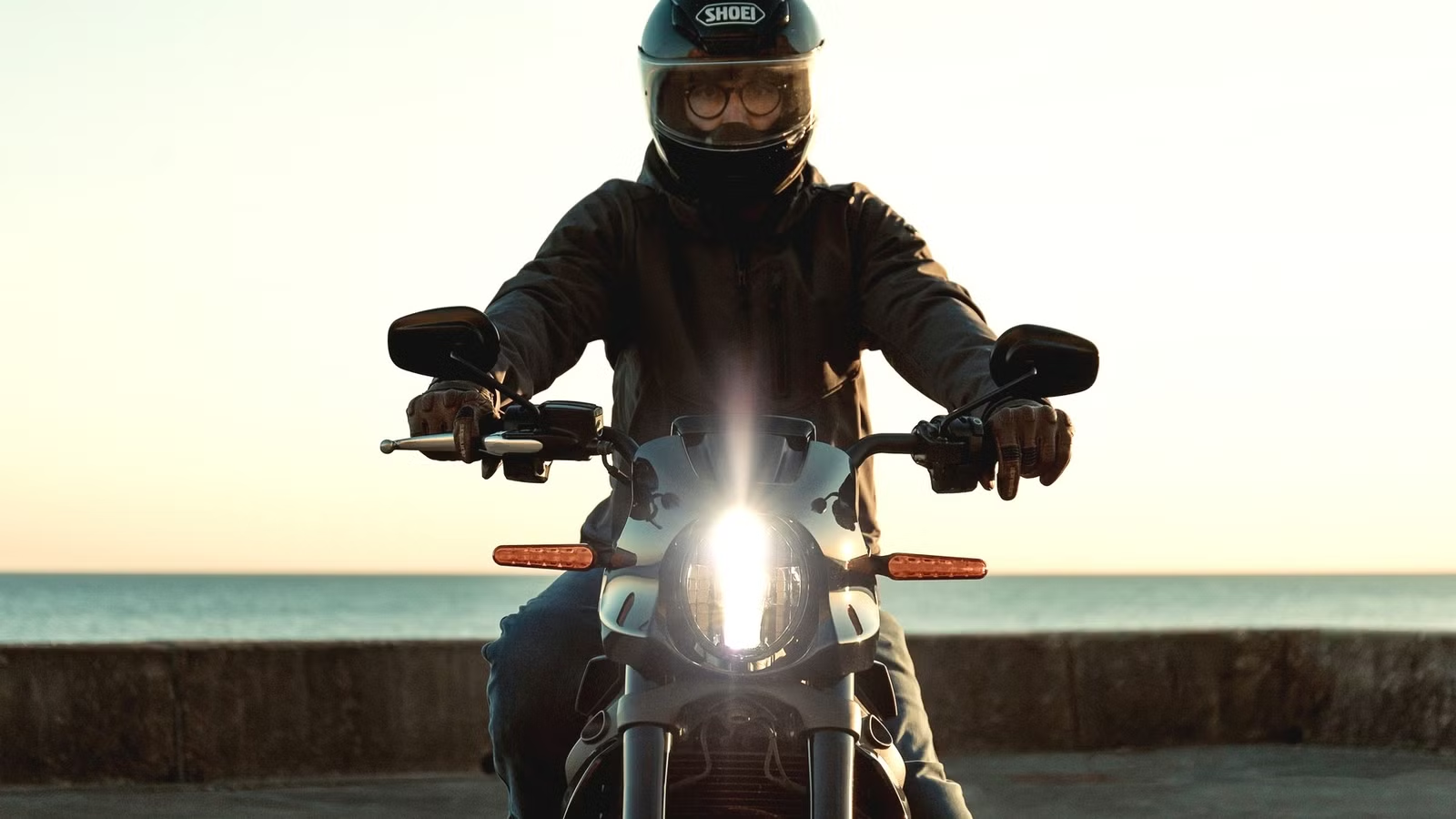
LiveWire just cut the price of its One motorcycle to $13,999 — down from the $29,799 it cost when it launched under the Harley-Davidson badge in 2019. That’s a $15,800 reduction over seven years, with the latest $2,500 trim announced this week. Factor in California’s ongoing EV incentive credits and the effective price could fall further still. It’s a remarkable number for a bike that once positioned itself as a premium halo product.
But the price tag is almost secondary to what the cut reveals. LiveWire sold just 381 electric motorcycles in all of 2025 — against an original projection of 53,341 units for that year. In Q1 2026, the company moved 91 bikes. The math is brutal, and a 57% price reduction from launch doesn’t look like a marketing move. It looks like a reckoning.
A Bike That Never Found Its Buyer
Front action shot of LiveWire One riding down the highway.Harley-Davidson
The One — originally the Harley-Davidson LiveWire — debuted to genuine critical enthusiasm. Journalists who rode it noted its surprisingly composed handling despite a 562-pound curb weight, and its electric powertrain delivers real performance: 100 horsepower, 84 lb-ft of torque, and a 0–60 mph time of around three seconds. It even landed a cameo in an Avengers film. None of it moved the needle on sales.
The core problem was always the price-to-use-case equation. At $29,799, the One asked buyers to pay a significant premium for a motorcycle with 95 miles of combined range and a 40-minute DC fast charge to 80 percent. For daily commuting, cheaper alternatives — including LiveWire’s own S2 Del Mar and Zero’s FXE — cover the same ground for less money. For long-distance touring, the range limitations require a level of planning most riders won’t accept. The One occupied an awkward middle ground, and the early-adopter pool dried up fast once those buyers were satisfied.
At $13,999, the One now sits just $1,000 above the S2 Alpinista within LiveWire’s own lineup — yet offers more power, a higher top speed, greater city range, and DC fast-charging capability. The value proposition has genuinely shifted. Whether there are enough buyers left to notice is a different question.
LiveWire’s Sales Numbers Tell the Full Story
2021 Livewire ONE static profile shotLivewire
The company’s financial picture makes the price cut hard to read as anything other than inventory clearance. LiveWire posted an $18.1 million consolidated net loss in Q1 2026, an improvement from $19.3 million in the same quarter a year prior, but not the kind of trajectory that suggests a turnaround is close. The New York Stock Exchange notified the company in July that its stock — which had fallen below $1.00 per share for 30 consecutive trading days — was at risk of delisting. LiveWire has since regained compliance, with shares sitting just above $1.14.
The One was last EPA-certified as a 2023 model, and Harley-Davidson’s service documentation appears to stop there as well. That detail matters: the price cut may be clearing remaining stock of a model that is no longer in active production, rather than signaling a new pricing strategy for an ongoing product. The bright spot in LiveWire’s portfolio remains its STACYC e-bikes, which found 3,959 buyers in Q1 2026 alone — a figure that dwarfs the entire electric motorcycle business.
Is This a LiveWire Problem or an Industry Problem?
Side view of a Livewire OneHarley Davidson
LiveWire’s struggles are acute, but the premium electric motorcycle segment broadly has not delivered the growth its early advocates projected. Zero Motorcycles, the longest-standing independent EV moto brand, has maintained a steadier presence — its FXE and SR/F models serve the commuter and sport segments without the identity confusion that plagued LiveWire’s positioning. Stark Varg, which targets the motocross market with its electric MX bike, has built a loyal following in off-road racing circles where limited range is irrelevant and instant torque is an advantage. Energica, the Italian premium EV brand, has found a niche among sport-touring riders willing to plan around charging infrastructure.
What separates those brands from LiveWire is focus. Zero built around commuter utility. Stark built around the race track. Energica built around a specific rider who already plans long trips carefully. LiveWire tried to build a halo product for a mainstream brand and found that neither the halo buyers nor the mainstream buyers showed up in sufficient numbers.
The electric dirt bike market, by contrast, is genuinely growing. That context makes Harley-Davidson’s acquisition of Dust Moto — a brand developing EV off-road bikes — look like a deliberate pivot toward a segment where electric powertrains solve real rider problems rather than create new ones. Short range doesn’t matter when you’re riding trails. Instant torque is a feature, not a compromise.
What Harley’s ‘Back to the Bricks’ Strategy Means for LiveWire
Harley-Davidson’s broader “Back to the Bricks” strategy is a course correction aimed at refocusing the company on its core identity after years of chasing demographic expansion that didn’t materialize. Within that framework, LiveWire’s role is less clear than it once was. The Dust Moto acquisition suggests Harley sees electric off-road as a viable adjacent market — one where the technology fits the use case rather than fighting it. Whether that means LiveWire as a brand survives in its current form, gets folded back into Harley’s portfolio, or simply winds down its street motorcycle ambitions is an open question the price cut alone can’t answer.
What the $13,999 One does make clear is that the premium electric street motorcycle, as a category, has not yet found the mainstream audience its early proponents expected. The technology works. The performance is real. The market, at least at these price points and with these range figures, hasn’t arrived.
