

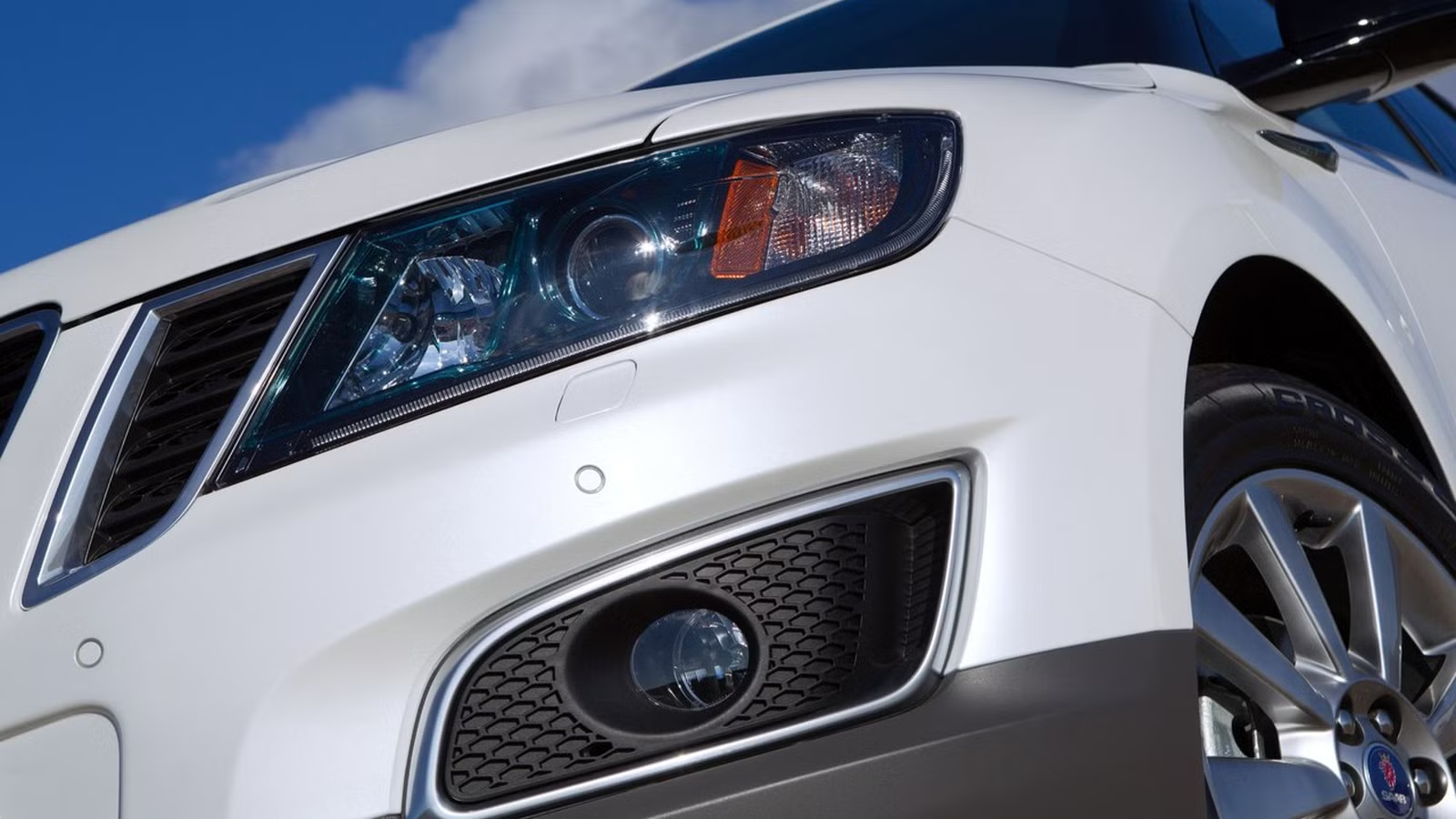
While certain design decisions can seem like no-brainers in hindsight, it’s rare that they are adopted as the future (and the blueprint for upcoming models) from the moment they first arrive. Turbocharged engines are a clear example of this, as they took a good few decades to be adopted as the go-to for most manufacturers around the globe. This didn’t stop them cropping up in a wide range of cars though, and General Motors was burned by this approach in the early 2010s.
Despite turbocharged SUVs being extremely popular these days, this one fared so badly it was discontinued after just 18 months.
The Shared Blueprint Behind Cadillac’s SRX And Saab’s Last-Ever SUV
The SAAB 9-4X was the Swedish company’s last roll of the automotive dice before it closed that chapter, focusing on other industries.SAAB
The story starts with a platform GM thought could anchor two luxury brands – one established, one fighting for its life. Based on GM’s Theta Premium platform, which was engineered to be stronger than the standard Theta foundations used for smaller vehicles like the Saturn Vue, Cadillac released the SRX in 2010, and the Saab 9-4X in 2011. These were the only two offerings ever built upon these tweaked underpinnings, though the Cadillac is easily the more common of the duo. While it was produced between 2010 and 2015, the 9-4X lasted just a single model year before being killed off.
The latter’s short life came as a result of Saab folding, with years of struggling sales finally leading GM to close the Swedish marque’s doors for good. Still, the collaboration between it and Cadillac left us with one of the rarest mainstream SUVs on the market. We’re talking about the turbocharged V6 variant of the machine, which was available only in 2010 and 2011 on the Performance trim. While it was offered through the entirety of the 9-4X’s life, Cadillac ditched the power plant midway through 2011 due to extremely weak sales.
In its place was a new naturally aspirated 3.6-liter V6, which is a strange decision when looking back at it from 2026, but NA engines were far more established than turbocharged units at the time. This was especially true in luxury cars, where the more linear power delivery provided by an NA engine helped increase the subtlety of the driving experience. The Saab model, geared more toward sharper handling and styling, suited the engine well, but the death of the brand cut short the final attempt to capture profitability before it could gain traction.
The Cadillac, which was developed as the plusher and more luxurious of the two SUVs, suited the NA V6 better.
How Two Brands Turned One 300-hp Platform Into Very Different SUVs
2010 Cadillac SRX Rolling Side shotCadillac
Aside from the difference in interior and exterior design philosophy, the SRX Performance and 9-4X were remarkably similar underneath. They used the same engine and transmission, which were mounted in the same platform. The 9-4X weighed around 100 lbs more than the SRX Performance, primarily as Saab elected to beef up the chassis to help improve handling.
To this end, the brand also offered the range-topping Aero model with adaptive suspension, which enhanced responsiveness and reduced body roll when tackling corners. The steering was also tuned to be more precise, whereas the Cadillac came with softer suspension and a less responsive steering setup to make it a more relaxing drive.
Both were able to make use of the same 300 horsepower and 295 lb-ft of torque], with this output shared between all four wheels via a six-speed automatic transmission. The SUVs could hit 60 mph in a shade under eight seconds, which was respectable given the kind of vehicles they were. The all-wheel drive system used was a Haldex-based setup, which was electronically controlled to help ensure the vehicles were more adaptable.
When running normally, the V6’s power was sent to the front wheels only to help save gas. The system could sense when the front wheels lost traction, so the rear axle could be brought into action to increase grip. But knowing the specs is only half the story – the real question is how many of these actually survived, and what it costs to own one today.
These Turbocharged SUVs Are Rare, But Cheap
The Saab 9-4X was the Swedish company’s next great hope… but it all came to naught.SAAB
Whether you fancy the softer and more relaxing vibe of the SRX Performance, or the sharper feel of the 9-4X, you’ll have one of the rarer SUVs on the road. Since both cars were only built for a year or two in turbocharged configuration, spotting another one would take a lot of skill – and luck.
It’s thought that only around 800 of the 9-4Xs were ever built, though it’s not known how many of these featured the turbocharged V6 as opposed to the NA 3.0-liter unit. While there were more turbo SRXs produced, it’s thought that only between 5,000 and 10,000 cars got the engine before it was discontinued.
Despite this level of exclusivity, you won’t need a lot of cash to secure your very own example. Since the Saab is considerably rarer, you can expect to spend an extra few thousand dollars to get a lower-mileage example, with specimens sporting around 90,000 miles being offered at around $14k on the used market. Equivalent SRXs, many with drastically lower mileage than that, can be had for closer to $11k.
If you’re not too worried about getting a higher-mileage machine, then there are plenty of tidy examples of either vehicle that sell for between $5,000 and $10,000. It is possible to spend less than $5k, but at that price point you’ll be scraping the bottom of the barrel in terms of condition, so we don’t recommend it unless you’re happy to drive it as a short-term stopgap until it dies.
There Are Some Key Maintenance Items To Watch Out For
2010 Cadillac SRX Overhead view Cadillac
Of course, being a 15-year-old V6 SUV, there are some key reliability issues you’ll need to bear in mind before you splash the cash. Some of these were classed as recalls when the car was new, so they should be fixed, but it’s well worth clarifying this yourself by checking over a particular vehicle’s service history.
The turbocharged V6 was recalled by the brand after it was found that it could suffer engine failure when driven hard with standard gas in its lines, rather than more expensive premium fuel. The low-pressure steering hose used in turbocharged cars was also prone to failure, but again, this should have been covered a long time ago under an enforced recall.
Aside from that, the V6 of this era is known to sometimes suffer from premature timing chain failure. When you fire up the engine, make sure to listen out for any chain rattle from the engine bay, as this is a clear sign the component could be up for replacement. It’s an engine-out job to sort it, and because the power plant is so tightly packaged, it’s an even more difficult job than normal. Speaking of which, any engine work is harder as a result, so labor costs can increase versus vehicles with more wiggle room.
Rival vehicles with NA engines from the era are generally a little more reliable, but you’ll have to make do without the impressive torque output of the turbocharged V6. Plus, given just how rare the early SRX Performance and 9-4X are, you won’t attract curious glances in quite the same way.
In terms of which is the better choice, the Saab comes with its distinctive Night Panel mode that dims the instrument lights when driving at night, evoking a fighter jet cockpit. What more do you need to know?
Base Trim Engine
3.0L V6 Gas
Base Trim Transmission
6-Speed Automatic
Base Trim Drivetrain
Front-Wheel Drive
Base Trim Horsepower
265 hp
Base Trim Torque
223 lb-ft @ 5100 rpm
Fuel Economy
18/25 MPG
Base Trim Battery Type
Lead acid battery
Sources: Cadillac, Saab.
