

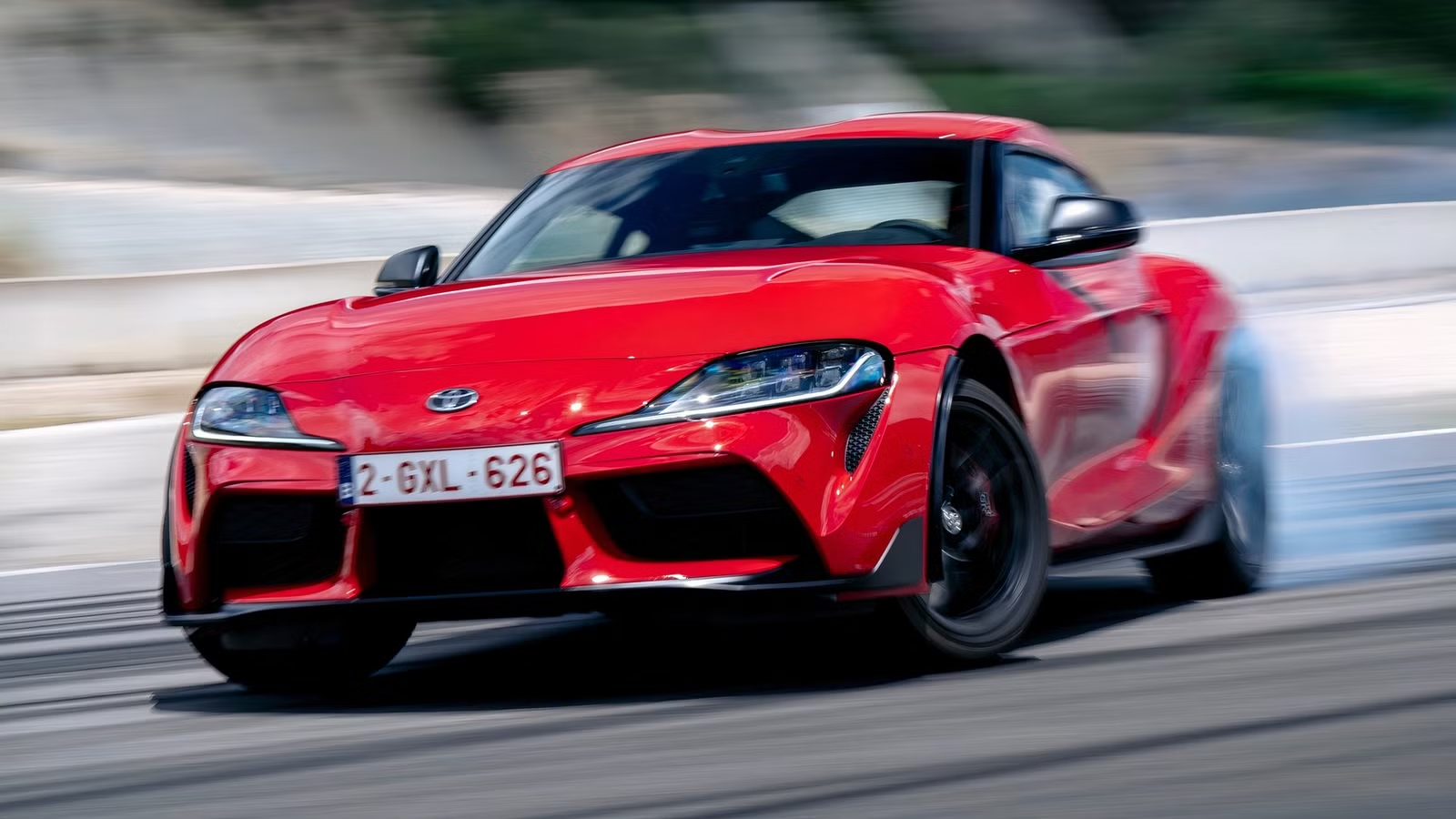
It felt like Toyota’s GR Supra would be fast-tracked to stardom after it made a triumphant return to showrooms in 2019, but things haven’t quite worked out that way.Toyota sold fewer than 40,000 GR Supras in seven years – less than half of what its BMW twin managed with the Z4. For a nameplate carrying 45 years of legend, that’s a brutal number. So why does Toyota consider the Supra a success anyway?
The New Supra Made Waves Upon Its Release
Front shot of a 2021 Toyota GR Supra 2.0Toyota
The Supra was one of Toyota’s most prolific models during the 20th century, with the car being a mainstay of the Japanese manufacturer’s range between 1978 and 2002. The two-door sports car was not only a thrilling drive in its standard form, but it garnered a reputation in the world of car modification, primarily due to its over-engineered mechanical makeup that allowed for a ton of upgrade work to be carried out without significantly affecting reliability.
It became a darling of the street racing and drifting world, and earned the reputation of a halo car due to being included in globally popular media heavyweights like the Need For Speed video game series, as well as the Fast and the Furious movie franchise. That’s why JDM enthusiasts went into hyperdrive when news leaked that Toyota was working with BMW on a new GR Supra back in 2012, with the car set to share a new platform with the German brand’s upcoming third-generation Z4.
The beauty of bringing the Supra name back was that, not only could drivers who potentially had one during its heyday turn back the years, but drivers who were too young to have one back then could now buy a brand-new example and live out the dreams of their youth.
The GR Supra Hasn’t Sold Particularly Well
The very first Toyota GR Supra to roll off the production line sold for more than $2 million at a Barrett-Jackson auction.Toyota
Despite Toyota’s new coupe boasting one of the most recognizable names in the automotive space, it ultimately lived in the shadow of its BMW-badged sibling when it came to global sales. While just shy of 90,000 G29 Z4s were shifted worldwide by the German marque between 2019 and 2026, Toyota only managed to wave off around 40,000 GR Supras, less than half BMW’s number. This figure was also more modest than the number of M2 coupes that BMW sold, with roughly 60,000 F87 cars being sold between 2015 and 2022.
Hell, the GR Supra even failed to eclipse the more expensive Porsche 718, of which comfortably over 120,000 units were sold globally during the same period the GR Supra was on sale. It did at least get the better of its Japanese rival, the Nissan Z, though the Z was badly hamstrung due to not being available in Europe.
The GR Supra’s modest sales figures were a disappointment, especially given the 3.0-liter straight-six version cost around $10,000 less than the equivalent Z4. It was also a good $40k cheaper than the flat-six-powered 718 Cayman, which was only a little bit more powerful. The sales numbers tell one story – but they may be missing the bigger picture entirely.
The Supra’s Close Relationship With The Z4 Was Likely A Sticking Point
BMW
Considering how much cheaper the GR Supra was versus the Z4, it may seem strange that a car that was practically identical aside from its cabin and styling would struggle so badly in the sales charts. There are a couple of key reasons for this. Firstly, the BMW name is much more globally known as a sporting brand, so it shouldn’t come as a surprise that most in the market for such a car would make a beeline for the BMW over a Toyota, despite the premium.
The Supra name is big in the JDM world, but this market is considerably smaller than the kind of customers that BMW was able to attract with the Z4. The trouble for the GR Supra was that, because of its close ties to the Z4, it alienated itself from the hardcore JDM audience. Many wondered what the point was of a car that looked like a Supra, but used a BMW engine and the same underpinnings as a Z4.
Having BMW branding and markings throughout the engine bay was never going to endear buyers who gravitated toward something like the Supraspecifically because they didn’t want a BMW. Toyota’s approach diluted the Supra formula, and thus it was never going to be as popular with JDM purists as the brand had hoped.
This left it in somewhat of a strange middle ground, where it didn’t have a mainstream enough name to attract the general person looking for a handsome sports car, but at the same time, wasn’t special enough to attract the audience that the previous Supra brought to the table. The obvious conclusion is that Toyota should have saved its money and not bothered with the resurrection of the GR Supra. But here’s what the sales charts can’t measure: the GR Supra may have been designed to fail as a product – and succeed as something far more valuable to Toyota.
The GR Supra Was A Loss-Leader That Rebuilt Toyota’s Entire Performance Identity
2025 Toyota GR Corolla front 3/4 angle in red while doing a powerslideToyota
Crucially, the GR Supra was a key ingredient in Toyota’s push to be seen as somewhat of an enthusiast brand again. It spent much of the 2000s and 2010s enhancing its reputation as the safe and dependable choice for families and those simply looking for a car that would get them from point A to point B. Group Chairman Akio Toyoda wanted to bring back a touch of spice to the company, hence the push to grow the manufacturer’s Gazoo Racing performance division.
The GR Supra was the halo model built to show the world Toyota wasn’t just about building slow and safe cars. Its GR 86 wasn’t quite enough to carry the torch on its own, so the Supra amplified that message in unmistakable terms. Alongside these models,the incredibly well-received GR Corolla and Yaris hot hatches further bolstered the GR name, and have brought the brand to a point where it’s being seen as a genuine performance bigwig these days.
The GR Supra may not have been particularly successful as a standalone model, but it has done a lot to help establish Toyota as a manufacturer that is seen to care about the driving enthusiast.
Toyota Learned From The Supra’s Mistakes – And The Next One Will Be Built Alone
Toyota FT-Se Concept RenderToyota
Toyota is taking and running with the torch that the GR Supra has helped light, too. Even though the Supra was discontinued beyond the 2026 model year, Toyota is already working on a follow-up model, though it’ll be a few years at least before we get to sample it. The good news is that the marque appears to have learned from its mistakes, as the sixth-gen Supra is set to be developed by Toyota on its own, so it should be more distinctive than its fifth-gen forerunner. This should please JDM fans, and could prove to be the missing piece in building the model’s popularity.
Beyond that, Toyota is also working on an all-new sports car that’ll likely sport the Celica or MR2 name, which will probably come with around 600 horsepower to play with. Its new GR GT supercar is also due to arrive very soon, with the machine designed to show that the brand cares more about making cool cars than achieving maximum profit.
The GR Supra certainly didn’t perform as well as Toyota was hoping in terms of sales, but its existence meant so much more than that. It was more about illustrating a renewed sense of purpose within the company, and showing enthusiasts that Toyota was a marque that wanted to provide exciting and engaging models for them to enjoy. In an automotive world that grows more sterile seemingly by the year, we can thank the GR Supra in part for reigniting the fire within one of the most influential manufacturers in the world.
In other words, yes, the GR Supra was most definitely worth building in our eyes. As the legendary Bugatti Veyron shows, performance cars can be worth more to a company than simply sales figures.
Sources: Toyota
