

Every generation produces its share of future classics — cars that fly under the radar today but command serious money and serious respect a decade or two down the road. The trick is spotting them before everyone else does.
We capped our budget at $30,000 and cast a wide net to find 10 cars sure to be collectible in the future.
1999-2004 Porsche 911
The First Water-cooled 911
Engine
3.4-liter Flat-six
Horsepower
296 hp
Torque
258 lb-ft
0-60
5.0 seconds
Depending on who you ask, Porsche either committed an unforgivable sin or accurately charted the course for the future when it introduced its first major rethink of the classic 911 for the 1999 model year. The prior model was still closely related to the original 911 that debuted 35 years earlier; its replacement, the so-called 996-generation 911, ditched air-cooled power for a more conventional cooling system. It was larger and more luxurious than before, and it could be ordered with a sweeping array of previously unavailable features like a CD-ROM-based navigation system.
Values for 996s have long trailed those of its air-cooled predecessors, and they’re even no match for its 2005 model-year replacement. The biggest reason? The 996’s controversial headlights, which feature integrated turn signals and fog lights. They’re simply not as elegant as what came before, though the 2002 update is widely regarded as an improvement. If you can overlook those droopy lights, the 996 delivers thrilling performance and a refined chassis.
1984-2001 Jeep Cherokee
The Original Family SUV
Engine
4.0-liter Inline-six
Horsepower
190 hp
Torque
225 lb-ft
0-60
9.5 seconds
The Jeep Cherokee wasn’t the first SUV, but it was the first one to make its way into a wide range of suburban driveways across the U.S. What made the XJ-body Cherokee, as it’s known to enthusiasts, such a success was its reasonable proportions; it didn’t drive like the capable off-roader that it was, and its four-door design made it far more useful than a Ford Bronco II or a Chevrolet Blazer S-10. It didn’t hurt that the Cherokee gained a torquey and smooth 4.0-liter inline-six option beginning in 1987.
Jeep planned to kill off the Cherokee when the larger Grand Cherokee arrived in 1993, but it hung on for nearly another decade simply because it was so popular. The pick of the litter today is certainly one with the six-cylinder engine, though we could spend an entire article debating whether the 1984–1996 model with its available chrome bumpers was more stylish than the 1997–2001 update with its car-like interior. Even Jeep has seemingly admitted that the mid-gen face-lift might not have been the best idea. The upcoming 2026 Cherokee definitely samples the original.
2004-2006 Pontiac GTO
The American-Australian Muscle Car
Engine
5.7-liter V8
Horsepower
350 hp
Torque
365 lb-ft
0-60
5.0 seconds
The Pontiac GTO ticks a lot of boxes for enthusiasts hunting a future collectible: its big V8 engines are powerful, it delivers classically predictable rear-wheel-drive handling, and it has an interesting story to tell. The GTO isn’t really a Pontiac, after all — it was designed, developed, and built by General Motors’ Holden subsidiary in Australia. Fans of American muscle may appreciate its Corvette-derived V8 engines, though the GTO definitely talks with an accent. It looks and feels like nothing else from GM’s American portfolio of the era.
The 2004 models featured a 5.7-liter V8, which was swapped out for a more powerful 6.0-liter V8 rated at 400 hp for 2005 and 2006. The higher-displacement engine enabled a 13.1-second quarter-mile run, making the GTO one of the quickest cars of its time.
2013 BMW 135is
BMW At Its Peak
Engine
3.0-liter Turbocharged Inline-six
Horsepower
320 hp
Torque
317 lb-ft
0-60
4.6 seconds
Oh, how one little letter can totally change a car’s personality. Such is the case with the 2013 BMW 135is, a single-year model that slotted between the sporty turbocharged 135i and the supercar-lite 1 Series M. The 135is was a nod to enthusiasts and enthusiasts only; BMW replaced the relatively analog 1 Series with the softer and more tech-heavy 2 Series for 2014.
The swansong 135is extracted 20 more horsepower from its sweet turbocharged inline-six, and BMW fitted a free-flowing exhaust with just the right amount of snarl. A buttoned-down suspension and model-specific 18-inch alloy wheels round out a special package that came in coupe and convertible forms, with either a six-speed manual transmission or a dual-clutch automatic. It was a cult classic in its own time.
2017-2023 Toyota Tacoma TRD Pro
The Off-roader’s Dream Truck
Engine
3.5-Liter V6
Horsepower
278 hp
Torque
265 lb-ft
0-60
4 seconds
By 2017, Toyota’s TRD division was already very good at making the automaker’s pickup trucks and SUVs more capable off-road. The redesigned Tacoma gave TRD the opportunity to create something truly special — and not just by improving the midsize truck’s ability to crawl over rocks and bash through a desert. This time, Toyota added a dose of collectibility by dropping a new exclusive paint color with each model year. Ranging from soothing Cement (2017) to retina-burning Lime Rush (2022), each shade has its own appeal.
Regardless of color, a Tacoma TRD Pro is a highly capable four-wheeler right out of the box, with special Fox Racing internal-bypass shocks, Eibach coil springs up front, and numerous other tweaks. Get one while you can; these trucks were meant to be used, and few are likely to be preserved in pristine condition.
2012-2019 Fiat 500 Abarth
A Snarling, Snorting Pocket Rocket
Engine
1.4-liter Turbocharged Inline-four
Horsepower
160 hp
Torque
170 lb-ft
0-60
7.3 seconds
Fiat’s revived, retro-style, city-friendly 500 was a hoot in just about any form, but it was at its best after receiving a sporty treatment from the automaker’s in-house tuner, Abarth. So-equipped 500s pack a lot of power for something that weighs around 2,600 pounds, and what may be the most snap-crackle-pop exhaust ever fitted to a production car sold in the U.S. A firm suspension and specially tuned steering help make the most of that power boost, too.
Fiat offered the 500 Abarth in both hardtop and retractable-roof semi-convertible configurations, with either a five-speed manual gearbox or a six-speed automatic. (The automatic has a bit more torque, enabling a quicker 0–60 mph sprint.) Right now, you can pick up a garage full of 500 Abarths for $30,000, but that may not always be the case.
1993-1995 Mazda RX-7
A Rotary-powered Touring Car
Engine
1.3-Liter Rotary
Horsepower
255 hp
Torque
217 lb-ft
0-60
5 seconds
The final version of Mazda’s RX-7 sports car, called FD in enthusiast circles, was undoubtedly the most refined, and arguably the most stylish. If you’re after a sporty classic that has some utility, the RX-7 offers a decent cargo area and a comfortable cabin. Moreover, the final two model years featured a softened suspension that improved ride quality, though all RX-7s are wild to drive thanks to their high-revving rotary engines and the near-perfect distribution of their mere 2,800-pound curb weight.
Sales were slow from the start, even though the RX-7’s little twin-turbo, twin-rotor engine delivered excellent acceleration. As a result, these iconic ’90s sports coupes remain rather underappreciated classics — if you can find one.
2005-2013 Chevrolet Corvette
The Modern Performance ‘Vette
Engine
6.0-liter V8
Horsepower
400 hp
Torque
400 lb-ft
0-60
4.3 seconds
The Chevrolet Corvette does not need an introduction. Undoubtedly the best value in the ‘Vette world right now is the sixth-generation, or C6, model that arrived for 2005. It retained the model’s signature long-hood, short-trunk proportions, albeit with exposed headlights. A big V8 rated at upward of 400 hp delivers predictably thrilling acceleration.
There’s a C6 Corvette for just about every taste and budget. Opt for the Grand Sport, and you’ll find a tasteful combination of a firmed-up suspension and forged alloy wheels, plus bigger brakes. Models with the six-speed manual even get a special dry-sump version of the big 6.2-liter V8.
2018-2020 Jaguar XF Sportbrake
The Connoisseur’s Wagon
Engine
2.0-liter Turbocharged Inline-four
Horsepower
247 hp
Torque
105 lb-ft
0-60
4 seconds
Though not the first Jaguar station wagon to grace U.S. dealers, the XF Sportbrake was easily the most intriguing. At its core it was simply a wagon version of the automaker’s XF sedan, and yet there’s nothing simple about it. With its long roofline and generous cargo area, the XF Sportbrake managed to be both pretty and practical — a combination Jaguar has rarely pulled off so convincingly.
The XF Sportbrake came only with the sportiest bits Jaguar offered on the sedan, including more aggressive bumpers and interior trim as well as adaptive dampers.
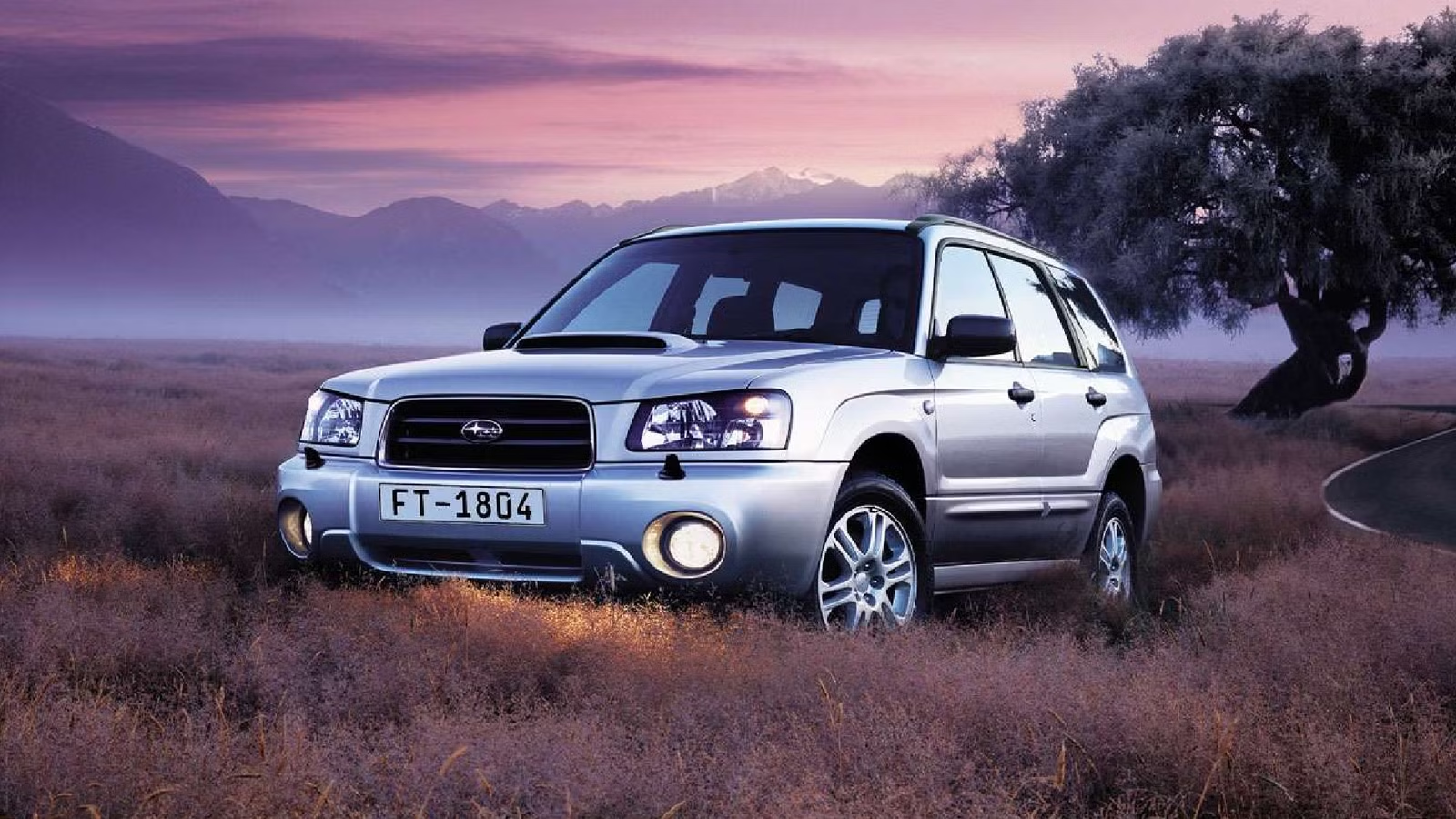
2004-2008 Subaru Forester XT
Utility + Turbo = Yes, Please
Engine
2.0-liter Turbocharged Flat-four
Horsepower
210 hp
Torque
235 lb-ft
0-60
6.5 seconds
Subaru’s two personalities — its practical side and its rally-bred side — combined in glorious fashion with the potent Forester XT that arrived here for 2004. While not quite the tall WRX some enthusiasts made it out to be, the Forester XT was nonetheless a very quick car for its time, and a practical one to boot.
For the 2006 model year, a new Forester XT Sports model leaned even further into the company’s rally heritage with special blue paint and a nifty body kit, though only the Japanese market received a genuine high-output variant called the Forester STi.
Sources: Porsche, Stellantis, General Motors, BMW, Toyota, Mazda, Jaguar, Subaru
