

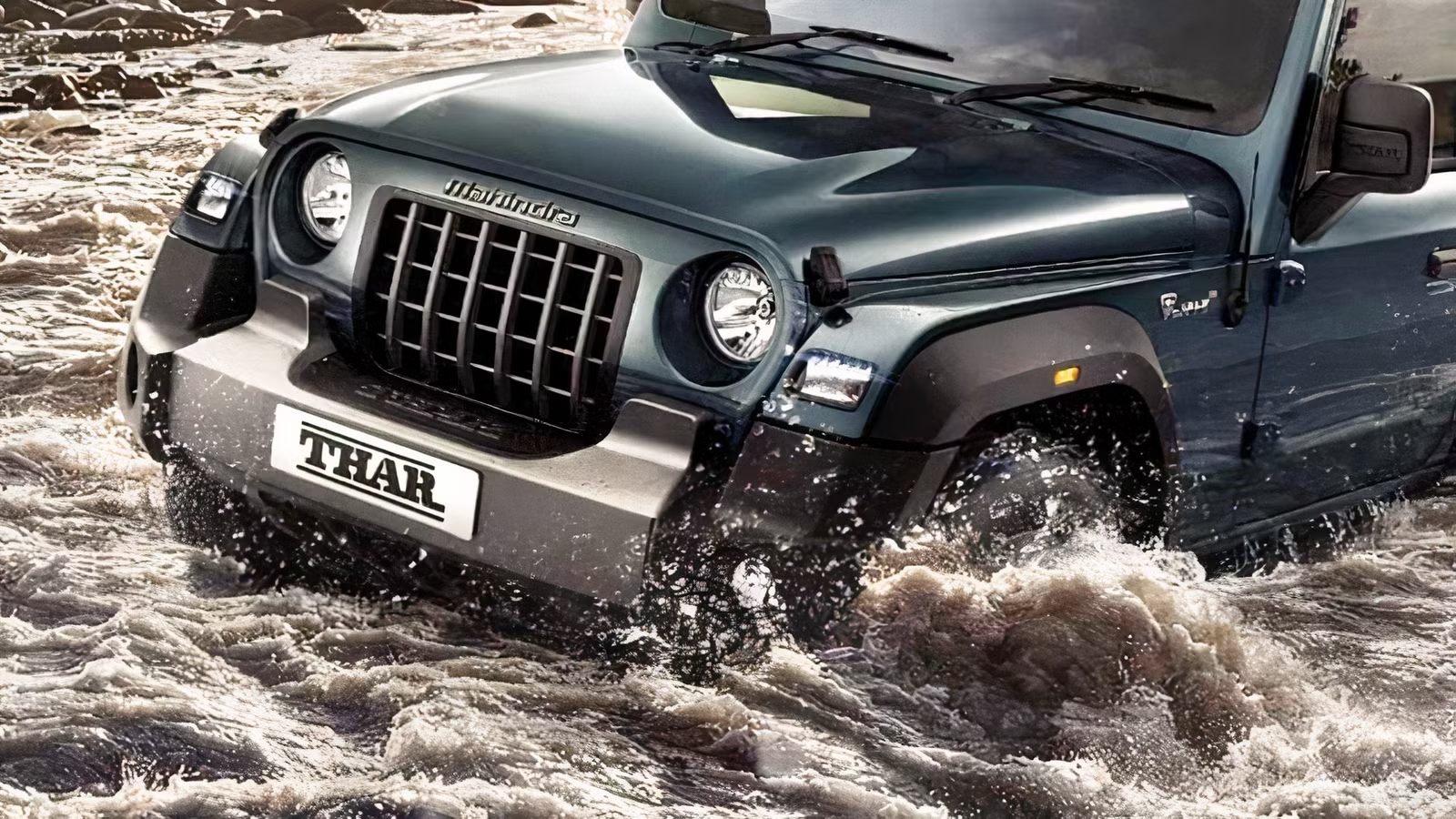
Linguists call it genericization — the moment a brand name becomes shorthand for an entire product category. In the automotive world, few names have achieved that status more completely than Jeep, which drivers routinely use to describe any rugged 4×4 or off-road-capable SUV, regardless of who built it. But here’s the uncomfortable question Jeep’s product planners probably don’t love asking: what happens when a rival starts building a vehicle that fits that description better than Jeep itself does?
That rival is Mahindra, and its second-generation Thar has quietly stolen considerable limelight from the American icon. You could make a compelling case that the Indian automaker has produced something that feels more like the Jeep people remember than anything Jeep currently sells.
Mahindra’s Modern Thar Proves Evolution Beats Imitation
2025 Mahindra Thar front quarterMahindra
2025 Mahindra Thar
Engine
2.0-liter turbo gas or 2.2-liter turbodiesel
Transmission
Six-speed manual or six-speed automatic
Drivetrain
Four-wheel drive
Power
130–150 hp
Torque
221–273 lb-ft
For decades, Mahindra was simply an Indian company that had licensed the right to build Jeeps from a US firm — and never stopped. Yet while Jeep itself shifted the formula, chasing luxury buyers with ever-larger Wranglers, Mahindra focused on perfecting the simple recipe that made the original CJ a legend in the first place.
The result is a latest-generation Thar that represents genuine, thoughtful evolution rather than mere imitation. It retains the short-wheelbase, ladder-frame architecture, real mechanical four-wheel drive, and removable body panels that defined the original — but wraps all of that in a level of comfort, safety, and refinement that makes it a credible everyday vehicle.
The Licensed Willys Develop Into Home-Grown Off-Roaders
2025 Mahindra Thar on the beach Mahindra
Mahindra first inked a relationship with Jeep in 1947, when it gained the rights to assemble the Willys CJ-3B for civilian and military use. This arrangement continued through the decades, as the Mahindra version of the Jeep became the backbone of rural mobility and defense fleets in India. Formally, the license agreement ended in the early 1990s, but Mahindra kept going to develop its own variants. Its first effort was the MM540, which was still unmistakably a Jeep, top to bottom.
As the new century arrived, Mahindra was still carrying the DNA forward with models like the Classic, Major, and Commander — tough, no-nonsense machines built for the harshest conditions imaginable. Then in 2010, Mahindra launched its first-generation Thar, which looked exactly like a CJ5 and was a nostalgic 4×4 aimed squarely at enthusiasts.
It wasn’t particularly impressive, especially when it came to ride quality, but it did prove to the company that a market existed for this type of go-anywhere, no-frills SUV. Indian consumers liked the concept but demanded better performance, more comfort, and improved safety. And so, Mahindra’s designers and engineers set about civilizing the first-generation Thar without sacrificing its all-important soul.
The Reinvented Thar For The 21st Century
2025 Mahindra Thar Roxx Mahindra
In October 2020, Mahindra debuted its second-generation Thar, and it was a substantial departure from its predecessor. The frame, suspension, body, powertrains, and interior were all redesigned, even as the familiar silhouette remained intact. You’d still find the upright windscreen, the tailgate-mounted spare wheel, and those round headlamps, but the proportions looked more muscular and purposeful. Mahindra also developed its own six-slot grille design — a subtle but confident declaration of independence that sidestepped any legal friction with Jeep.
Beneath the skin sat a new ladder-frame chassis engineered to meet modern crash standards, with coil suspension at all four corners replacing the old leaf springs. Properly sealed doors and a factory hardtop made the new Thar genuinely practical for daily use.
Some of the most significant changes arrived inside the cabin. Gone was the spartan metal dashboard; in its place came a water-resistant seven-inch touchscreen — updated to a 10-inch unit on certain models — with smartphone connectivity. The driver’s seating position was raised for better visibility, forward-facing rear seats replaced the old side-facing benches, and dual airbags became standard.
Under the hood, Mahindra offered two modern engines: a 2.0-liter mStallion turbo gasoline unit and a 2.2-liter mHawk turbodiesel, producing 150 hp and 128 hp respectively. Both paired with six-speed manual or automatic gearboxes, and both drove through a part-time four-wheel-drive system with low range and a mechanical locking rear differential.
Mahindra scored a direct hit in the Indian marketplace, having successfully combined modern usability with classic looks. The company had to ramp up production repeatedly to meet demand, and eager buyers often waited more than a year to take delivery.
The Smart Suspension Revolution
For many, the boldest engineering decision here was the move away from solid front axles toward smarter suspension. Unlike Jeep, which retains solid front axles on the Wrangler, Mahindra concluded that the typical Thar owner was not primarily an off-roader. Most would spend far more time on highways and pothole-ridden city streets than on gravel trails, and the suspension setup was chosen accordingly.
The new Thar adopted independent double-wishbone front suspension paired with a multi-link solid rear axle, coil springs, and stabilizer bars. The rear axle preserves the durability and load control that body-on-frame 4×4 buyers expect, while the independent front end delivers the precision and ride comfort that modern drivers demand. The payoff is lighter, more accurate steering, more predictable damping, and significantly less fatigue on long journeys — all without abandoning the rugged character that defines the nameplate.
Power, Comfort, And Design To Rival the Wrangler
2025 Jeep Wrangler Rubicon X front 3/4Jeep
The gasoline-powered Thar reaches 62 mph in under 10 seconds, while the diesel’s torque makes short work of steep climbs or sand dunes. Inside, Mahindra has struck a convincing balance between comfort and toughness, and the build quality feels solid throughout. A convertible soft top remains available for those who prioritize open-air driving over noise insulation, but the hardtop is the more popular everyday choice. Visually, the new Thar retains all the classic Jeep cues — upright stance, round lamps, short overhangs — but adds a wider track and modern LED lighting. The overall effect captures the charm of a 1990s Wrangler TJ within a thoroughly contemporary package.
Still, Mahindra hasn’t entirely knocked the ball out of the park. Some owners complain about rear-seat practicality in the three-door version — access is awkward and cargo space with the seats up is limited. Shorter occupants can struggle with the high ride height, and despite the switch to coil springs, noticeable body roll and some steering play remain points of criticism. The upside is that the Thar is available in a four-door Roxx variant, which goes a long way toward resolving the space complaints leveled at the standard model.
The SUV That Shows Jeep What Jeep Used To Be
2024 mahindra thar full rear red parked near a streamMahindra
It can’t be comfortable for Jeep to watch a company that once licensed its products build what is arguably the truest spiritual successor to the original CJ. The price gap only sharpens the contrast: in the US, the Wrangler is a $40,000-plus lifestyle statement, while the Thar starts at the equivalent of around $12,000 in India. With the 2025 update, the Thar gains a bolder grille, more technology, a 10.25-inch touchscreen, and a price adjustment — all moves designed to sharpen Mahindra’s iterative edge.
It’s fair to say, then, that the Thar shows Jeep what its vehicles used to be: small, capable, and honest transportation within reach of ordinary buyers.
Mahindra hasn’t simply copied the Jeep formula — it has refined it through several decades of real-world evolution. And with the switch to independent front suspension, it may have moved to the front of the evolutionary line, delivering a package that suits modern life without straying from the original Jeep ethos.
Sources: Mahindra, Jeep
