

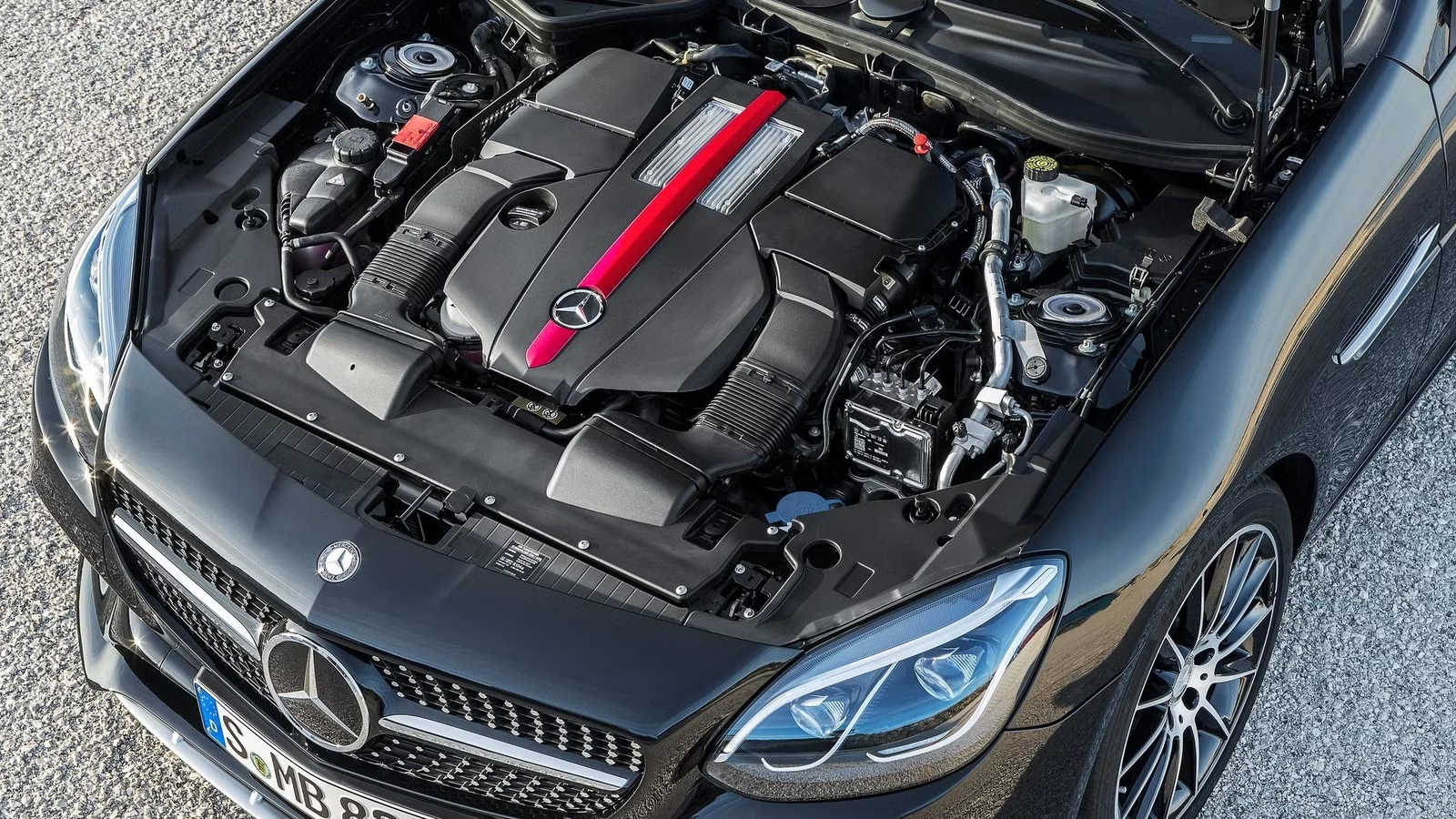
Ranging roughly between the mid-1990s and the mid-2000s, Mercedes-Benz suffered from a litany of issues stemming from things like a rush to expand its market, cost-cutting, and the rapid adoption of new, cutting-edge tech. This led to a period of questionable build quality, and happened to coincide with Daimler’s partial majority ownership of Chrysler.
However, once the bad times ended, Mercedes was keen to get back to building quality cars and components. Just a few years after Merc’s sale of Chrysler in 2007, the German automaker introduced, arguably, one of the most reliable engines it’s made over the last 20 years; the M276 V6. It’s been featured in a wide swath of Merc’s cars, ranging from compact executive sedans, mid-size SUVs, and even a couple of sporty models.
Where The M276 V6 Came From
2017 Mercedes-AMG E43 Engine BayMercedes-Benz
The M276 engine was introduced around 2010/2011 (depending on market and model), but it had actually been in development for quite some time, even before Merc’s sale of Chrysler. The foundation of the M276’s development actually began around 2005. Many folk incorrectly claim that the M276 is closely related to Chrysler’s Pentastar V6 when, in fact, both engines are entirely different, save for utilizing a similar V-angle.
When Mercedes-Benz made the decision to begin work on designing the M276, it was due to the then-current M272 V6 being subject to rapid obsolescence. As engine tech throughout the automotive market quickly advanced, the M272 was left behind in a major way. So, instead of revamping the mill, Merc decided to replace it with something new.
The M276’s first assignment was on a few 2011 model-year Merc models, including the S 350, the E 300 BlueEfficiency, and the C 350 4Matic. In total, three variations of the engine were produced, with the first being the 3.5-liter M276 DE35. Come 2013, a second iteration entered the fold, that being the M276 DE30 LA, with the later two letters denoting its turbocharged status.
Its displacement also shrank from 3.5-liter to 3.0-liters. Finally, in 2015, the last variation hit the market. This time, it was a 3.5-liter turbocharged unit called the M276 DE35 LA. This version would be utilized by the fewest number of Mercedes-Benz models, although it was found in the W222 Maybach S 400 from 2015 to 2017.
Related
AMG’s First Take On The Mercedes-Benz C-Class Was Really Weird
The 1995-1997 C36 AMG had a potent engine but only came with an automatic gearbox.
Detailing The M276
2014 Mercedes-Benz C350 Coupe engineMercedes-Benz
Mercedes-Benz M276 V6
DE35
DE30 LA
DE35 LA
Displacement
3.5L
3.0L
3.5L
Aspiration
natural
twin-turbocharged
Power
248–302 hp
329–385 hp
333 hp
Torque
252–273 lb-ft
354–384 lb-ft
354 lb-ft
Max Boost Pressure
N/A
23.5 psi
10.2 psi
Cylinder Bore
3.66 in
3.46 in
3.66 in
Piston Stroke
3.39 in
3.23 in
3.39 in
Compression Ratio
12.2:1
10.5:1
10.7:1
Production Timeframe
2011–2018
2013–2023
2015–2018
*Specs courtesy of Mercedes-Benz
Across all three versions of the M276 sit myriad similarities. For starters, all of them share a common, 60-degree V-angle. This isn’t necessarily uncommon for automakers, but it does come with a couple of clear upsides.
For one thing, V6 engines that use a 60-degree angle don’t need a balancing shaft to counteract the engine’s vibration, eliminating a component that helps make the engine more reliable. In addition, a narrower V-angle means the engine will sport a thinner footprint, which helps with overall packaging. All three M276 variants also share an aluminum block and a pair of aluminum cylinder heads.
Mercedes-Benz decided to employ a set of Nanoslide cylinder wall coatings, which help to reduce friction within the combustion chamber while also helping to isolate and dissipate heat. Four chain-driven overhead camshafts operate on a 24-valve valvetrain, and both the intake and exhaust valves boast variable valve timing, helping to increase power output alongside efficiency.
Direct fuel injection is used, with Merc installing piezoelectric injectors that fire two to three times per intake stroke, which helps to even out the air-fuel mixture, resulting in cleaner, more efficient combustion.
2014 Mercedes-Benz C350 Coupe frontMercedes-Benz
It also has a multi-spark ignition system, which will fire each individual spark plug up to four times per one piston cycle, further helping to achieve a cleaner burn. It also helps to smooth out the engine’s start-up, as the M276 uses automatic start-stop tech in most applications. Its water, oil, and fuel pumps are all demand-controlled, meaning they only work as hard as they’re required. Its alternator uses an on-demand operation, too.
Thanks to all the efficiency-boosting tech, Mercedes-Benz claimed that the M276 was up to 24 percent more fuel efficient, while also producing more power than the older M272 V6.
Related
Mercedes Breaks Its Silence On BMW Engine Rumors
Mercedes cars will continue to use Mercedes engines.
Here’s What Makes It So Reliable
2018 Mercedes-AMG GLE 43 frontMecum
One of the hallmarks of the M276’s penchant for reliability lies in its 60-degree configuration. Because it provides the mill with a good amount of balance – much more than a 90-degree engine – it doesn’t need a balancing shaft, as we mentioned previously. By not using the extra shaft, the M276 is a bit less mechanically complex, which always bodes well for reliability.
In addition, having a smoothly operating mill means all other internal and external components of the engine are not subjected to harsh vibration, helping to preserve engine parts and promote longevity. Rotational friction is also lessened by omitting a balancing shaft, which reduces the engine’s overall ability to produce excessive heat.
The next reliability-boosters are those Nanoslide-coated cylinder liners. Nanoslide is Merc’s own creation, and operates in a similar manner to Nikasil cylinder wall coating. The coating is applied using a twin-wire arc method, and is known to significantly reduce combustion chamber friction. This means less heat and less mechanical strain being put on bottom-end components over time. The Nanoslide liners are also known to degrade much slower than traditional unlined or cast iron-lined cylinder walls.
2022 Mercedes-AMG GLC 43 3.0L Twin-turbo M276 V6 EngineMercedes-AMG
You also can’t forget the M276’s use of timing chains. Many modern engines employ timing belts which are, arguably, much more prone to failure than chains. Timing belts are known to stretch prematurely, meaning the engine itself could jump timing. If this happens, catastrophic damage could possibly occur. Timing chains reduce the risk of stretching and/or timing issues simply because they’re more robust and, of course, made of metal, not rubber. Earlier M276 engines were somewhat prone to timing chain rattle on cold startups, but Merc helped to solve the issue in 2013 by introducing new timing chain tensioners.
It’s noted that the most reliable iteration of the M276 V6 itself is the naturally aspirated DE35 version, simply because its lack of forced induction means less heat is being produced, and its overall mechanical make-up is less complex than its turbocharged siblings.
Models You Can Find It In
2018 Mercedes-AMG E43 M276 V6 engine bayBring a Trailer
Across its three variations and 13-year-long production timeframe, Mercedes-Benz threw the M276 V6 into dozens of its models. We’ll list them below:
M276 DE35
2011–2013 S 350
2011–2014 E 300 BlueEfficiency
2011–2014 CLS 350 BlueEfficiency
2011–2014 C 350
2011–2014 C 350 BlueEfficiency
2012–2014 C 300 4Matic
2012–2016 E 350 BlueEfficiency
2012–2016 E 400 Hybrid
2012–2015 ML 350 BlueEfficiency 4Matic
2015–2018 GLE 350
2012–2015 GLK 350 4Matic BlueEfficiency
2013–2015 GLK 350
2012–2014 R 350 4Matic BlueEfficiency
2013–2017 S 400 Hybrid
2011–2015 SLK 350 BlueEfficiency
M276 DE30 LA
2013–2014 E 400
2013–2017 E 400
2014–2020 S 400
2014–2019 GL 400 / GLS 450
2014–2017 CLS 400
2014–2017 S 500 plug-in hybrid
2014–2015 CLS 400
2015–2019 AMG GLE 43 4Matic
2015–2021 C 400 4Matic
2015–2022 AMG GLC 43 4Matic
2015–2017 C 450 AMG 4Matic
2015–2017 ML 400 /
GLE 400 4Matic
2016–2017 GLE 450 AMG 4Matic
2016–2018 GLE 500 e /
GLE 550 e
2016–2021 AMG C 43 4Matic
2016–2018 E 400 4Matic
2016–2018 AMG E 43 4Matic
2018–2020 S 580 e
2019–2020 E 450 4Matic
2014-2020 SL 400
2017-2020 SL 450
2016–2018 R172 AMG SLC 43
2019–2020 R172 AMG SLC 43
2016–2023 BAIC BJ90
M276 DE35 LA
2015–2017 S 400 4Matic
2015–2016 E 400
2015–2017 CLS 400
2017–2018 E 400 4Matic
2015–2017 Maybach S 400 4Matic
It’s One Of The Ultimate Wallflower Engines
2018 Mercedes-AMG E43 M276 V6 engineBring a Trailer
Much like Jaguar, Mercedes-Benz still suffers from some of the bad reputation it garnered back in the 90s and 2000s. Of course, that bad rep was warranted due to the sort of vehicles they were putting out, but the thing is, a lot of that bad quality is no longer there. The M276 is a great example of this, as it manages to be extremely reliable, a fair bit powerful, and yet it manages to fly well under the radar.
If you’re ever in the market for a used Merc and you aren’t dead-set on a V8, be sure to check out an M276-equipped model before making any decisions.
Sources: Mercedes-Benz, MBClub UK, MBWorld, Automotive Tech Info.
