

The year was 2004. You could still buy a Pontiac, a Honda Element, a Subaru Baja, a Mercury, or a Saturn Ion. Bluetooth hadn’t quite joined the party yet, but if your car was fancy enough, it may have had iPod integration. The Honda Ridgeline was first shown as a concept. Chrysler had just launched the new LX-platformed series of rear-drive products that would take the HEMI V8 to the mainstream, and the last-ever car from Oldsmobile would roll off the assembly line as the brand was being wound down.
That last-ever car was a 2004 Oldsmobile Alero, with a 3.4-liter V6, 170 horsepower, 200 lb-ft of torque, and a four-speed automatic. The particular V6 engine under its hood had served GM well, powering a multitude of vehicles across numerous brands. It was part of a series of compact, narrow-angle V6 engines that also included 2.8, 3.1, 3.5 and 3.9-liter versions over the years. If you’re wondering, the popular 3.8-liter V6 was also on the scene, though it came from a different engine family.
2001 Oldsmobile AleroOldsmobile
The guts of these engines were all developed decades earlier to be cheap, durable, and robust. Mission largely accomplished. Still, by the early 2000s, more stringent fuel economy and emissions standards were incoming, prompting automakers to develop new engines with new technologies. Automakers strived to build fewer individual engines, and instead looked to produce more engines with a ‘one-size-fits-many’ approach that would reduce manufacturing costs and complexity. Port fuel injection and pushrod valvetrains made for V6 engines that were cheap and reliable, but significant modernization was required to meet incoming new targets.
The solution for GM’s next-generation products arrived alongside the departure of the Alero and GM’s dated V6 engines in 2004. The resulting next-generation V6, initially dubbed the “high feature” V6 engine, had been designed to deliver competitive power output while rolling out aggressive fuel-saving measures that capitalized on the latest tech available at the time. Below, we’ll look back at the evolution and iterations of one of the most popular V6 engines on the road, which even found its way into some of the fastest Cadillacs.
The Cadillac CTS Brings GM’s Modern V6 Online For 2004, Reliability Problems Begin
2005 Cadillac CTS Euro Spec Silver Rear Angled ViewCadillac
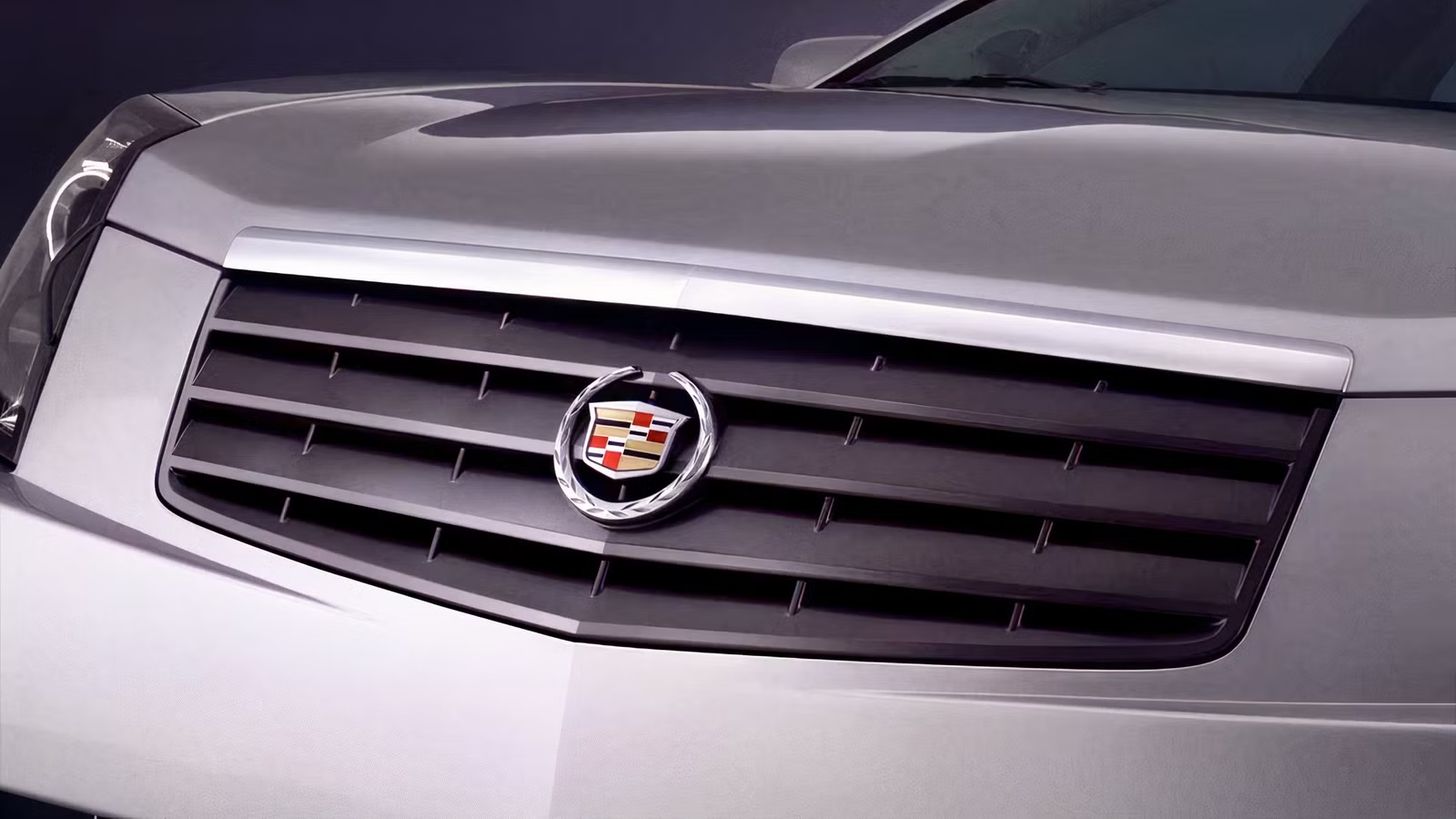
What better place to launch a sophisticated new engine than under the hood of a sophisticated new luxury sedan? The first car to use GM’s latest 3.6-liter compact V6 was the 2004 Cadillac CTS. At this point, the engine was called the ‘LY7’ and its main party trick was its lightweight construction and a quad-cam layout with variable valve timing and 24 valves, good for 255 horsepower and 252 lb-ft of torque while reducing fuel use versus previous V6 engines. This was a major advancement over past engines.
Before long, the new V6 would go on to power a wide range of incoming sedan and SUV products being launched into a highly competitive marketplace. The overhead cam design and compact dimensions of the high-feature V6 helped it achieve respectable mileage and power figures at launch in 2004, and laid the foundation for future updates. Still, the lengthy timing chain and associated hardware used to drive the complex new valvetrain would become a reliability liability for several years to follow. The owner’s community has documented issues with timing chains that can prematurely wear and stretch, likely caused by the timing system’s design and exacerbated by low-quality timing system parts and long oil change intervals.
2005 Cadillac CTS 3.6L V6Cadillac
2008 Cadillac CTS
Engine
3.6-liter naturally aspirated V6
Power
263 hp
Torque
253 lb-ft
Drive
RWD
Transmission
6-speed manual
By 2008, the original engine had been updated with a revolutionary new fuel delivery technology called Gasoline Direct Injection, which was widely proliferating the industry at the time as a means to help automakers meet tightening targets for fuel economy and emissions. Now dubbed the LLT, the direct-injection version of the next-generation V6 was the next major advancement. Now, fuel was blasted into the combustion chambers at extreme pressure, cooling the combustion chambers from the inside out with every injection event. Cooler combustion chambers can make more power, so this version of the engine boasted up to 302 horsepower with improved fuel consumption.
Still, timing chain problems persisted, and some owners reported excessive oil consumption and excessive carbon buildup on intake valves, a side effect of GDI in some engines. By now, the high-feature V6 was in a bit of hot water: while well-regarded by industry experts and impressive on the spec sheet, actual owners were taking to internet forums to share stories of still-ongoing timing chain and wear issues.
2010 Cadillac SRX Overhead view Cadillac
The Fix Finally Arrives For 2012 With the LFX
2010-2013 Chevrolet CamaroChevrolet
The V6 engine gets its second update for the 2012 model year, and it’s a major one. By this point, the switch to direct injection technology was complete, so the latest updates focused on programming and materials to further trim away at fuel consumption and further boost power output. Importantly, a new cam timing chain and tensioner setup was installed to address the now well-documented issues of expensive timing system problems. Other major engine revisions for this ‘LFX’ iteration sought to reduce stress and friction within the engine, while adding rigidity to its overall design.
The highest-performing version of this engine once again went into the Camaro of the day, with the third-generation engine now giving it a 323-horsepower punch, up 12 ponies from the second-generation powerplant. All other variations of this engine now made at least 300 horsepower, roughly the same as the highest-performing versions of the second-generation engine. Partly to thank was an increased compression ratio for the LFX iteration, enabled by the optimization of the direct injection system.
A Clean New Design Arrives With the LGX for 2016
2017 Buick Lacrosse. Front, three-quartersBuick
2017 Buick LaCrosse Premium AWD
Engine
3.6-liter V6 gas NA
Power
310 hp
Torque
268 lb-ft
Drive
AWD
Transmission
8-speed automatic
By the time the 2016 model year rolled around, GM had been building their latest V6 engine family for 12 years, and earlier timing chain-related issues were well in the past. The next update arrives in the form of the LGX V6 engine, which shares little with the previous engines on your page. Further improvements to efficiency and refinement are targeted.
The aluminum engine block carries over with structural improvements for added rigidity, and most of the parts inside are all-new. This includes pistons, connecting rods, the crankshaft, and the valve timing system. Oiling system? New. Cooling system? New. Exhaust manifolds are now cast into the cylinder heads, reducing weight. The top-performing unit in the Camaro now makes 335 horsepower.
The LF4 Version Powers The Fastest V6 Cadillacs With A Major Boost And Patented Charge Cooling
2016 Cadillac ATS-V Coupe White Front Angled View DrivingCadillac
Another version of this engine arrived in 2016 as well. Intended to be the segment’s most powerful six-cylinder, the 2016 Cadillac ATS-V was home to the most extreme variation of the 3.6-liter engine.
Sharing little with the LGX in terms of materials and hardware, this twin-turbocharged version, dubbed LF4, used a patented liquid charge cooler to keep boost temperatures down, and employed titanium parts in both the engine’s internals and turbochargers for lightweight durability. To challenge some of the world’s fastest performance sedans, the ATS-V generated 464 horsepower and came with a laundry list of track-ready supporting upgrades.
Is It Finally On The Way Out?
Many of GM’s offerings are now being equipped with cleaner, boosted four-cylinder engines, or finding themselves electrified in one way or another. With the Cadillac XT6’s discontinuation confirmed, only the Chevrolet Blazer and Cadillac XT5 find themselves motivated by the LGX V6 at the moment. It’s unlikely the V6 will find its way under any other hoods, and just as unlikely that either of these two models will continue using it following future updates. The writing looks to be on the wall then, for GM’s 3.6L V6. It may have endured a rocky start, but once those timing chain woes were dealt with, this V6 quickly turned into one of GM’s most versatile and valuable powerplants, upon which thousands of cars still depend on a daily basis.
Sources: GM, Cadillac, wbodytech.com.
