

In 2026, the U.S. used car and SUV market has grown in popularity, becoming a vital alternative for buyers who have become priced out of the new vehicle market. Average sticker prices have stubbornly surpassed the $50,000 threshold due to several key factors. This, combined with elevated interest rates and rising import tariffs, has led to an extreme new-vehicle affordability crisis. As a result, consumers have been pushed toward the more budget-conscious pre-owned market. This has driven unprecedented demand for used hybrid vehicles and older, high-mileage SUVs.
At the same time, used car prices are experiencing renewed upward pressure. Average prices have climbed more than six percent year-over-year to nearly $27,000. This is largely because of an inventory shortage. Dealerships are grappling with a critical lack of three-to-six-year-old vehicles. This is a direct consequence of the halted auto manufacturing and stunted production rates from the COVID-19 pandemic era. Automakers now prioritize high-margin luxury SUVs over compact cars and consumers hold onto their current cars for a record average of 13 years. The 2026 pre-owned market has become highly competitive, scarce, and essential for American drivers.
Honda’s Dependable Reputation In The Used Market
2021 Honda CR-V Hybrid driving shotHonda
Honda’s class-leading reputation for reliability in the U.S. is built on a foundation of mechanical precision and human-centric engineering. The Japanese brand remains one of the world’s largest engine manufacturers, leading to a powertrain development structure that serves as its core DNA. Honda prefers to optimize and create proven internal combustion, hybrid, and chassis systems rather than chasing short-term technological trends.
The modern day of automotive engineering sees competitor brands embracing the complexityof vehicle technology with glitchy digital interfaces or fragile high-strung turbo systems. Honda stays true to its Monozukuri philosophy, which focuses on the art of making things with pride and quality. This consists of a rigid adherence to the Three Reality Principle of experiencing the actual place, part, and situation.
Honda’s modern manufacturing mindset dates back to founder Soichiro Honda’s mandate that engineering decisions remain in the hands of engineers. This direction has led to a series of high-revving and highly durable engines that are easy to maintain. The brand empowers factory floor associates with an egalitarian culture where anyone can challenge a design to improve product quality. Doing so leads to vehicles that coast past the 200,000-mile mark. Most American consumers value the brand’s products for their low-cost long-term ownership experience, robust resale value, and an engaging, predictable driving experience.
The Honda CR-V’s Trustworthy Ownership Experience
2021 Honda CR-V Hybrid front 3/4 shotHonda
The 2021 Honda CR-V remains one of the brand’s safest bets if you’re looking for a well-rounded and dependable used compact SUV. When new, it acts as the bedrock of the brand’s crossover lineup, sitting above the subcompact HR-V and beneath the midsize Passport and three-row Pilot. This model year specifically solidified its status as one of America’s favorite family vehicles. Highlighting its massive consumer appeal, Honda managed to sell 361,271 units in the U.S. throughout 2021, despite being subject to intense global supply chain shortages to remain the brand’s undisputed bestseller.
When new, the 2021 CR-V was highly sought-after for its near-perfect execution of the compact SUV formula. The brand paired a spacious, class-leading cargo area and intuitive cabin design with an efficient and robust turbocharged engine. Furthermore, the inclusion of the Honda Sensing safety suite as standard equipment across all trims, combined with the popularity of its fuel-efficient Hybrid variant, made it an attractive package of practicality, resale value, and daily dependability.
Comprehensive Features Across All Trims
Honda
When new, Honda priced the base LX trim of the 2021 CR-V at $25,350. A fully optioned, range-topping Touring trim reached up to $36,350. Five years later in the 2026 used market, the vehicle’s exceptional value retention is heavily reflected across aggregated data. According to J.D. Power, actual consumer transactions for a pre-owned 2021 CR-V average between $19,900 and $22,000 for the base model, climbing up to $30,550 for upper trims depending on regional demand and drivetrain configuration.
Valuation metrics from Edmunds place the broader market retail and trade-in window slightly wider at $16,702 to $29,912, highlighting that a base model in clean condition commands strong mid-$19,000 appraisals. Bolstering these figures, iSeeCars data highlights the model’s low depreciation curve, noting that the combination of market scarcity for mid-pandemic vehicles and Honda’s bulletproof reputation means buyers can expect to pay a resilient average of $18,000 to $20,500 today just to secure a well-maintained entry-level LX.
The CR-V’s Highly Attractive Maintenance Costs
Honda
Evaluating the ongoing operating costs of a 2021 Honda CR-V highlights why it remains a darling of the pre-owned market, balancing low mechanical risk with strong financial predictability. According to Edmunds’ True Cost to Own projections across a typical five-year ownership window, a mid-pandemic 2021 CR-V incurs between $5,410 and $6,021 in general maintenance, accompanied by an exceptionally low $3,046 to $3,598 earmarked for unexpected repairs. Data from RepairPal underscores this mechanical resilience, noting that the CR-V boasts an average annual repair bill of just $407 alongside a low 10 percent probability of any breakdown being severe. These are significantly below the compact SUV class average.
Honda
Beyond the garage, fueling expenses reflect a predictable operational budget, averaging between $8,042 and $9,415 over a half-decade depending on volatile gas prices and whether a buyer opts for the standard 1.5-liter turbo or the hybrid. However, the most compelling asset in the CR-V’s running ledger is its slow rate of value loss. iSeeCars analysis reveals a five-year depreciation rate of 34.5 percent, which is far better than the industry standard. This low-depreciation profile is further validated by Kelley Blue Book, which routinely highlights the vehicle’s superior Five-Year Cost to Own metrics, demonstrating that while secondary running costs like insurance and financing add unavoidable weight, the CR-V’s bulletproof reliability effectively shields owners from the heavy financial bleed typical of aging crossovers.
Honda’s Trustworthy Engine Design
2021 Honda CR-V Hybrid engine shotHonda
Under the hood, the standard non-hybrid 2021 Honda CR-V is powered by a refined turbocharged 1.5-liter four-cylinder engine based on the L15B7 architecture. In the 2021 model year, it produces 190 horsepower and 179 pound-feet of torque, sent to either the front or all four wheels via a conventional CVT. Honda claims a modest 0 to 60 MPH acceleration time of 7.5 seconds for all-wheel drive and 7.8 seconds for the front-wheel drive. Both drivetrains reach a limited top speed of 117 MPH and will tow up to 1,500 pounds. Hybrid models are strictly not rated for towing.
The L15B7 is a direct-injected and turbocharged engine that requires a strict reliance on Honda’s dashboard Maintenance Minder system to keep it in check. Standard operating practice dictates full-synthetic 0W-20 engine oil and filter changes every 5,000 to 7,500 miles. Diligent owners often shorten this to 5,000 miles to preemptively mitigate fuel dilution risks common in colder climates. Furthermore, to preserve the health of the high-friction belt and pulley system inside the CVT, the transmission fluid requires a fresh drain and refill interval ideally every 30,000 to 50,000 miles. This falls under the Maintenance Minder Sub Code 3 and ensures the fluid remains free of performance-robbing thermal breakdown and debris.
Fuel Consumption Figures That Are Hard To Beat
2021 Honda CR-V Hybrid rear 3/4 shotHonda
The official EPA metrics for the 2021 Honda CR-V vary slightly based on the drivetrain. Regardless, all variants showcase good efficiency estimates. The standard front-wheel-drive model boasts an EPA-estimated fuel economy of 28/34/30 MPG on the city/highway/combined cycle. Equipping a real-time all-wheel-drive system adjusts those numbers to 27/32/29 MPG.
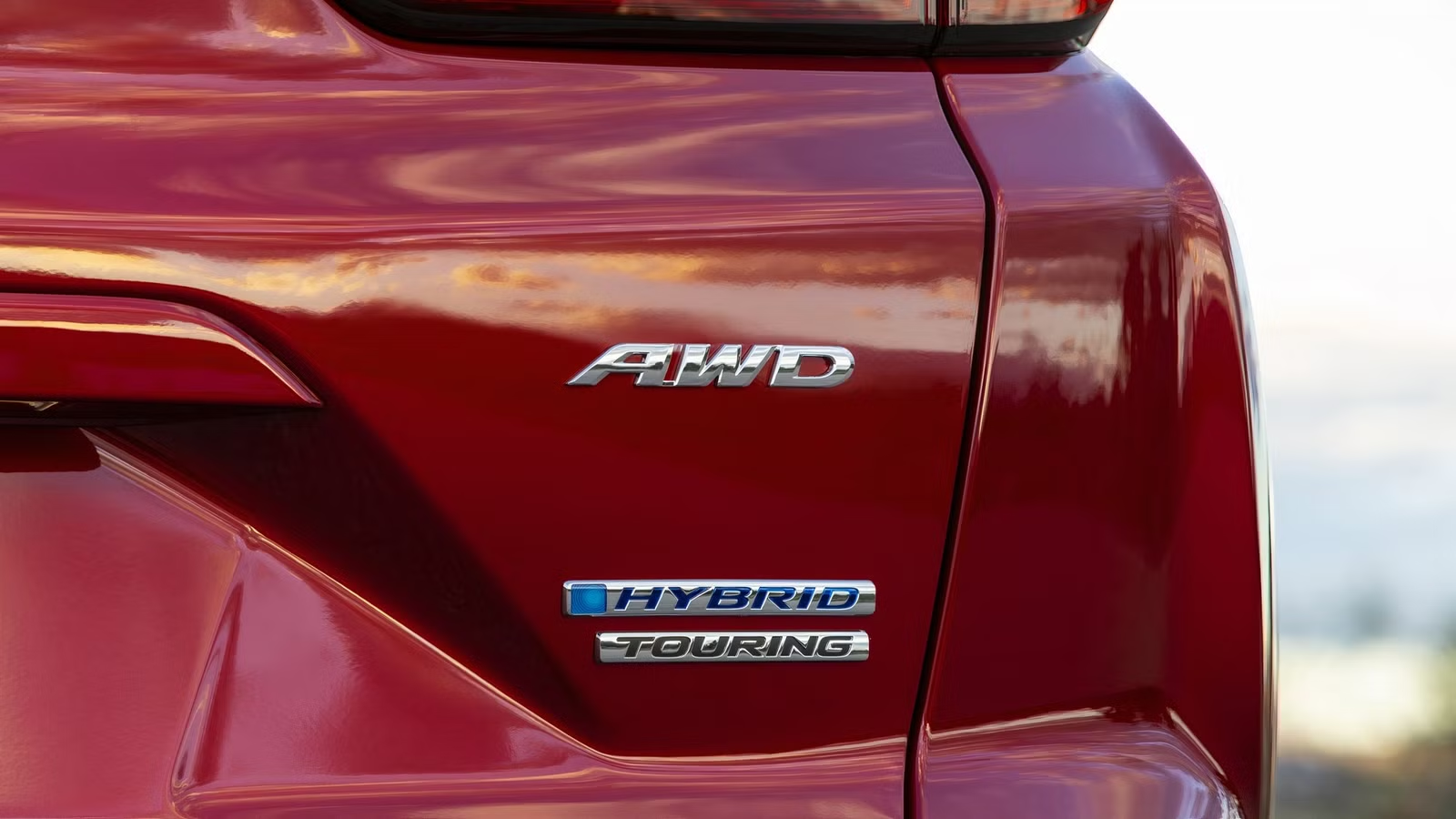
The AWD Hybrid version pushes efficiency further, securing an impressive 40/35/38 MPG. The standard gasoline models feature a 14.0-gallon fuel tank that yields a total calculated driving range of 420 miles for FWD models and 406 miles for AWD configurations. The Hybrid variant squeezes a range of 532 miles from the exact same 14.0-gallon tank.
2021 Honda CR-V Hybrid rear shotHonda
A standard 2021 CR-V costs $2.65 to $2.75 to drive 25 miles. This drops to $2.10 for the Hybrid. The ICE’s fuel consumption performance results in a manageable annual fuel cost of around $2,100 to $2,150 based on 15,000 miles of mixed driving. This frugal footprint translates to an estimated five-year fuel savings of $500 to $250 compared to the average new vehicle of its era for the gasoline models. Hybrid owners maximize their returns by saving $2,750 over a five-year ownership window.
Base Trim Engine
1.5L Turbo Inline-4 Gas
Base Trim Transmission
Continuously Variable Automatic (CVT)
Base Trim Drivetrain
Front-Wheel Drive
Base Trim Horsepower
190 hp
Base Trim Torque
179 lb-ft @ 2000 rpm
Fuel Economy
28/34 MPG
Make
Honda
Model
CR-V
Segment
Compact SUV
Infotainment & Features
8 /10
Sources: Honda, Edmunds, iSeeCars, KBB, RepairPal, J.D. Power, and the EPA.
