

When the classic muscle car era officially kicked off in the early 1960s, nearly every American automaker became professionally obsessed with building the largest or most powerful V8 possible. While some small-production engines had already exceeded 400 cubic inches by the 1960s, one of the first mainstream production engines to reach over 400 CID officially was Buick’s 401 Nailhead V8. Following close behind were larger engines such as Buick’s 430 CID V8 in 1967 and Chevrolet’s 454 CID V8 in 1970.
While many automakers were busy making performance engines for muscle cars, a couple sat on the sidelines. The automakers’ flagship marques, such as Cadillac, Lincoln, and Imperial, focused on smoothness rather than outright performance. Being strictly luxury nameplates, speed and handling were at the bottom of the priority list. However, this didn’t stop Cadillac from building the largest production V8 ever used in automotive applications, measuring in at a massive 500 cubic inches (8.2 liters). In addition, the huge powerplant saw use in an unlikely model: the front-wheel-drive Cadillac Eldorado.
The Epitome Of American Car Design
1970 Cadillac Eldorado finished in red with red interiorBring A Trailer
Quick Facts About The 1970 Cadillac Eldorado
- Marked the final year of the namesake’s eighth generation
- Closely related to the Oldsmobile Toronado
- Marked the only Cadillac to receive the 500 CID V8
- Produced the most torque of any mass-market automobile in 1970
- Built on GM’s E-Body platform
When it comes to famous makes and models, there’s an argument that the Cadillac Eldorado might be the epitome of mid-century automotive luxury. The nameplate first hit the streets in the early 1950s. At the time of its initial inception, Cadillac had just celebrated its 50th anniversary. A 1952 concept car created by the brand was built simply to commemorate the milestone. Still, plans to bring the aforementioned concept to life quickly came together thanks to an overwhelmingly positive public reaction.
The name “Eldorado” was chosen for the concept-turned-production model. The name itself is a combination of two Spanish words: “El Dorado.” The term was used to denote a mythical “Lost City of Gold”, reported to be somewhere deep in the vast Colombian jungle. When you think of it, naming a flagship Cadillac after a place of untold wealth makes some sense. The first Eldorado model rolled off the assembly line in early 1953.
From the Collection of Bidder “DDSEOE”Bring A Trailer
Almost immediately, the Eldorado became the face of Cadillac and a symbol of the American auto industry, alongside the Chevrolet Corvette. Loads of 1950s-era stars owned an Eldorado, including Elvis Presley, Marilyn Monroe, Frank Sinatra, and John Wayne. In 1959, the company introduced the fourth-gen model. The 1959 model’s prominent tail fins, long body, and jet-age styling became the very symbol of mid-century American motoring.
1967 cadillac eldorado front black and whiteCadillac
As the 1960s rolled around, car design became much sleeker and more minimalist, although the Eldorado managed to hold onto its ever-smaller tail fins until the 1965 model year, after nearly all other luxury models had abandoned theirs. That same year, the Eldorado adopted a pair of vertical headlights on either side of its front end, a popular mid-60s look. However, by 1967, the eighth-gen Eldorado came around sporting a much more hunkered-down and sporty look.
Related
The Most Beautiful Cadillac Ever Built Was Designed In Italy
A classic American Cadillac meets a time-tested and respected Italian designer, and the results are outstanding.
Little Fanfare For The Biggest V8
1970 Cadillac Eldorado finished in red with red interiorBring A Trailer1970 Cadillac Eldorado finished in red with red interiorBring A Trailer
The eighth-gen Eldorado marked a stark contrast in design to previous generations. Instead of a chromed-out land yacht, GM’s then chief of design, Bill Mitchell, chose to go in a sleeker, understated direction. This was also done to further distance the Eldorado’s styling from other E-Body platform mates, namely the Oldsmobile Toronado and the rear-wheel-drive Buick Riviera. In 1967 and 1968, the Eldo sported hidden headlights, with 1969 bringing back exposed ones along with a redesigned interior.
1970 Cadillac Eldorado finished in red with red interiorBring A Trailer1970 Cadillac Eldorado finished in red with red interiorBring A Trailer
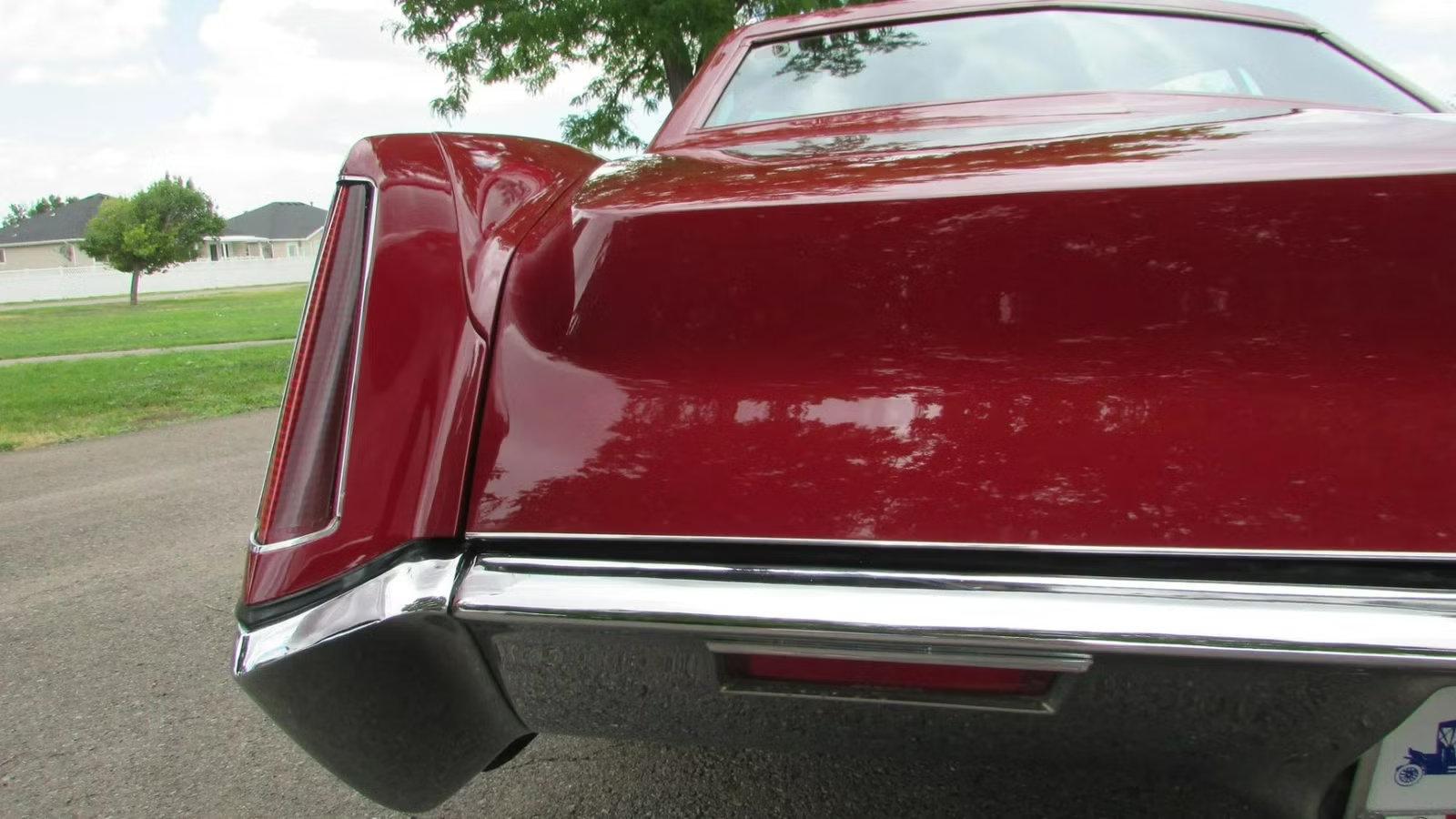
In the final year of the Eldorado’s eighth generation, styling upgrades were minimal. A new power sunroof produced by ASC was offered as an option, along with an anti-lock braking system called Trackmaster. The small tail fins seen on the 1967, 68, and 69 models were gone, effectively ending the finned Cadillac Eldorado era for good. Along with a couple of new options, the 70 Eldorado also came standard with luxury upgrades such as power windows, locks, and mirrors, as well as air conditioning and an upgraded radio.
That same year, Cadillac unveiled its biggest V8 ever, with a displacement of 500 cubic inches. Not only was the powerplant Caddy’s largest, the mill was also the biggest V8 ever fitted to a production car, an honor that it still holds to this day. However, unlike other brands advertising huge engines, the 500 CID Eldorado only sported a single small “8.2 Litre” badge on its front grille. Despite being the largest production V8 engine ever produced, it was only offered on the Eldorado.
Related
Ranking America’s Most Powerful FWD Cars
We’ve got quite a penchant for FWD power over here in the States.
How The World’s Largest V8 Gets On
1970 Cadillac Eldorado finished in red with red interiorBring A Trailer
At its core, the 500 CID mill was actually a 472-Series V8. The 472 CID engine was introduced in 1968, after Caddy’s 429 CID mill had reached its structural size limit. To make the 472 engine even larger, Cadillac engineers removed the crankshaft and replaced it with one that allowed a larger stroke, increasing displacement by 28 cubic inches. The 500 sported a compression ratio of 10.0:1 in 1970, along with a bore of 4.3 inches and a stroke of 4.304 inches.
1970 Cadillac Eldorado finished in red with red interiorBring A Trailer
Handling the gigantic motor’s high power output was GM’s Turbo-Hydramatic TH425 front-wheel-drive three-speed automatic transmission. The gearbox was heralded for its near-bulletproof build thanks to an oversized drive chain. The Eldorado and its front-wheel-drive companion, the Oldsmobile Toronado, needed wheels with positive offset due to the sheer size of the archaic yet robust front-wheel-drive drivetrain. The ’70 Eldorado’s suspension was a torsion bar setup in front and a leaf-spring setup in the rear. Stopping was handled by a pair of discs up front and drums at the back. Power-assisted brakes were standard.
1970 Cadillac Eldorado finished in red with red interiorBring A Trailer
Engine Details
500 CID (8.2L) NA V8
Horsepower
400 hp
Torque
500 lb-ft
0-60 MPH Time
9.6 seconds
Top Speed
125 mph
Curb Weight
4,721 lbs
*Specs courtesy of Curbside Classics & CarFolio.com
The figures above would have been extremely impressive back in the day, but looking at them now we can see how much the automotive world has moved on. The four-cylinder engine in the Mercedes-AMG C63 S E Performance produces 469 hp by itself. It’s one of the most power-dense engines ever made. Heck, even a Ford Mustang GT makes more power from a 5.0-liter engine.
Current Pricing
1970 Cadillac Eldorado finished in red with red interiorBring A Trailer
Despite containing the world’s largest production V8, the ’70 Cadillac Eldorado doesn’t go for all that much money in today’s market. According to Hagerty, a 1970 Cadillac Eldorado in good condition goes for roughly $17,400 on the open market.
A Short-Lived Legend
1970 Cadillac Eldorado finished in red with red interiorBring A Trailer
The 500 CID Caddy V8’s introduction in 1970 also marked the final year of the classic American muscle car era. The very next year, compression ratios were reduced to cope with unleaded fuel. However, by 1973, a whole host of new emissions regulations went into effect, forcing automakers to significantly reduce engine power by adding a litany of air-friendly gizmos, such as smog pumps and catalytic converters.
The 500 CID mill survived the initial onslaught of red tape. It remained exclusive to the Cadillac Eldorado until 1976, when the brand began installing it in all models except the Seville. However, ’76 was also the last year of the 500 CID V8. The next year, General Motors would begin downsizing across all of its subsidiaries. The reduction in size also extended to engines, as a 425 CID V8 replaced the big mill.
With its exit from the mortal stage, the 500 CID Cadillac V8 went down in history for its sheer size, although few remember it.
Sources: Curbside Classic, Hagerty, CarFolio
