

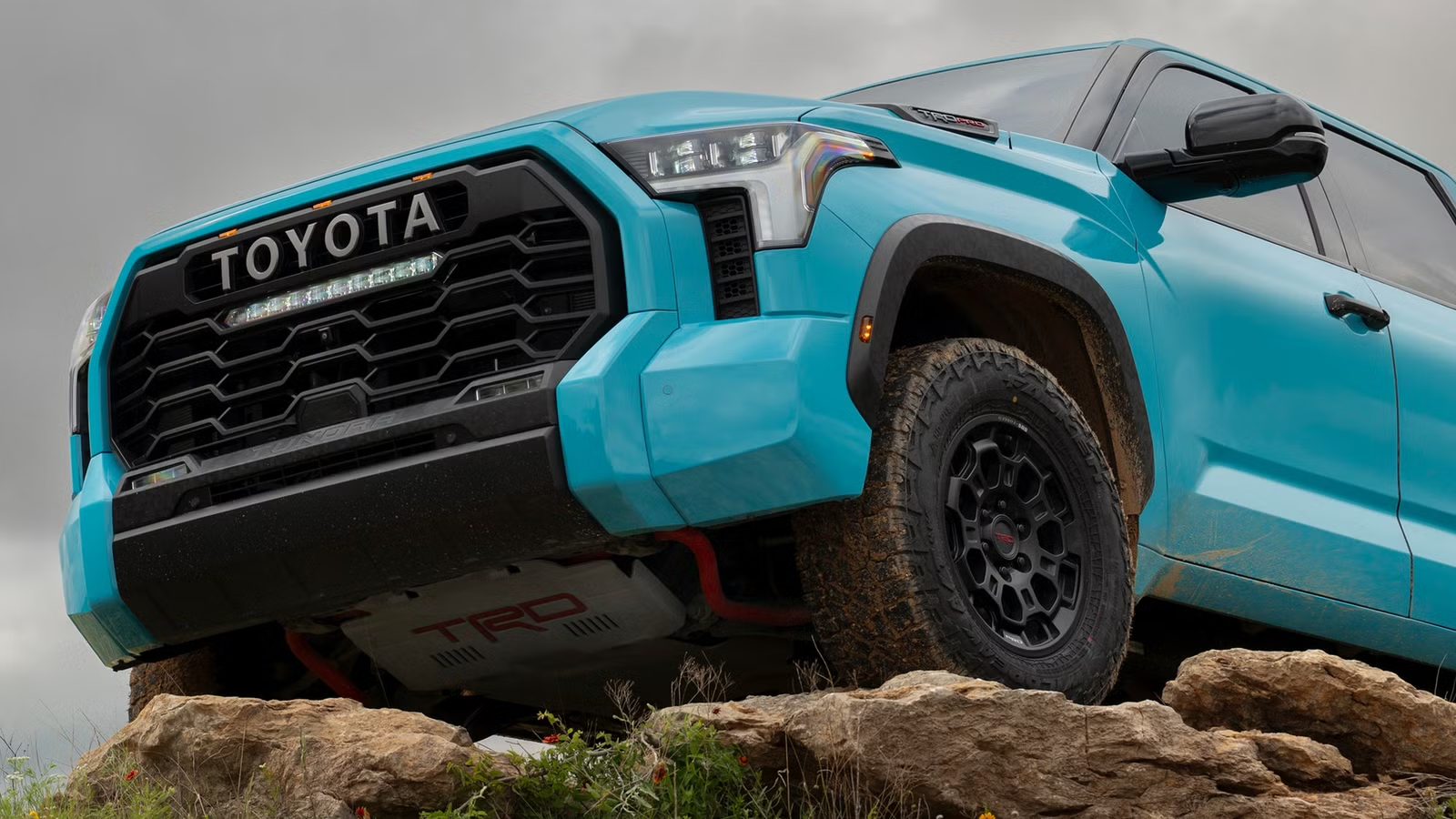
The word of the day is “lubrication”. For years, the Toyota Tundra was on an absolute hot streak, thriving on the dependability of its second‑generation 5.7‑liter V8, which had virtually no lubrication problems to speak of. That legacy is now in hot water, thanks to a third-generation truck with an all-new engine that’s been facing recalls nearly from its launch.
Toyota blames leftover manufacturing debris for the recall issue, but teardown specialists are painting a more dramatic picture of a lubrication vulnerability within. The clash between manufacturer and mechanic is reshaping the Tundra’s reputation, and quietly proving that owners who held on to their old-school V8 models were right.
Toyota Blames Manufacturing Debris
2022 Toyota Tundra Red Front Angled View DrivingToyota
Toyota’s next‑generation twin‑turbo V6, the V35A‑FTS, was an extremely important engine for Toyota, with large V8 shoes to fill. Not only is the new powerplant the heart of multiple Toyota and Lexus truck and SUV models, but it’s also the heart of Toyota’s advanced i-Force Max hybrid engine, which powers flagship versions of the Tundra. The hybrid version of the engine is not affected by the recall; more on that later.
So just what’s happening? From the driver’s seat, owners typically describe failures as sudden and major, often accompanied by an increase in engine noise and often (but not always) leaving them stranded. Usually, there’s no warning light before shutdown, and usually, the engine can’t be restarted after it dies.
One example comes from a Toyota Tundra Forum post. A 2022 SR5 Premium owner recounted being “two‑thirds of the way through a 180‑mile drive” when the engine began sounding louder than usual. After stopping for food, they noticed a “bad sound at idle and especially at low speed,” describing it as muffled. It persisted for over 70 miles. The next day, a Toyota dealer diagnosed the sound as rod knock, a fatal condition linked to the recall failure.
The owner noted that they were lucky they weren’t left stranded, and other commenters noted this unusual case of the engine standing up to continued driving, as V35A‑FTS failures are often reported to be more instantaneous. Usually, it’s a sudden loss of power with no prior warning, often while towing a trailer or during high-load or high-altitude driving.
2022-2025-toyota-tundra-i-force-max-trd-pro-front-3_4-2Toyota
Inside the engine, according to Toyota, manufacturing debris that is meant to be carefully cleaned out during engine block production may not have been. Imagine slim, splinter-shaped metal shards, small enough to go virtually undetected by the naked eye.
Even a small amount of these unwanted manufacturing remnants could form a fatal clog within the oil supply, cutting off lubrication to critical components. This was most likely to occur in high-stress situations where lubrication becomes even more critical, often resulting in catastrophic engine failure and significant collateral damage.
Visualize a crankshaft, propelled by the firing pistons above it, rotating at high speed deep within the bottom of the engine. The crankshaft spins rapidly and is acted on by tremendous forces, but it spins while locked into place because it’s clamped firmly into position by a series of bearings that fix it to the engine block.
Within these bearings is a microscopic film of engine oil that separates the smooth metal surface of the (rotating) crankshaft from the smooth (but fixed) metal surface of the bearing that holds it in place.
Tolerances between these two surfaces are incredibly small and highly engineered. A consistently pressurized flow of clean engine oil is crucial at these points of contact; even a slight disruption in oil supply can dramatically accelerate wear. A major disruption in oil supply, perhaps caused by an oil passage clogged by debris, can be fatal in seconds. Without oil between the surfaces, friction causes heat levels to skyrocket, metal surfaces fatigue and degrade, and the bearing damage wipes out the engine.
The Engine Toyota Chose To Replace A Legend (And Why That Gamble Is Failing)
The Toyota Tundra has an all-V6 powertrain range built around a twin‑turbocharged 3.4‑liter engine, which debuted under the hood of the third‑generation Tundra that arrived for the 2022 model year. The twin-turbocharged 60-degree V6 uses four cams and 24 valves with variable timing, as well as dual-injection fuel delivery which combines port and direct injection for each cylinder.
Output is rated at 389 horsepower at 5,200 rpm and 479 pound-feet of torque between 2,000 and 3,000 rpm, paired with a 10-speed automatic. The hybrid version – not covered by this recall – adds an integrated 48-hp electric motor, raising output to 437 hp and 583 lb‑ft of torque.
Applications for the non-hybrid version include the Toyota Tundra (2022–present), the Lexus LX600 (2022–present), and the Lexus GX (2024–present).
An engine this capable, powering vehicles this expensive, failing this catastrophically – and Toyota’s own fix keeps failing too.
This Recall Is Prompting Some Big Depreciation Hits
2022 Toyota Tundra Door badgeToyota
The first recall wave, filed under campaign 24V‑381, covered more than 102,000 units. Toyota acknowledged that machining debris obstructed oil flow to the #1 main bearing, causing rapid overheating and catastrophic engine failure. Even after introducing an “improved debris‑clearing process” in 2024, filings for the second recall, 25V‑767, revealed that the fix did not, in fact, fully eliminate contamination.
By the time the third recall, 26V‑320, was announced, Toyota again conceded that machining debris could still damage the bearing, expanding coverage to an additional 44,000 model‑year 2024 Tundras. That’s a bad look for the replacement of one of the most reliable pickups on the road.
Toyota Tundra Recall: At A Glance
- Toyota has issued a third major recall for its 3.4-liter twin-turbo V35A V6 engine, adding approximately 44,000 model year 2024 Tundras to the list.
- In its federal filings, Toyota admitted that previous manufacturing updates designed to clear machining debris from the engines failed to prevent the issue, stating that “remaining debris could be sufficient to cause damage to the #1 main bearing.”
- The total number of affected vehicles across the three recalls (May 2024, November 2025, and May 2026) now exceeds 250,000 units.
- Toyota has already replaced over 70,000 engines, but for newer recall waves, the company has shifted from automatic replacements to a software-based inspection that measures the resonant frequency of the crankshaft.
Complications have also arisen with replacement engines. Torquenews.comreported on owners who experienced trouble even after receiving new powerplants. One owner’s replacement engine overheated catastrophically due to an improperly bled cooling system refill, while another faced issues when the intake manifold was not properly secured by the technician, leading to further problems.
Toyota’s filings are sticking to identifying debris as the root cause, even as remedies evolve. More than 77,000 engines were replaced outright in the first recall wave, but newer campaigns are now directing owners toward a resonant‑frequency inspection that claims to detect bearing wear acoustically, as well as by referencing stored ECU data that reveals how hard the engine has been driven throughout its life. Toyota’s official stance remains that debris is the culprit, and that inspection‑based remedies can identify engines at risk without requiring mass replacements.
The market isn’t buying it, and second‑hand, third‑generation Tundras are suffering. Some dealerships will not even accept unrepaired models as trade-ins, while others are offering dramatically reduced values. As Toyota shifts to a software‑based triage system, electronic scans have started to determine the fate of affected Tundra V6s, and owners who earlier paid a premium for Toyota’s reputation are now seeing resale values fall instead. In fact, trucks cleared by software but not fitted with replacement engines can be worth as much as $9,000 less than comparable units that received new engines.
These are significant problems caused by very small pieces of metal. But is something else at play?
Experts Say A Design Flaw Created A Microscopic Battle This Engine Is Losing
2022 Toyota Tundra 1794 Edition Smoked Mesquite. Motion. On-road. Front, three-quartersToyota
Can manufacturing debris destroy an engine? Absolutely, but independent teardown specialists and mechanics are arguing that manufacturing debris alone does not fully explain the Toyota Tundra’s engine recall issues. After all, some engines outside of Toyota’s recall VIN range have suffered similar failures, and so have engines built during a stepped-up period of debris cleaning applied at the factory.
This made a few experts scratch their heads, so they started tearing down engines for a closer look. Now, some experts are raising concerns about a design flaw deep within the engine’s bottom end, where the crankshaft and its bearings reside in an environment of tremendous heat and pressure.
Though Toyota’s stance has always revolved around the debris explanation, evidence collected by multiple engine teardown experts seems to be pointing to a bigger issue: a #1 main crankshaft bearing that’s having trouble remaining in existence. By examining wear patterns and failed components from destroyed engines, experts say that signs point to a collapse of the critical microscopic oil film, specifically at the #1 crank main bearing surface.
According to these experts, various elements of the V35A’s architecture and construction have created an inherent weakness and sensitivity to load and lubrication pressure. To simplify: when the V35A is under maximum load, pressure and force that should be evenly distributed across the crankshaft and its bearings are unevenly concentrated toward the front of the engine, at the #1 crankshaft main bearing.
2022 Toyota Tundra Orange Rear Angled View Bed w/ Tailgate Down w/ Drop-in BedlinerToyota
The added pressure squishes the crankshaft against its #1 main bearing with too much force. This restricts the space for oil to flow around the bearing surface, preventing the adequate formation of that microscopic lubricating layer. This rapidly accelerates wear, with additional restrictions caused by metal debris speeding up this process. Sometimes, metal manufacturing debris is forced into the space between the crankshaft journal and bearing surfaces, effectively fusing the two together and destroying the engine in the process.
Hybrid models can suffer similar failures, but they are not covered by the recall in part because their electric motors allow the vehicle to be driven to safety even if the gasoline engine has already failed catastrophically.
That old 5.7-liter V8 suddenly looks wiser than ever.
Base Trim Engine
3.4L Twin-Turbo V6 Gas
Base Trim Transmission
10-Speed Automatic
Base Trim Drivetrain
Rear-Wheel Drive
Base Trim Horsepower
348 hp
Base Trim Torque
405 lb-ft @ 2000 rpm
Fuel Economy
18/24 MPG
Infotainment & Features
10 /10
Sources: TFLTruck, USA Today, CBS News, Motor1.com, Tundras.com, NHTSA, Torquenews
