

To win at international-level racing, manufacturers and teams that take part generally need to get creative in order to find advantages. In most series’, the technical regulations are developed to create as fair and level a playing field as possible, to help keep budgets and speeds under control. The World Rally Championship is no exception, though finding the balance between having an open development battle that’ll interest manufacturers, while having things close enough to keep competition tight and budgets under control, is particularly difficult.
The Group A rules looked to have found a happy medium, though Toyota illustrated that there were still ways to find a considerable advantage, despite the tight rule set.
Toyota Was Determined To Dominate The WRC
In 1993, the Toyota Celica ST185 WRC car got airborne during testing for the legendary Safari Rally, in Kenya. The iconic photograph was apparently staged by Toyota, with a test driver behind the wheel.Toyota (Reinhard Klein)
Having largely kept out of international rallying during the WRC’s wild Group B era, aside from developing a relatively uncompetitive rear-wheel-drive Supra racer, Toyota turned up with its ambition turned up to 11 when the Group A regulations turned up. It started using the Celica for the 1988 season, with the car securing its first podium finish in that year’s Rally of Great Britain. Following further development, Toyota’s ST165-based challenger ended up claiming a maiden win in Australia the following year, as well as second overall in the constructors’ championship.
The Japanese marque enjoyed further success over the next half-decade, with the team securing runner-up manufacturers’ titles until 1992, which complemented a pair of drivers’ titles for Carlos Sainz in 1990 and 1992. Toyota’s All-Trac all-wheel drive system was a key reason for this rise to prominence. It took a step forward with the ST185 Celica-based follow-up, building on a runner-up constructors result in 1992 with two consecutive championships in 1993 and 1994, while Juha Kankkunen and Didier Auriol claimed the drivers’ crowns across both years.
The Pressure Was On For Toyota To Remain On Top
toyota celica gt four st205 rear white rounding a cornerWikimedia Commons: Makary
Following several years of domination by Toyota, there was pressure from the manufacturer to continue its run as the likes of Ford, Mitsubishi, and Subaru all started to improve. By 1995, it was time for the third evolution of the Celica, on this occasion being based on the ST205 generation of the coupe, to take on the world’s rally stages. The trouble was, while more radical than its forerunners, Toyota struggled to get its head around setting the machine up. Mitsubishi and Subaru had won events before the Celica finally claimed its debut victory in the fourth round in France.
That said, Toyota looked to have worked out how to make its latest contender tick, as illustrated by the fact it led the manufacturers’ standings with just two rounds left, while its lead drivers were right in contention for the drivers’ title. As it turned out, there was another key reason as to why the Celica had proven so competitive versus its rivals.
Toyota Found A Way To Get Around The WRC Turbo Rules
1993 Toyota Celica WRC engine, top view, before the Turbogate scandal shocked the motorsport world.Toyota
In fact, rather than simply dial in the new ST205, Toyota had instead developed an ingenious trick with its turbocharger system. For context, the WRC forced each competitor to run a 1.3-inch air restrictor to the turbo inlet. This was enforced to prevent each car from exceeding the 400 horsepower mark, as following the dangerous Group B era, the WRC’s governing body wanted to keep speeds much lower to improve safety. Since the restrictor reduced the amount of airflow through the turbo, less grunt was produced.
Wanting to build a handy advantage over its competitors, Toyota’s engineers had come up with a way to get around the air restrictor to provide its Celicas with extra grunt under load. Essentially, Toyota tweaked the restrictor plate so that a small section of it would be pushed back when the turbo was under load, which would allow extra air to flow through into the turbo. It worked by using the standard steel cuff that kept the turbo hose clamped down, which could push a set of three washers within the turbo when under boost. When the washers shifted, they actioned the small mechanism built into the tweaked restrictor plate, thus opening the crescent-shaped subsection that Toyota had cut in.
The beauty of the hack was that, because it used components that would have been on the car anyway, nothing looked out of place. The tweaked restrictor didn’t rattle or move in any way to make it seem any different than a non-tampered-with component, and it only moved under the extreme pressure of the turbo at full chat. This meant it went undetected by the WRC’s technical team during each inspection, allowing Toyota to get away with it through the bulk of the 1995 campaign. It provided a hell of an advantage, too, since the extra airflow allowed the engine an extra 50 hp versus stock.
This Forward-Thinking Solution Found Its Way Onto The Road Version
Red 1994 Toyota Celica GT-Four side shotCollecting Cars
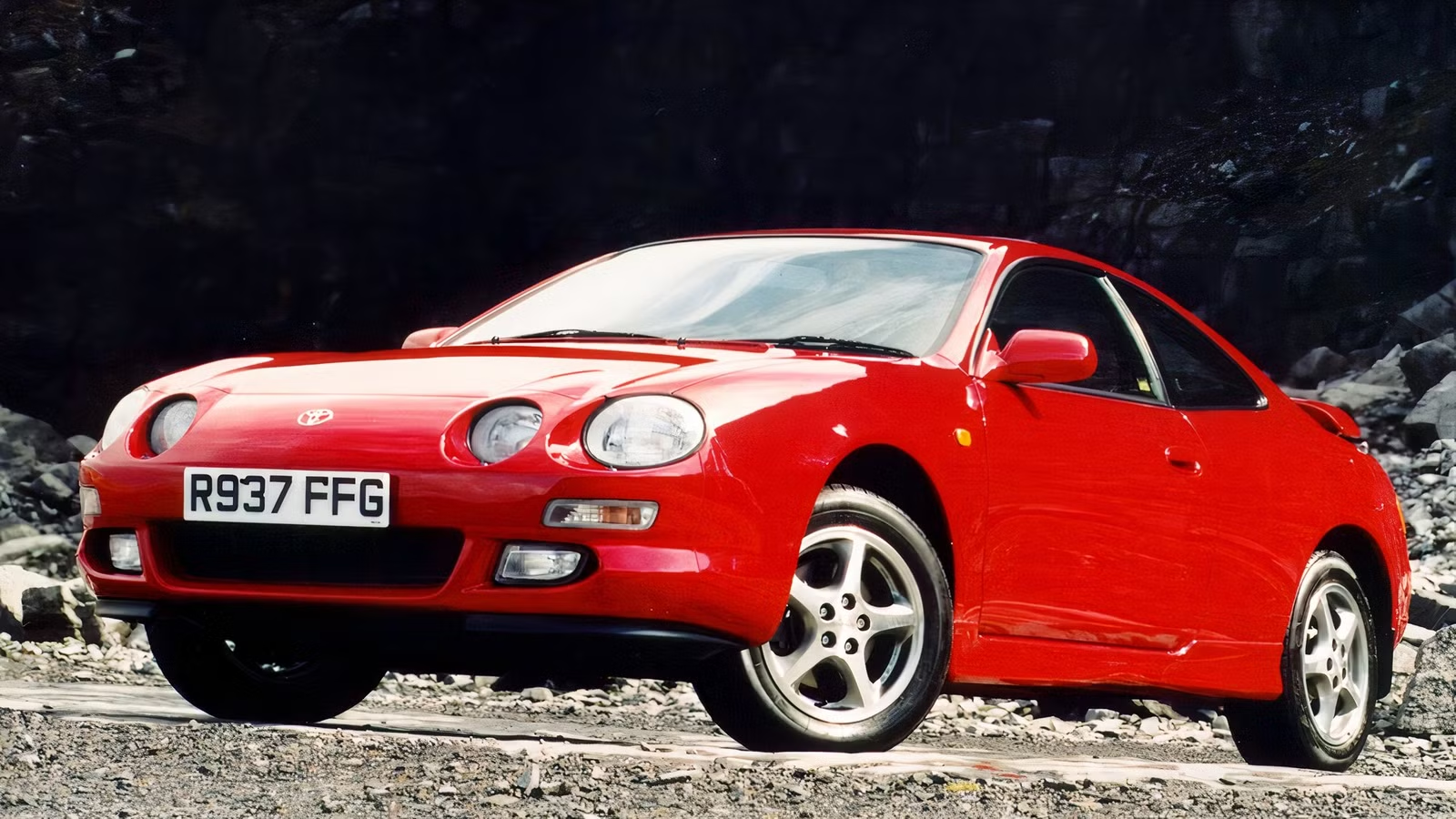
Interestingly, the basic engineering layout of the Group A Celica ST205 was also installed on the production version of the car, called the GT-Four. Group A regulations demanded that each manufacturer produce a minimum of 2,500 road-going examples of the rally car, which prevented brands from developing expensive tech that would never make its way into its road range, and thus kept racing budgets under control. As a result, the production Celica GT-Four was equipped with a road-tuned version of the 2.0-liter turbocharged 3S-GTE engine found under the hood of the Group A car.
To ensure the whole turbo design could be fitted to the rally machine in the first place, all the anti-lag pipework for the boosted turbo was left in place on the GT-Four. Toyota disabled the system in the road cars however, mainly as while it helped increase power and quicken up the throttle response, the anti-lag system could wreck a turbo in record time. The valve controlling the system was blocked off using a spot weld, while the electrical solenoids that ensured it could work were left uninstalled.
Due to the hardware being present though, it was possible for owners to get it all connected back up and working. It was a complex job, since not only did the weld need undoing, and the solenoids wired back into the ECU, but the ECU itself also needed reprogramming to allow for the system to work properly. Unless the car’s owner was particularly mechanically gifted, carrying out the process to get it all functioning was very expensive. Plus, unless you went further and replaced the turbocharger, it would probably blow up soon after anyway, making the whole thing pointless. Still, it’s a cool little easter egg that further illustrates just how awesome homologation specials are.
Toyota Failed To Get Away With Its Tricks
Toyota Celica GT-Four WRCToyota
While Toyota’s turbo shenanigans ensured it held an advantage over its rivals heading into the final couple of rounds of the 1995 WRC campaign, its luck of evading the WRC technical team eventually ran out. During an inspection carried out at the Catalunya round of the championship, the penultimate event, one of the FIA technical team pushed a little harder on the restrictor plate than normal while checking it out. He found that a portion of the plate face moved when the extra pressure was applied, which immediately raised suspicion.
Following a deeper inspection of the unit, the FIA uncovered Toyota’s little secret. The engineering job was so tidy that FIA President Max Mosley described it as “the most sophisticated and ingenious device I have ever seen in 30 years of motorsport.” Still, no matter how impressive the device was, the FIA had to take action. Toyota was thus disqualified from the entire 1995 season on the spot, losing all of its drivers’ and constructors’ points. Beyond that, it was banned from taking part in the remaining two events of the 1995 term, as well as the entire 1996 season.
The punishment was stiff, but the FIA needed to be seen to be making an example of a brand that went so far as to pull the wool over the eyes of the organization, as well as its rival manufacturers. Still, having served its suspension, Toyota returned in 1997 with its Corolla WRC, which would go on to claim the manufacturers’ title in 1999. Though this time, it didn’t need the help of an illegal turbo to do so.
If you want to try out the solution for yourself, perhaps getting out there and tracking down an original Celica GT-Four road car could satisfy your craving. Just make sure you budget for some extra turbos, because boy will you get through them.
Sources: Toyota.
