

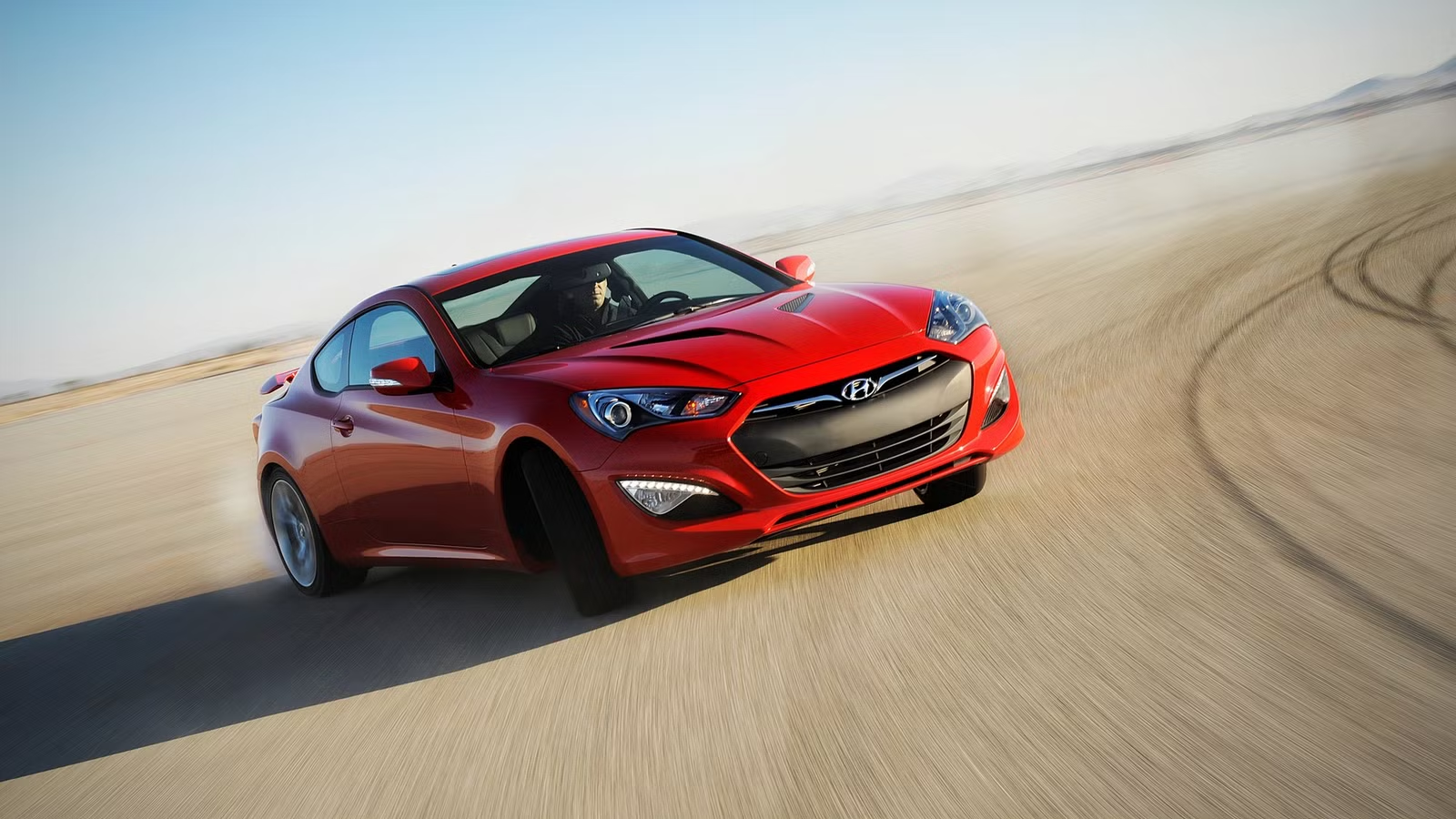
Grassroots drifting has increasingly turned to affordable rear-wheel-drive cars that offer a capable chassis and plenty of potential for modifications. Rather than spending a fortune on purpose-built competition machines, enthusiasts can start with inexpensive used cars and invest in the upgrades that matter most on the track.
V8 engine swaps have become an especially appealing route, combining an adaptable chassis with the torque, power potential, and extensive aftermarket support of American V8s. The result can be a formidable drift car that can challenge more expensive builds without requiring a high-end factory performance car.
The Hyundai Genesis Coupe Is Becoming A Budget Drifting Favorite
The 2010-2016 Hyundai Genesis Coupe offers an appealing starting point for drift builds, thanks to its front-engine, rear-wheel-drive layout and availability on the used-car market. Unlike more expensive sports cars, it can provide a relatively affordable platform for enthusiasts who want to develop a dedicated track machine. Used examples can sometimes be found for less than $9,000, although prices vary with mileage, condition, model year, and trim.
Choosing an affordable donor also leaves more money available for the modifications that matter. Builders can allocate their budgets toward adjustable suspension components, steering upgrades, safety equipment, differential improvements, and engine modifications rather than spending most of their funds on the car itself. A well-chosen example can therefore offer a practical foundation for a progressive build, allowing owners to upgrade components as their driving skills and competition ambitions develop. However, inspecting the car for mechanical problems and previous damage is essential to avoid unexpected repair costs.
Its Rear Suspension And Long Wheelbase Suit Controlled Drifting
The Genesis Coupe’s independent multi-link rear suspension gives drift builders several adjustment points for fine-tuning how the car responds under acceleration, braking, and lateral loads. Changes to alignment, spring rates, dampers, and suspension geometry can help drivers manage grip transitions and maintain a consistent slide. The 111-inch wheelbase also provides a useful foundation for balancing rotation and stability, although the final result depends heavily on setup and driver input.
These characteristics make suspension development an important part of preparing the coupe for competitive drifting. Certain Genesis Coupe trims were also available with Brembo brakes, providing a stronger starting point for managing repeated braking demands. However, performance depends on the condition of the calipers, rotors, pads, and fluid, as well as suitable tires and brake cooling. Track-focused builds may require additional upgrades to withstand sustained high-speed use.
The Factory 348-HP V6 Already Delivers Serious Performance
The Genesis Coupe’s 3.8-liter V6 makes a compelling case for keeping the factory engine, particularly in later models equipped with gasoline direct injection (GDI). For 2013, Hyundai introduced an updated 3.8-liter engine rated at 348 horsepower and 295 pound-feet of torque when paired with the eight-speed automatic transmission or a six-speed manual transmission. That output gives aspiring drift drivers a useful performance baseline without the additional expense and complexity of an immediate engine conversion.
The used market can make these cars even more attractive, with some running examples advertised below $9,000. However, that price is not guaranteed: model year, mileage, mechanical condition, trim, and regional demand all influence asking prices. Buyers should also budget for maintenance and track preparation, since a low purchase price alone does not guarantee a reliable competition car.
LS V8 Swaps Bring The Torque Needed For Aggressive Drift Builds
Replacing the factory V6 with a GM LS-family V8 can transform the Genesis Coupe’s power delivery, with engines such as the 5.3-liter and 6.0-liter variants offering substantial displacement and considerable torque potential. Depending on the specific engine and modifications, an LS swap can provide the wheelspin needed to sustain long corners and link consecutive turns without relying on high engine speeds. The result, however, depends on gearing, differential setup, throttle control, and tire choice rather than horsepower alone.
The conversion also involves significant engineering work. Builders must account for engine mounts, exhaust clearance, cooling capacity, fuel delivery, wiring, and compatibility with the chosen transmission. The added engine mass can affect weight distribution, making suspension adjustments important after installation. Parts, fabrication, labor, and troubleshooting can quickly increase the overall cost, so a properly planned conversion requires more than simply fitting a V8 into the engine bay.
Off-The-Shelf Swap Parts Make Building A V8 Genesis Easier
A growing selection of aftermarket components can make an LS-powered Genesis Coupe more achievable than a conversion requiring extensive one-off fabrication. Purpose-built engine mounts help position the V8, while compatible wiring harnesses and engine-management solutions can simplify electrical integration. Supporting parts, including transmission adapters, oil-pan solutions, and cooling components, can further reduce the need to design every detail from scratch.
However, compatibility varies by engine, transmission, and model year, so builders should confirm fitment before purchasing parts. Steering and suspension upgrades also play an important role in preparing the coupe for drifting. Aftermarket angle kits can increase steering lock, helping drivers catch slides at greater angles, while adjustable coilovers and alignment components allow changes to camber, toe, and ride height. These adjustments help tailor the car’s response to individual driving styles and competition rules. Careful setup remains essential, since more steering angle alone doesn’t guarantee better control or faster transitions.
A Properly Built Genesis Coupe Can Become A Formidable Drift Competitor
A well-developed Genesis Coupe can bring together a carefully prepared chassis, a suitable powertrain, increased steering lock, and a suspension setup tailored to the demands of competitive drifting. Rather than purchasing an expensive, factory-built performance car, builders can develop the platform in stages, prioritizing the upgrades that deliver the greatest benefits for their budget and experience level. The key is creating a cohesive package where the engine’s output, steering response, and suspension work together.
Competitive success requires more than a powerful engine or extensive modifications. Driver skill, differential selection, alignment, tire management, and consistent reliability all influence performance during a judged run. Builders must also ensure their cars meet the technical and safety requirements of the series in which they compete. Ultimately, a thoughtfully engineered car with a dependable setup can be more effective than a higher-powered build that lacks balance, consistency, or adequate preparation.
Base Trim Engine
3.8L V6 Gas
Base Trim Transmission
6-Speed Manual
Base Trim Drivetrain
Rear-Wheel Drive
Base Trim Horsepower
348 hp
Base Trim Torque
295 lb-ft @ 5100 rpm
Fuel Economy
17/24 MPG
Segment
Midsize Coupe
Sources: Hyundai, Formula Drift, Cars.com
