

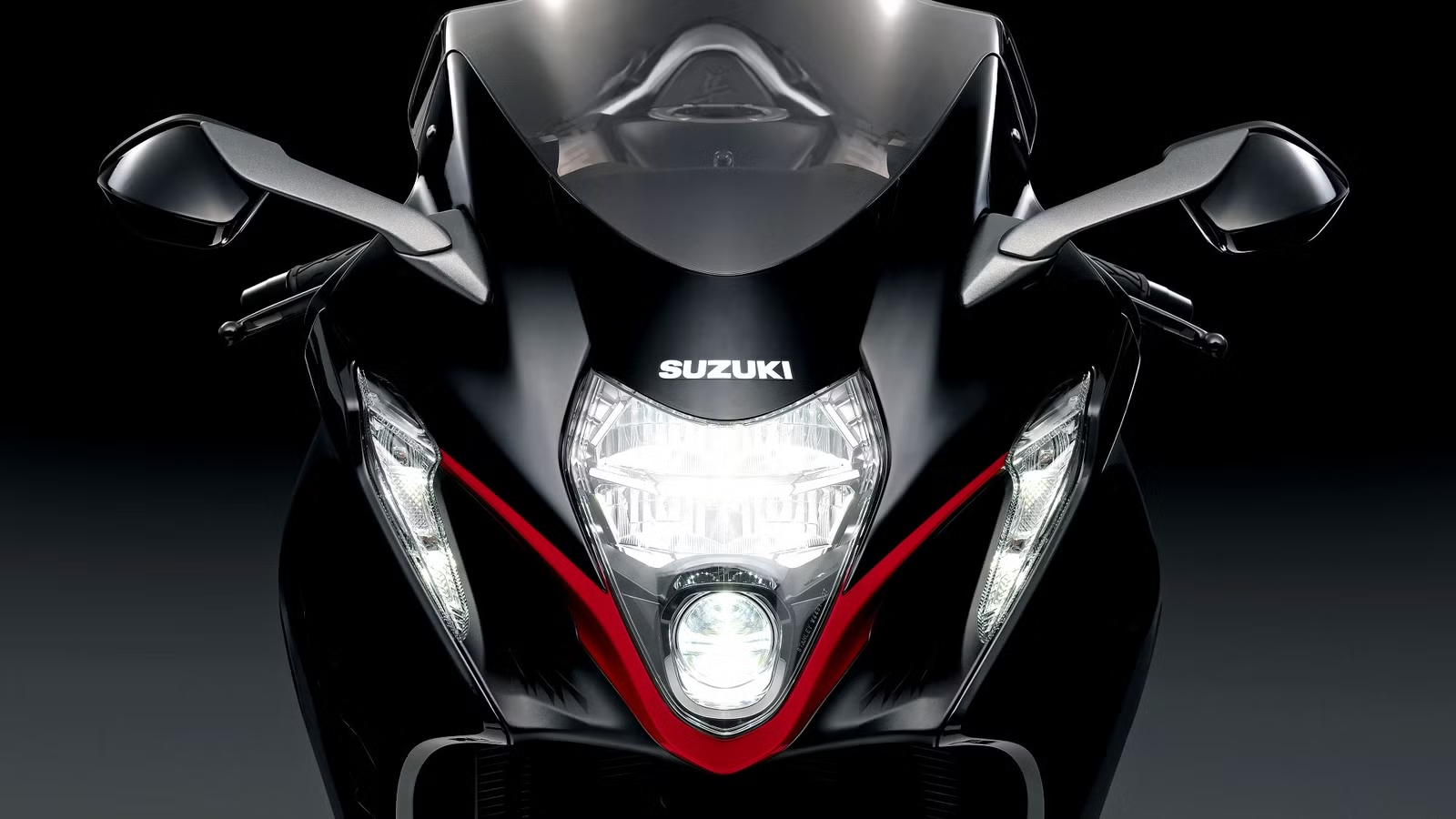
Some motorcycles overwhelm riders with brute force, but the very best high-performance machines deliver astonishing speed in a way that feels smooth, stable, and almost deceptively easy. What separates a truly great sports bike from the rest isn’t just how fast it can go, but how it makes that speed feel to the rider.
The most memorable machines aren’t always the loudest or most aggressive, but the ones that combine power with poise, turning extreme performance into something surprisingly approachable. They blur the line between thrilling and comfortable, allowing riders to tap into high speed without feeling overwhelmed or out of control.
UPDATE: 2026/07/03
We have updated this article with more information on the bike’s primary rival.
Why Some Sports Bikes Can Feel Faster Than They Actually Are
Aprilia
Speed isn’t just a horsepower number on a spec sheet. A motorcycle can feel frantic at a moderate pace if the throttle’s sharp, the chassis is nervous, the wind protection is poor, or the riding position makes every mile feel like a small wrestling match. That sensation can be exciting, but it’s not the same thing as true high-speed composure. The bikes that feel genuinely fast in the real world are the ones that stay calm while the scenery starts moving very, very quickly.
Aerodynamics play a huge role here, especially once the speedometer climbs into serious territory. A tucked-in fairing, planted front end, long wheelbase, and predictable suspension setup can make a motorcycle feel less dramatic at speed, even when it’s covering ground at an absurd rate. That’s why the fastest-feeling bike isn’t always the most powerful one. Sometimes, the machine that lets the rider relax a little is the one that ends up going quickest.
Confidence Is The Real Performance Multiplier
Rider on a Kawasaki Ninja ZX-10R at the trackKawasaki
A motorcycle only gives you access to the performance you’re comfortable using. If the front end feels vague, the throttle response is abrupt, or the bike moves around too much underneath you, even experienced riders will leave a lot on the table. Confidence changes that equation. When a motorcycle feels settled, predictable, and communicative, the rider can trust it enough to roll on harder, brake later, and carry more speed without feeling like every input is a dare.
Related
The Motorcycle That Proves Suzuki Still Knows Best
This Suzuki is a legend in the motorcycle world, but what makes it truly stand out is its ability to remain relevant and desirable even today
Building A Motorcycle That Doesn’t Fight The Rider
2026 GSX-S1000GT+ cornering smoothly with a passenger, front third quarter cinematic shotSuzuki Cycles
The engineering behind effortless speed is less about making everything sharper and more about making everything work together. A longer wheelbase helps stability. Refined suspension keeps the tires connected to the pavement. Aerodynamic bodywork reduces the amount of punishment the rider takes from the wind. A broad, smooth engine lets the bike surge forward without needing constant gear changes or dramatic rpm. The goal isn’t to remove excitement, but to remove unnecessary friction between the rider and the road.
The Suzuki Hayabusa Makes Speed Feel Effortless
2026 Suzuki Hayabusa cornering hardSuzuki Cycles
The Suzuki Hayabusa best captures this idea, and has done so for more than two decades now. When it arrived in 1999, it became famous as one of the fastest production motorcycles in the world, but its legend was never built on speed alone. What made it different was the way it delivered that speed. It wasn’t a nervous race replica with lights. It was a big, aerodynamic, long-legged hypersport machine designed to stay composed when most motorcycles started to feel busy.
That identity has carried into the current model, which starts at $19,499 in the US. The latest Hayabusa still uses a 1,340cc liquid-cooled, DOHC inline-four with an 81.0 mm bore, 65.0 mm stroke, 12.5:1 compression ratio, fuel injection, and ride-by-wire throttle bodies. Output is rated at about 187 horsepower and 110 pound-feet of torque in global trim, routed through a six-speed constant-mesh transmission, a Suzuki Clutch Assist System-equipped wet multiplate clutch, and chain final drive.
Engine
1,340 cc liquid-cooled DOHC inline-four
Output
187 horsepower and 110 pound-feet
Transmission
6-speed constant-mesh, bi-directional quickshifter, chain drive
0 to 60mph Time
Around 2.7 seconds
The Latest Hayabusa Is Better Than Ever
2026 Suzuki Hayabusa cinematic shotSuzuki / Valnet
Before getting into the clever stuff, the physical package explains a lot. The current Hayabusa has a 58.3-inch wheelbase, 23-degree rake, 3.54 inches of trail, 31.5-inch seat height, 4.9 inches of ground clearance, and a 5.3-gallon fuel tank. Curb weight is listed at 582 pounds, which sounds hefty beside a liter-class superbike, but that mass is part of why it feels so planted at speed. It isn’t trying to be a featherweight track toy. It’s built to cover distance with authority.
Frame
Twin-spar aluminum frame
Suspension
Fully adjustable KYB inverted fork, fully adjustable KYB link-type rear shock
Brakes
Brembo Stylema 4-piston front calipers with twin discs, Nissin 1-piston rear caliper, ABS
Wheels and Tires
17-inch wheels; 120/70ZR17 front, 190/50ZR17 rear
Wet Weight
582 pounds
2026 Suzuki Hayabusa electronicsSuzuki
The hardware is backed by a deep electronics suite called Suzuki Intelligent Ride System. It includes Suzuki Drive Mode Selector Alpha, power mode selection, traction control, anti-lift control, engine brake control, launch control, cruise control, a bi-directional quickshifter, and an active speed limiter. A Bosch six-axis IMU supports systems such as Motion Track Brake System, Slope Dependent Control, Hill Hold Control, linked braking, and ABS. There’s also LED lighting and a TFT display between classic analog gauges.
Safety Features
ABS, Motion Track Brake System, Slope Dependent Control, Hill Hold Control, linked braking, traction control, anti-lift control
Electronic Features
Ride-by-wire throttle, Suzuki Intelligent Ride System, ride modes, power modes, engine brake control, launch control, cruise control, quickshifter, active speed limiter, TFT display, LED lighting
The chassis keeps the same composed theme. Up front, the Hayabusa uses an inverted telescopic fork, while the rear gets a link-type single-shock setup. Braking comes from Brembo Stylema four-piston front calipers with twin discs and ABS, plus a Nissin single-piston rear caliper. Tire sizes are 120/70ZR17 up front and 190/50ZR17 at the back. The bodywork remains unmistakably shaped by the wind, with Suzuki Ram Air Direct intakes feeding the engine as road speed builds.
It’s More Than A Straight-Line Speed Machine
The easy joke is that the Hayabusa is only for highway pulls, but that undersells what this motorcycle has become. No, it isn’t a tiny supersport built to flick through a go-kart track. It’s a large, powerful, stable machine that rewards smooth inputs and flowing roads. Its size gives it presence, but it also gives the rider room to settle in. That matters when the goal isn’t just one explosive burst of acceleration, but hours of fast, controlled riding.
That’s why the Hayabusa has always had a strong sport-touring streak. The wind protection is real, the engine doesn’t need to be thrashed, the seat height is manageable, and the 5.3-gallon tank gives it useful range. Cruise control makes highway stretches easier, while the quickshifter keeps the ride clean when the road opens up. It can commute, tour, carve sweepers, and embarrass plenty of supposedly sharper machines when the pace gets serious.
The Fastest Motorcycle Isn’t Always The Most High Tech
2026 Suzuki Hayabusa traction control in workSuzuki
The Hayabusa’s lasting appeal comes from the fact that it doesn’t confuse intimidation with excellence. There are motorcycles with more aggressive ergonomics, more track-focused suspension, and more exotic spec sheets. There are also bikes that make speed feel harsher, busier, and more demanding than it needs to be. The Hayabusa takes a different route. It makes enormous performance feel organized, which is a much harder trick than simply making a motorcycle loud, stiff, and angry.
The Hayabusa Isn’t The Only Bike Of Its Kind
The Hayabusa isn’t the only hypersport bike that makes ridiculous speeds feel effortless; it has had a very close competitor from Kawasaki for quite a while. The Ninja ZX-14R, originally introduced as the ZX-14 in 2006, was a direct response to the legendary Suzuki Hayabusa. The green hypersport was designed to dethrone the Hayabusa by offering larger displacement, sharper styling, and more refined power delivery. For fans of the ZX-14R, the bike has succeeded in doing that.
Kawasaki Ninja ZX-14R riding on the highwayKawasaki
Kawasaki likes to call the ZX-14R the King of the Quarter Mile, and that credit goes to its inline-four engine. Displacing 1,441cc, this four-banger engine dishes out 197 horsepower — 10 more ponies than the Hayabusa — and 116.5 pound-feet of torque. This engine is celebrated for its creamy smooth power delivery and massive low-end torque. According to reports, the ZX-14R is also quicker than the Busa in both 0-to-60-mile-per-hour sprints and quarter-mile, achieving a low-to-mid 9-second range in the latter.
Kawasaki
Owners claim the Ninja ZX-14R also offers a slightly more relaxed riding position, but in terms of tech, it remains more traditional and analog, with only power modes, ABS, and traction control present. While the Hayabusa has always been in the spotlight for being the go-to large-displacement hypersport bike, the ZX-14R is no less of a serious sports bike that makes high speed feel effortless. The ZX-14R is a no-brainer if you’re only after performance, but the Hayabusa still trumps it thanks to its modern electronics package and a more well-rounded riding experience.
Related
The Motorcycle With Low-Stress Ownership And High-End Performance
The Hayabusa-killer can also be dependable enough for over 100k miles.
Why The Hayabusa Has Become A Legend Beyond The Factory Floor
A black 2004 Suzuki Hayabusa parked in a barn, front third quarter studio shotBring a Trailer
The Hayabusa’s legacy isn’t built solely on what it delivers straight from the showroom. Few production motorcycles have developed an aftermarket following as extensive as Suzuki’s flagship hyperbike. For more than two decades, it has been the platform of choice for drag racers, land-speed competitors, and custom builders, thanks largely to the incredible strength of its engine and drivetrain.
That popularity has created an ownership advantage that many rivals simply can’t match. Whether an owner is looking for luggage systems, touring accessories, suspension upgrades, comfort-focused ergonomics, or serious performance modifications, there’s an enormous catalog of proven components available. Unlike newer performance bikes that often require proprietary solutions, the Hayabusa benefits from one of the most mature aftermarket ecosystems in motorcycling.
Bring a Trailer
It also means finding knowledgeable mechanics and tuning specialists is rarely a challenge. Decades of development have resulted in a vast knowledge base, making maintenance, upgrades, and troubleshooting far more straightforward than on many newer high-performance motorcycles. For buyers planning to own a bike for years rather than seasons, that’s a significant advantage. The Hayabusa isn’t just easy to ride fast—it’s remarkably easy to personalize, maintain, and continue improving long after the initial purchase, which is one of the reasons it has remained relevant through three generations.
That’s why it remains one of motorcycling’s great icons decades after its debut. It still has the numbers, the presence, and the name recognition, but the real magic is how naturally it goes about its work. The current model is powerful, refined, aerodynamic, electronically sophisticated, and comfortable enough to use beyond the occasional full-throttle blast. It proves that the best high-performance machines don’t just chase speed. They make speed feel like something the rider can actually command.
Source: Suzuki Cycles
