

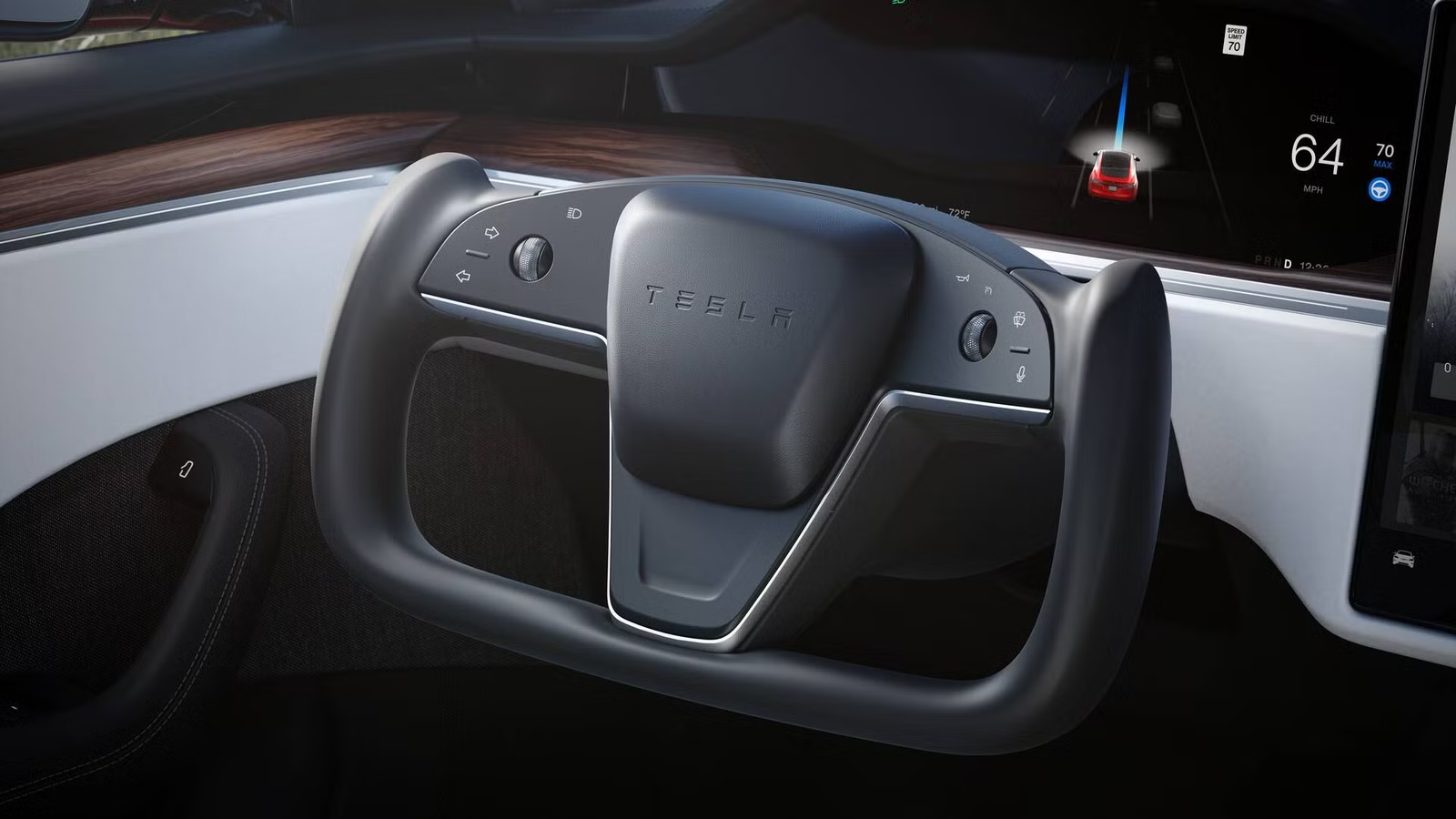
Tesla made quite a big deal out of its final Model S and Model X deliveries with a run of 350 invite-only Signature Series cars in May 2026. Buyers could also get excited about the white Alcántara, gold badging, and numbered dash plaque, and forget that they had to pay a five-figure premium over the previous, more “ordinary” cars. At the same time, Tesla made little mention of a feature that was making its last appearance. The steering yoke, fitted as standard on Model S and Model X cars, was quietly riding out of production, and many people were glad to see the back of it.
The Last 350 Cars Featured The Yoke
2026 Tesla Model S steering wheel and dashboardTesla
In 2025, Elon Musk had his eyes squarely fixed on his futuristic Optimus humanoid robots. He needed to clear the decks within some of his production facilities to focus on this kind of future and decided to give an “honorable discharge”—in his own words—to two Tesla models. This led to the company closing its order books for the Model X and Model S in April 2026, with roughly 600 cars in global inventory. Tesla then raised the prices on those survivors by $15,000, making the cheapest new Model S $109,990 and the costliest Model X close to $130,000.
In addition, Tesla promised its Signature Series as a proper send-off for both models. It would produce 250 Model S and 100 Model X in Plaid specification only, with the Model X in six-seat configuration exclusively. And each one of these cars had the controversial yoke, meaning that the very last S and X models shipped with that chopped-off steering wheel.
Five Years, Four Prices, and One Reversal
2021 – 2025 Tesla Model X interiorTesla
The yoke steering “wheel” arrived on the 2021 Model S and Model X as the only choice available. At the time, Elon Musk was adamant that Tesla would not provide a round wheel, although by early 2023 his company had made an about-face. The yoke was now a no-cost option, with the round wheel standard on both cars. Previous owners could also swap over to the round wheel if they paid a $700 retrofit charge through local service centers.
It is an indication of how the market regarded the yoke steering mechanism that this retrofit sold out within days. As it turned out, the yoke was part of quite a significant misstep by Tesla: when it introduced its 2021 Model S and Model X, those vehicles did not have any column stalks either. Tesla had migrated the turn signals, horn, lights, and wipers onto capacitive pads set into the hub, which did not go down well with the community. Eventually, Tesla would reintroduce mechanical horn versions for the yoke and the round wheel to try and reverse some of the criticism.
In the end, Tesla’s actions reveal a great deal about its yoke steering wheel experiment. It started off with a feature that was compulsory before making it free. It then decided to make it an extra option at $250 before raising that surcharge to $1,000. Perhaps it was trying to deter people from choosing it, but either way, the yoke also had its own quality problems. Some owners reported that its rim material would peel off at mileage as low as 4,000.
Tesla Mostly Pulled The Yoke A Year Before It Killed The Cars
2026 Tesla Model X Plaid side angle in red while parkedTesla
As time went by, Tesla started to quietly remove the yoke from its new car inventory. When the refreshed Model S and Model X came along in June 2025, they had revised suspension, a quieter cabin, a new front camera, and an additional $5,000 tag. But there was no sign of the yoke on the Long Range trims. Now, buyers could only get that option on Plaid models, and it still came at a $1,000 premium.
Technicians weren’t particularly happy if they had to retrofit a yoke device either, as swapping certainly wasn’t a straightforward unbolt-and-refit job. Those technicians would need to change the driver’s airbag at the same time because the round wheel and yoke airbags were not interchangeable at all. The technician would then have to run a dedicated gateway routine through Service Mode or Toolbox to reconfigure the car for the new wheel type. This was followed by a firmware reinstall, and it’s little wonder that a complicated retrofit would carry a $700 price to begin with.
By mid-2025, Tesla was only offering the yoke on a single trim of a soon-to-be-canceled model line. Eventually, when production of that model line stopped in May 2026, the yoke was no more.
The Steering Rack May Have Been A Bigger Problem Than The Yoke
2025 Tesla Cybertruck InteriorBrett. T. Evans/CarBuz/Valnet
An aircraft-style control like this is all very well if a driver barely has to move the steering wheel in most situations. But when a manufacturer attaches such a device to a conventional steering rack beneath, that raises some significant issues. After all, when drivers needed to execute a three-point turn or squeeze into a very tight parking space, they would typically have to turn the steering device multiple times. This often meant that they were reaching for part of a rim that simply was not there, which naturally led to a significant degree of frustration.
Other manufacturers, eventually including Tesla, knew that such a setup was problematic. When Tesla introduced its Cybertruck, it came with more of a squared-off wheel that some called a “squircle.” But it sat behind a steer-by-wire system that featured a variable ratio requiring less than one full rotation. Meanwhile, Lexus paired its one-motion grip yoke with steer-by-wire in the updated RZ. This only required 150 to 200° of total travel but, interestingly, only went on sale in Europe and Japan.
Mercedes confirmed in 2026 that its refreshed EQS would feature a flat-topped, concave-bottomed yoke, but it would also be aboard its first steer-by-wire model. Interestingly, Mercedes went considerably further on the engineering front, running two aircraft-style parallel signal paths for redundancy. The company would spend considerable effort testing its system, by all accounts racking up more than a million kilometers (621,000 miles) of testing.
While all of this was going on, Tesla never re-engineered the rack on its Model S or Model X models at all. Instead, it decided to retire its yoke, even as Mercedes was preparing to launch its own steer-by-wire version.
Beijing Seems Ready To Finish The Job
2027 Mercedes-Benz EQS sedan, yoke steering wheelMercedes-Benz
The long-term prospects for the controversial yoke are certainly in question in China. Here, the country’s Ministry of Industry and Information Technology intends to replace Rule GB11557-2011, which is a steering injury standard that has been in place since 2011. These new rules specify measurements at 10 defined points around the steering wheel rim, several of which are simply open air on a half wheel. The regulation strips out the technical provisions that previously accommodated such designs and thus leaves no defined compliance pathway for them.
Apparently, regulators are worried about the risk of a driver’s body traveling past the rim toward the dashboard in the event of a frontal impact. And if those rules do go into effect in 2027, as anticipated, manufacturers will not be able to homologate a yoke in the world’s largest car market.
The Wheel Tesla Actually Believes In
Tesla Cybercab white leather front cabin-1Tesla
Tesla’s own answer to the yoke debacle and the general steering wheel question appears in the CyberCab. This entered production at Giga Texas in spring 2026, but has no steering wheel, no pedals, and no manual controls of any kind. This is clearly how Tesla views the automotive industry of the future and, of course, makes a device like the yoke totally superfluous.
In the end, the yoke had a very ignominious life at Tesla, with the company trying to sell it to customers who mostly declined it. Tesla then tried to price it out of the market until the numbers did the talking, and eventually engineered it out of the Long Range cars a year before the program formally ended. Perhaps nobody noticed that the yoke had finally disappeared because it had already been disappearing for three years prior. And as Tesla managed to make the story about its two discontinued flagships much bigger and grander than whatever was bolted to their steering columns, the yoke just quietly vanished.
Sources: Tesla, Mercedes-Benz, Chinese Standards.
