

When we say diesel, you probably think of black smoke billowing out the top of a truck’s exhaust stack, or the workhorse Cummins diesel that tows like a train. You probably don’t think of sports cars and performance, but back in the 1970s, Mercedes-Benz wanted to change that. Their solution? Creating an engineering test bed that would smash speed records and prove to everyone that this fuel type was the future.
While diesel might not have taken off like Mercedes had expected, the C111 concept car is still one of the company’s most legendary prototypes and helped pave the way for diesel sports cars decades after. Here’s all you need to know about Mercedes’ record-breaking concept that looked like a spacecraft.
The C111 Isn’t A Single Car
mercedes-benz c111 multipleMercedes-Benz
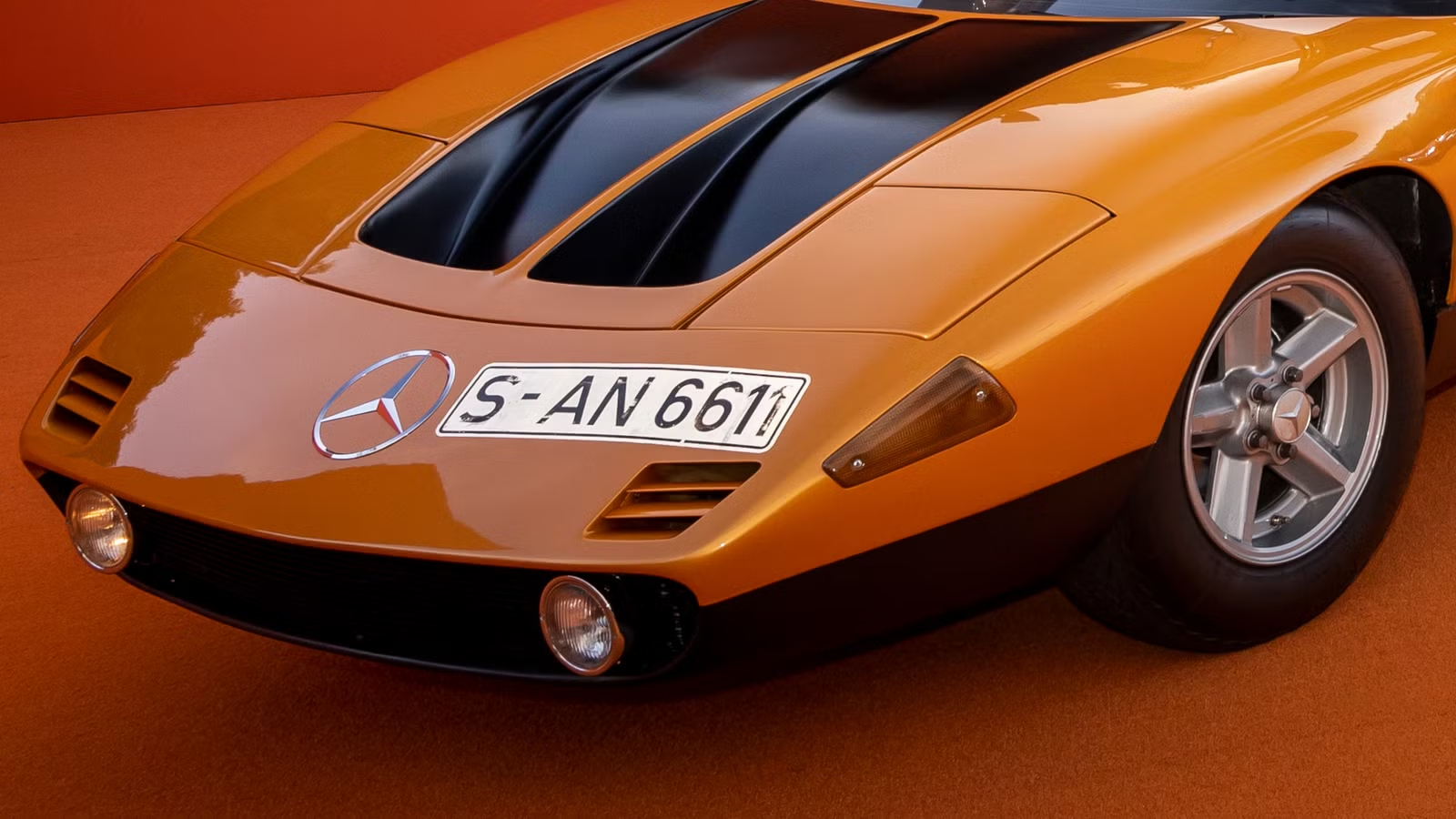
While we’re focusing on the diesel variant in this article, it’s important to know what the C111 series of cars is. Mercedes-Benz was always seen as a luxury brand in the 1960s, but engineering was still at the heart of the company, and it needed a place to test emerging technology in real-life conditions. Work began on the first C111 in 1967 before being unveiled at the 1969 Frankfurt Motor Show. The gullwing doors and bright orange paint caught eyes, but impressive tech lay under that surface.
mercedes-benz c111 interior gray driver’s POVMercedes-Benz
This first model used a three-rotor Wankel engine, which was still new technology at the time. Then, a year later, a C111-II came out and added a fourth rotor to the mix, upping power to an impressive 346 horsepower that gave it performance stats to beat out the Ferrari Daytona launched a year previous. The Wankel’s benefits were outweighed by the drawbacks though, and the 1970 oil crisis meant fuel-thirsty rotary engines went out of fashion.
It Wasn’t Just Engines The C111 Pioneered
While it’s the speed records that the C111 is famous for, it also improved other technologies that were new at the time. That includes a body made entirely from fiberglass. This material is lighter, easier to produce, and does not rust like metal, so engineers found it to be a great choice for creating this super-aerodynamic shape in the 1960s. There was also an advanced triple-wishbone rear suspension setup that was used later in Mercedes sports cars.
It Had A Humble Engine With Smooth Aero
1978 Mercedes C111-III streamlined diesel-powered concept carMercedes-Benz
Mercedes-Benz turned to diesel after abandoning rotary. This fuel type was seen as slow and too unrefined for road use, so they created the C111-IID to prove people wrong. They also used the bulletproof 3.0-liter OM 617 inline-five diesel, which usually only made under 100 horsepower in the company’s sedans. In this experimental car, though, Mercedes fitted a large turbocharger that pushed power up to 190 horsepower.
While the C111-IID was impressive, amassing a few records of its own, the C111-III is what really pushed the boat forward. Using the same engine now pushed to 230 horsepower, it could sit at high speeds comfortably in testing. That’s also down to the aerodynamics, which were super advanced for the time. It had enclosed headlights, a drag coefficient of 0.191 Cd (almost half of the modern Mercedes-AMG SLS).
While the iconic orange paint may have been removed, it utilized the famous silver arrow exposed metal to match the Mercedes cars of the time. It also sat much lower on the ground than the original C111 cars to improve aero efficiency.
It Smashed Record After Record
Mercedes-Benz C111-IIIMercedes-Benz
The diesel C111 cars are mainly remembered for how many records they smashed at the Nardo test ring. Here, the large circular track meant drivers could drive at top speed for hours on end to test the efficiency and roadholding of the world’s fastest cars. Between the earlier C111-IID and the C111-III, they broke records for not only diesel engines, but any car. It’s said that the C111-IID broke 16 records in 1976, but nothing compared to the C111-III.
This streamliner broke nine records, six in terms of distance and three for time over the near-eight mile ring. The first attempt ended in tears after a tire burst, but in the following test, four drivers ran consistently with a second car for over 12 hours. Fuel efficiency sat at around 12 mpg, and the car did 12 hours at almost 200 mph easily.
Mercedes-Benz would close out the C111 program with a 500-hp twin-turbo V8 gasoline engine after retiring the C111-III, conquering more records as it went. The V8 could sit at 250 mph on the same test track. It was the diesel that proved the most famous, though, and it proved that diesel wasn’t just for trucks.
How Diesel Became A Real Alternative In Performance Cars
Close
Europe has historically been much more open to accepting diesel fuel in passenger cars, so there are many cars that the US simply doesn’t get. Take the Volkswagen Golf GTD, for example, which is a GTI in all but engine. It can sometimes feel faster than the GTI in real-world conditions thanks to all that torque low-down, and its highway efficiency makes it a good choice for those who have a long commute but want to have fun on the weekend.
In fact, the entire Volkswagen group were smitten with diesel until the diesel gate scandal in the 2010s, with even Porsche and Bentley getting in on the action. You could even choose a Porsche Panamera with a diesel engine. We also all remember the Audi V12 TDI engine and Touareg V10 diesel engine — famed for their torque and pulling power. They weren’t super popular thanks to spiraling costs, but diesel still proved a worthy choice.
2009 Audi Q7 V12 TDI finished in white with black interiorAudi
Outside VAG, BMW created some M-lite cars that used powerful diesel engines, especially in their SUVs. These engines were well-suited when weight was a big factor. Mercedes-Benz never really focused on diesel sports cars after the C111, with the closest thing being the C30 CDI AMG, making the same power as the C111-III. While the days of diesel are numbered in many areas of the world, it still has many benefits in countries where it’s easily accessible.
Let’s not forget the diesel race cars, either, which have claimed wins at Le Mans thanks to superior fuel efficiency and torque when coming out of corners. A BMW 320d also won at the grueling 24 Hours of Nürburgring in 1998 for the same reason. In 1952, the first ever turbocharged and wind-tunnel designed Indycar also ran on diesel power, claiming pole position before retiring in the race.
Other Famous Mercedes-Benz Concepts
Close
Mercedes loves a concept car — especially when it’s trying to improve its on-road products. These concept cars might feel like vanity projects, but they’re important in unifying the brand into one design language or testing out new technology. One of the most recognizable examples is the recent Vision One-Eleven, which takes the C111 into the electric age. The ‘lounge’ interior is a big focus, with a large panoramic display and gullwing doors.
As more brands create electric vehicles, the race to cure range anxiety and ballooning weight is a great way to justify a concept’s development costs. The Vision EQXX is a great example, using new battery technology and a super aerodynamic shape to achieve over 750 miles on one charge, making it one of the most efficient electric cars ever built. Some of this long-range performance can be found in the latest CLA sedan, showing that prototypes for tech can directly link to new cars.
The Mercedes-Benz Vision EQ Silver Arrow.Mercedes-Benz
Some concepts don’t have much technical benefit, but they help us know where the brand is heading with its looks. The outlandish Mercedes-Maybach coupe design concepts directly inspired the latest Brabus Bodo grand tourer earlier this year, and before the first EQ line came out, Mercedes released a series of ‘Vision’ cars that helped steer the brand in one direction.
Sources: Mercedes-Benz, Hagerty, MercedesBlog
