

When families sit down at a kitchen table to work out their finances, they’ll want to know how much their car is going to cost going forward. And that number crunching can often throw up some interesting comparisons, which could certainly bring their vehicle’s value into perspective.
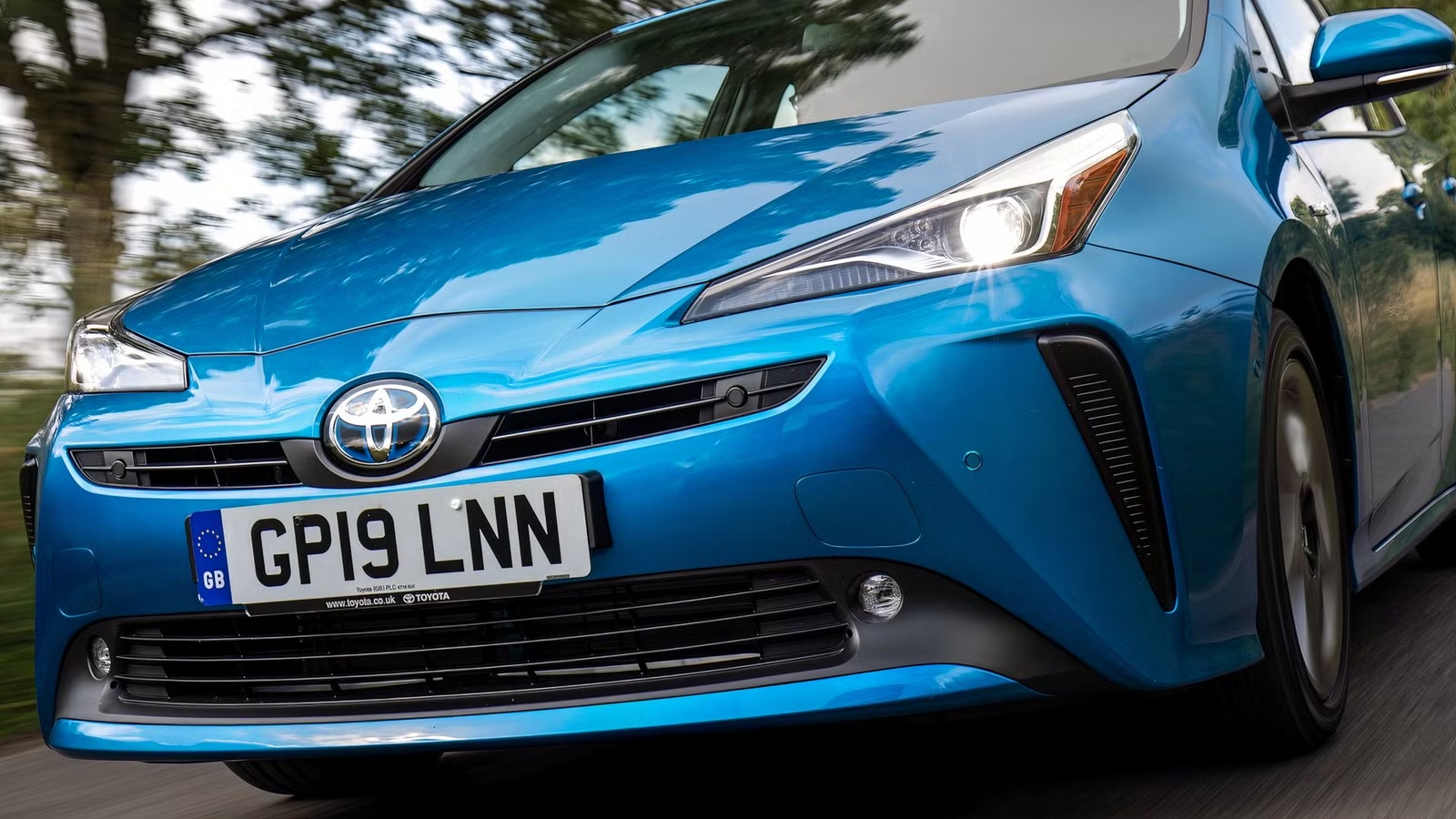
After all, those numbers may reveal that a 10-year-old car might not ask too much of its owners for the remaining useful years of its life. And an older Toyota Prius might only cost around $149 a month in value terms, which is about the same cost as a typical family phone plan.
The Prius Turns $12,688 Into Another 7.1 Years
2016-2018 Toyota Prius exteriorToyota
The online portal iSeeCars judges vehicles according to their average listing price and asks how much useful life that money might still buy. In its latest analysis of the 10-year-old Toyota Prius, it came up with some interesting figures. The Prius has an average list price of $12,688 and, according to iSeeCars, has another 7.1 years of predicted life. If you spread the purchase price across those years, the result is $1,791 per remaining year, which is the equivalent of a $149-per-month.
iSeeCars carried out a 2026 study to analyze the “Most Reliable Used Cars For The Money”, and this involved more than 900,000 used vehicles. Analysts also included odometer readings from around 400 million vehicles in their longevity research, and the net result for the ten-year-old Prius compares favorably with the used market as a whole. After all, iSeeCars suggests that the average ten-year-old vehicle sells for $14,195 and has 5.9 remaining years, which results in a much higher $2,415 price per remaining year. The Prius costs roughly 10.6% less to buy in the first place than the average decade-old car, but it offers 1.2 additional predicted years of life, which means that its price per remaining year figure is almost 26% lower.
There’s an even more interesting benchmark that covers ten-year-old hybrids and EVs specifically. Here, the average purchase cost is $12,978, with 6.9 predictive remaining years, and that works out to be $1,875 for each remaining year. And while the Prius isn’t radically cheaper when included in this group, it’s still about 4.5% below the segment average, with slightly more predicted life. Even better for the Prius, it enjoys some good durability credentials across the marketplace. Here, iSeeCars gives the model an 8.0 out of 10 reliability score, ranking it first out of hybrid cars for reliability.
iSeeCars Is Pricing The Life Left, Not The Years Already Used
2016 Toyota Prius VToyota
It’s important to understand the methodology used in this study, which goes beyond just the predictable reliability of the Prius itself. In everyday used car shopping, most people begin with age, mileage, and price. They will naturally treat the cheaper car in any comparison as having better value, unless mileage or condition gave them an obvious reason not to. But iSeeCars adds another dimension by assessing how much life is still left in a vehicle. It takes the average list price of the vehicle and compares it with its expected remaining lifespan to come up with its price-per-year figure.
In very basic terms, a $10,000 car that has five predicted years remaining works out at a nice, round $2,000 per year. A $13,000 alternative that has eight years remaining would be $1,625 per year. Despite costing a lot more up front, this doesn’t automatically make that second car the one to buy, but it does help show why a sticker price alone can be misleading.
$149 Per Month Is A Phone Plan, Not An Ownership Cost
2016-2018 Toyota Prius exteriorToyota
The numbers provided by iSeeCars can certainly bring a family spreadsheet exercise into perspective when the result appears alongside a phone plan entry. The first number to appear on the spreadsheet may be that $149.25 per month, reflecting the “value” of the Prius for every predicted year of its remaining life.
Another line of the spreadsheet may detail an AT&T phone plan, such as that company’s Extra 2.0 option, which is $40 per line when taking four lines. That’s equivalent to $160 a month, although taxes and fees could be additional and other small print could affect the end result. And that suggests that the Prius’ $149 monthly equivalent could genuinely sit below the cost of a mainstream, four-line family phone plan.
That said, it’s also important to remember that the $149 monthly equivalent is not the car’s annual cost of ownership. That figure won’t include fuel, insurance, repairs, maintenance, registration, tax, financing, tires, or any other running expenses. Then again, it doesn’t subtract whatever resale or scrap value an owner may get at the end of the car’s life either. Instead, it’s simply the purchase price divided across the predicted remaining lifespan, or to put it another way, the “value” that the owner may get out of the vehicle in the broadest terms.
Some Other Hybrids And EVs Beat The Prius On Cost Per Year
2015 Ford Fusion HybridFord
While Toyota’s reliability reputation is legendary in the industry, the surprising part of the iSeeCars study is that the Prius did not come out on top in a ranking of 25 ten-year-old vehicles. Among this cohort, the Prius actually sits in 24th place, tied with the Volkswagen Passat and while it does perform better relative to the overall average, several cheaper vehicles produce even lower price-per-year figures.
Among ten-year-old hybrids and EVs, the Prius comes in fourth place behind the Nissan Leaf, the Tesla Model S, and the Ford Fusion Hybrid. The Leaf comes in at just $1,108 per remaining year, mainly because its $5,675 average purchase price is extraordinarily low, but its predicted remaining lifespan is also only 5.1 years. Meanwhile, the Tesla Model S attacks the equation from the opposite direction. It’s much more expensive at $16,874, but buyers might get another 10.3 years of life.
Perhaps the Ford Fusion Hybrid is the most instructive result when compared to the Prius, at $10,016. It’s $2,672 cheaper to buy than the Toyota, and it has a 6.1-year expected remaining lifespan, which is a full year shorter than the Prius. However, its lower purchase price still pushes its cost per remaining year down just below the Toyota’s. It’s important to note that the Fusion Hybrid is not automatically the more reliable car. Here, iSeeCars‘ separate reliability analysis gives the Fusion Hybrid a 6.9 out of 10 score, with the Prius on 8.0.
All of these comparisons reveal what happens when you assess a vehicle’s value based on the intersection of reliability and price. And a car may be able to last longer and still lose this calculation if buyers are willing to pay enough of a premium for it.
A Five-Year-Old Prius Reveals Another Side Of The Equation
2021 Toyota Prius Prime ExteriorToyota
When buyers are looking at the younger end of the used car market, the Prius returns another interesting result, and in the five-year-old hybrid and EV group, the Prius actually ranks first. Here, it has an average list price of $21,040, an expected remaining lifespan of 8.9 years, and a price per remaining year of $2,354. This compares favorably to the category average, which is significantly higher, at $2,750 per year.
It’s important to remember that these figures represent two separate cohorts appearing at roughly the same point in the used car market. They’re not the same batch of Priuses tracked as they aged from five years old to ten years old. A shopper choosing between the two today is considering a younger cohort averaging $21,040 with 8.9 predicted years left versus an older cohort averaging $12,688 with 7.1 remaining years. The older group costs $8,352 less up front but gives up only 1.8 years in the study’s predicted remaining life calculation. Consequently, its purchase price per remaining year falls.
In any case, individual cars don’t age according to population averages. Factors like accident history, corrosion, maintenance, previous use, mileage, and hybrid system condition can all come into the picture and fully overturn what a statistical model suggests for the nameplate as a whole. But comparisons between five-year-old and ten-year-old cars aside, the study by iSeeCars does provide shoppers with an interesting set of statistics. Those shoppers don’t simply have to look at a ten-year-old car and think about how much of its life has already gone. Instead, they can ask how much life could be sitting in front of them and then work out how much they’re being asked to pay for it.
And those results should be generally favorable for a 10-year-old Prius. After all, the average purchase price is below that of the decade-old market generally, while the predicted remaining life is above it. And those two advantages work rather well together to generate an annualized purchase price figure that’s firmly in the territory of a family cellphone plan.
Sources: iSeeCars, Toyota, AT&T.
