

True story: the Ferrari F355 ruined my mom’s VCR. When I was a teenager in 1998, I rewound a specific segment of Motor Trend TV so many times that the idler assembly in the old Magnavox turned into confetti. The scene in question involved the then-new Ferrari 355 F1, complete with a fascinating five-valve-per-cylinder V8 that revved to the moon. Competitors including the latest 911, Viper and Lotus Esprit were also on hand for this top-speed test.
1996 Ferrari F355 GTS Michael Schumacher RM Sotheby’s
Of all the 90s dream cars in attendance, the on-camera presenters were trying to keep straight-faced as Ferrari’s little F129 V8 tempted them into childlike giddiness. Narrator Jim Scoutten paused the voice-over for a sound bite that every car enthusiast in North America would hear: during its top-speed run on the test track at Ford’s Arizona proving grounds, the 355 F1 passed the camera at close range, doing triple the speed limit at its redline, and leaving an F1-inspired scream in its wake.
Yellow 1997 Ferrari F355 F1 nose viewFerrari
This was the stuff of dreams for an aspiring young gearhead curious about why auto experts in the ’90s were getting so excited about Ferrari’s latest V8 engine design with not four, but five valves per cylinder. Nearly 30 years on, the sound, feel, and emotion of this now-extinct engine still gives its biggest fans goosebumps, and that’s exactly what makes it so special.
Only Two Automakers Ever Built A 40-Valve V8 – Here’s Why That Number Is So Strange
1997 Ferrari F355 F1 V8 engine sideFerrari
For a variety of reasons, the number five is an unusual one when it comes to car engine anatomy, namely because most car engines are built with even – not odd – numbers of components.
Most engines have four cylinders or six. Still, you’ll find plenty of five-cylinder power in today’s Audi RS3 and numerous other Quattro-rockets throughout the history books. Five-cylinder engines are rare occurrences in the marketplace, and five-valve-per-cylinder engines are even rarer. That’s especially true of eight-cylinder, five-valve (40-valve) engines, of which only two automakers ever partook – one being the previously-mentioned Ferrari.
1997 Ferrari F355 F1 front interior side viewFerrari
The five-valve engine was one of those rare and defining technical moments of engineering from an era when automakers were becoming masters of engine breathing.
In The 80s and 90s, More Flow Meant More Power
1997 Ferrari F355 F1 steering wheel with shift paddlesFerrari
Why the drive to more valves per cylinder? For years, engineers knew that improvements could be made to engines by helping them breathe more efficiently, drawing air and fuel in and expelling exhaust gases out faster and more thoroughly. Making it easier for an engine to breathe increases its ability to rev freely, to the benefit of horsepower. This allows smaller engines to perform like larger ones, helping engines downsize to the benefit of fuel efficiency.
Yellow 1997 Ferrari F355 F1 back endFerrari
Let’s start at two. For much of automotive history, engines had two valves per cylinder: an intake valve to let air and fuel in, and an exhaust valve to let spent combustion gases out. For a very long time, this is the way most engines were built, because simple two-valve engines were reliable and cheap to mass produce.
The two-valve engine never went extinct. Today, you can find popular two-valve engines across the market, including virtually every GM and Stellantis product with eight cylinders. Most Corvettes haveused a two-valve engine from day one, and continue to do so today. The Dodge Viper’s exotic V10 engine was also a 2-valve affair from start to finish.
The mighty Dodge Viper V10, with around 600 hp in the game, proved to be a highly successful endurance racing car.LBI Limited
Engines with four valves per cylinder were becoming a recognized high-performance standard by the mid-1980s. By this period, four-valve layouts were spreading across multiple performance segments, while Honda was transitioning from three-valve engines in the early 1980s to four-valve engines by 1987. Numerous sporty Honda and Toyota models had embraced four-valve technology by the end of the decade, nearly a full generation ahead of many Western automakers,according toAutoZine Technical School.
The Four-Valve Wave That Made Five Valves Feel Inevitable
- Ferrari 308 GTB Quattrovalvole (1982)
- BMW M635CSi (1983)
- Ferrari 288 GTO (1984)
- Mercedes 190E 2.3‑16 (1984)
- Saab 9000 (1984)
- BMW M5 (1985)
- Ferrari Testarossa (1985)
- Lamborghini Countach QV (1985)
- Volkswagen Golf GTI (1985)
Technologically, engineers knew that multi-valve engines were a big part of the solution, though the complexity and cost of mass-producing four- and five-valve engines kept them out of the mainstream for years.But in 1994, one automaker decided complexity and cost were irrelevant – and what they built redefined what a sports car engine could sound like.
Ferrari’s Five-Valve Future Seemed Certain In 1995
Michael Schumacher Blue Ferrari F355gtsRM Sotheby’s
Costs and complexity are no problem if you’ve got Ferrari’s F1 budget. With racing success translating to next-generation road car technologies, motorsport-proven 5-valve engines arrived in the Ferrari F355 and F50 for the 1995 model year. While the Ferrari F50’s 60-valve V12 served as its biggest technological statement of the era, the F355 brought that same five-valve-per-cylinder engineering to Ferrari’s V8 lineup. It boasted 375 horsepower and 268 pound-feet of torque while it took 4.5 seconds to reach 60 mph. Top speed was said to be 183 mph.
Michael Schumacher Blue Ferrari F355 GTSRM Sotheby’s
As the decade turned, these high-revving, five-valve powertrains evolved into their next iterations. The Ferrari F355 was replaced for the 1999 model year by the Ferrari 360 Modena, which successfully carried Ferrari’s 5-valve V8 into the 2000s. Meanwhile, development was already underway for the flagship supercar that would succeed the F50, though a 5-valve engine wasn’t in the cards.
1995 Ferrari F50 Sotheby’s auctionRM Sotheby’s/Jorge Guasso
When the brand’s next halo car, the Enzo, arrived for 2003, it switched back to a four-valve V12 engine instead of continuing with the F50’s 60-valve design. Shortly after, the Ferrari 360 Modena was replaced by the Ferrari F430 for the 2005 model year, with the new car swapping the five-valve V8 setup for a brand-new four-valve architecture.
1995 Ferrari F50 Sotheby’s auctionRM Sotheby’s/Jorge Guasso
Ferrari’s five-valve era spanned exactly a decade before winding down in 2004, ending a unique, high-revving chapter that wouldn’t be revisited.
From Yamaha Motorcycles To Mass Market Audis
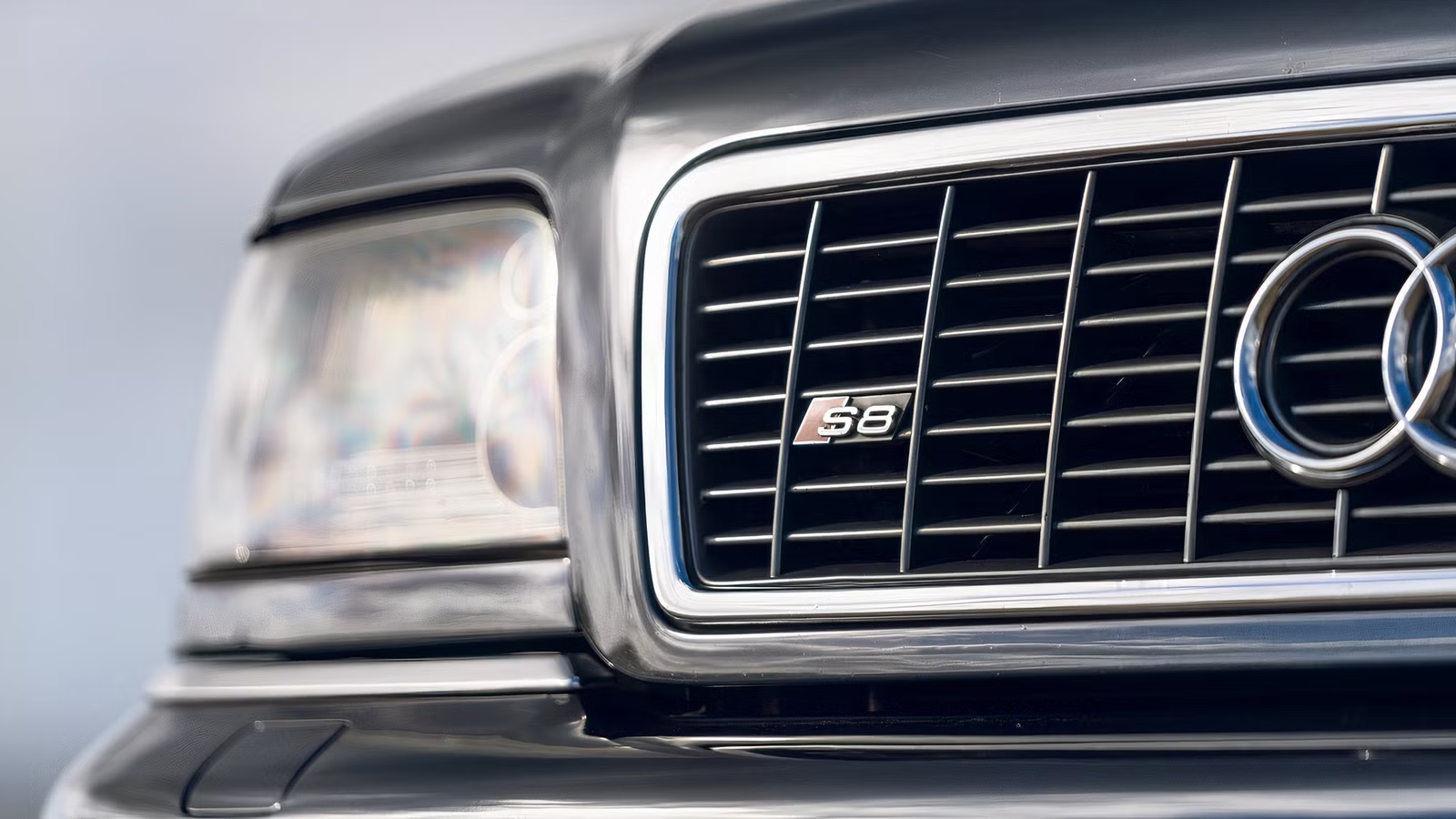
A front-quarter shot of the 2001 – 2003 Audi S8Audi
Here, it’s worth noting that Yamaha was working on five-valve engines for high-performance motorcycles back in the mid-80s. For 1991, they helped create a 5-valve four-cylinder engine for the Toyota Corolla Levin (1991–1995), one of the first road-going applications of the setup. The resulting engine was a 1.6-liter, 20-valve four-cylinder.
For context, on a similar timeline, Honda’s developments in high-performance motorcycle engines were also leading to the development of advanced valvetrains, specifically the VTEC system, which would go on to popularize the brand’s four-valve performance engines in the decades to follow.
1995 Ferrari F50 Engine Close-UpFerrari
Though Ferrari’s five-valve engines were built to captivate enthusiasts, Ferrari wasn’t the only automaker building them. The 1991 Bugatti EB110 featured a 3.5-liter, 60-valve, quad-turbo V12. However, Volkswagen Group was the manufacturer most responsible for putting five-valve technology into mass production, offering a 1.8-liter 20-valve turbo four-cylinder and 30-valve V6s (in 2.7, 2.8, and 3.0-liter displacements).
The Audi 5-Valve V8 Saw The End Of The Era
A detail shot of the 2001 – 2003 Audi S8’s V8 engineAudi
After Volkswagen Group extended its five-valve technology to more and more engines, a 40-valve V8 arrived in 3.7 and 4.2-liter displacements. That made Audi the primary high-volume 5-valve V8 automaker, tuning its 4.2-liter unit for smooth, effortless torque in luxury sedans and Avant wagons rather than high-strung, track-focused exotics.
There are numerous reasons why 5-valve engines didn’t stick around. Advances in valve timing and engine electronics were giving automakers new ways to enhance engine breathing, and the widespread adoption of continuously variable valve timing (VVT) systems and direct injection was incoming — each a technological leap that would take combustion engines to new heights. The thing is, these systems worked better with four-valve layouts.
Audi S8 (D2) 1996-2003Audi
Audi honed this 40-valve V8 for years before eventually switching back to a four-valve design after 2006, when direct injection arrived. If you’re following along, that means that Ferrari’s 5-valve V8 left the scene in 2004, with Audi’s 5-valve V8 leaving the market after 2006. There hasn’t been another one since, and there likely never will be.
Sources: Yamaha, Audi, Ferrari, AutoZine
