

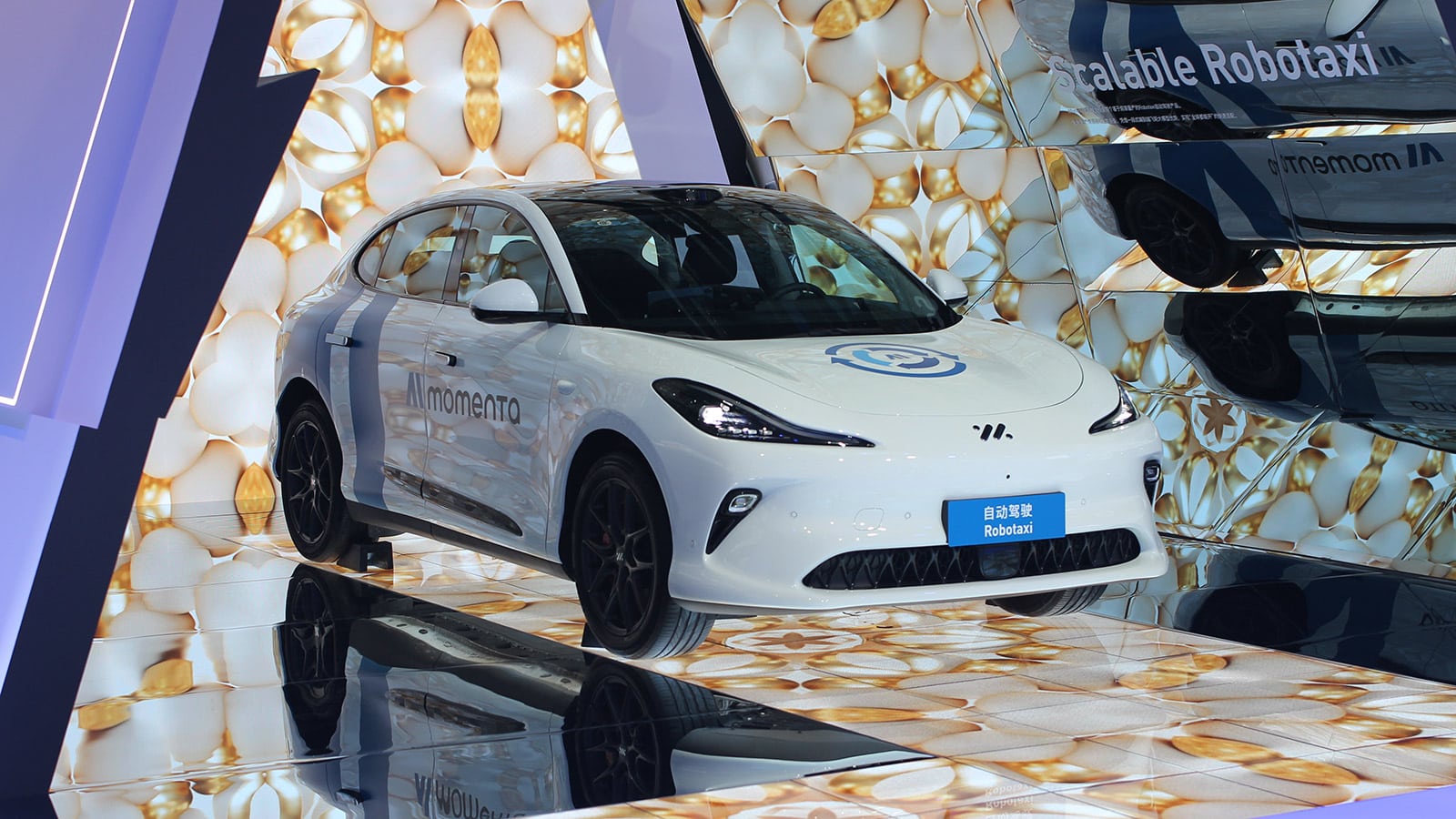
A Momenta robotaxi on display at the Shanghai Auto Show in April 2025. Credit: CnEVPost
- Momenta has entered the robovan market, with its vehicles operating for several months in Suzhou, where it is headquartered.
- The company is seeking to extend its autonomous driving technology beyond passenger vehicles into more applications.
Chinese autonomous driving company Momenta (HKEX: 6880) has entered the autonomous cargo van, or robovan, market, with its vehicles operating for several months in Suzhou, where it is headquartered, local media outlet 21jingji reported Friday, citing people familiar with the matter.
There had previously been speculation that Momenta was entering the robovan sector. This marks the first time a major media outlet has reported the move.
Founded in 2016, Momenta is one of China’s leading third-party smart driving solution providers. More than 1 million mass-produced vehicles equipped with its systems have been built, spanning over 100 vehicle models, while it has secured nominations for more than 210 models.
The company was listed in Hong Kong on July 8, raising about HK$6.8 billion. Momenta previously said it would use about 60% of its IPO proceeds for research and development and around 20% to advance the commercialization of robotaxis.
Entering the autonomous freight market suggests Momenta is expanding its autonomous driving capabilities into more applications to spread the high upfront cost of research and development, the 21jingji report noted.
Momenta launched the first production application of its R7 world model in April. The company aims to build a physical AI foundation platform that can support the large-scale deployment of passenger vehicles, robovans, robotrucks and robotaxis, and potentially expand into robotics.
Robovan is widely seen as a key commercial application for L4 autonomous driving. More than 33,000 autonomous delivery vehicles had been deployed in China as of the end of December 2025, according to a recent report by the China Federation of Logistics & Purchasing.
China’s annual production and sales of autonomous delivery vehicles could reach 860,000 units by 2030, with the total fleet exceeding 2 million vehicles, according to the report.
The market is currently highly concentrated. As of the first quarter of 2026, Zelos, whose customers include Cainiao, had a robovan fleet of more than 25,000 vehicles, giving it a market share of 52.3%. Neolix had 17,000 vehicles, accounting for 36.2%.
A Zelos robovan. Credit: Zelos
Together with Rino, the top 3 companies controlled more than 95% of the market.
Rapidly falling costs are one factor bringing the industry closer to a breakout. LiDAR prices have dropped from about 100,000 yuan ($14,720) in the early stages to the 1,000-yuan range, while the bill-of-materials cost of an autonomous delivery vehicle has generally fallen below 100,000 yuan, 21jingji noted.
However, further market expansion still depends on regulators granting broader road access. China currently has no nationwide product-approval and certification system for autonomous delivery vehicles, with local governments setting their own rules.
That means companies must apply for separate permits each time they enter a new city.
Momenta is not the only new entrant. Other autonomous driving companies, including WeRide (NASDAQ: WRD), have also expanded into autonomous freight. WeRide’s mass-produced robovan W5 was deployed in 2025.
License issuance is gradually resuming in some cities after the completion of an industry-wide safety review in late June, according to Bloomberg.
($1 = 6.7939 yuan)
