

Not long after the first wave of minivans popularized then high-tech new V6-powered, front-drive platforms, these architectures morphed into a new wave of family sedans that followed suit. Virtually everyone would sell you a cheap sedan with a V6 engine. For many years, if you were a perfectly reasonable person, you probably had a Honda Accord, Toyota Camry, Chrysler Intrepid, or Ford Taurus in your driveway because sedans were the way that sensible families got around.
2000-2004 Dodge Intrepid Front Angle ViewDodge
Now, the cheap family sedan is pretty much dead, and it didn’t die off suddenly or dramatically like a character in Prison Break, instead fading into the background as shoppers found favor with replacements that were taller, heavier, and (especially) more profitable. Below, we’ll track the slow and steady death of the affordable sedan over time, see where the market sits today, and recommend some reprieve from the used marketplace, where there are deals to be had for those of us who still want to drive sedans.
The Sub-$30,000 Family Sedan Is Virtually Extinct, And The Numbers Prove It
2003 ford taurus frontFord
As we’ve previously reported on the demise of the sub-$30,000 pickup truck, once-attainable sedan nameplates with superstar sales status were neglected for years, allowed to languish on dealer lots and age into extinction. At the beginning of this year, the average price for a new vehicle in the US cracked $50,000 for the first time, likely meaning that more shoppers with an average income are considering used models, not new ones.
2026 Honda Civic Si driving front 3/4Honda
You’ve still got some sub-$30,000 options available in the 2026 sedan universe, including the Honda Civic (base MSRP $24,695), the Toyota Corolla (base MSRP $23,125), and the Hyundai Elantra (base MSRP $22,625). Hyundai’s larger Sonata starts at $27,450, meaning out-the-door pricing is likely to exceed the $30,000 mark, especially if you step up from the base model.
The same goes for the 2026 Honda Accord, which comes in from $28,395 before destination. Ditto the hybrid-only 2026 Toyota Camry, with its starting MSRP of $29,300. In 2026, if you’re shopping for a sedan and want to be out the door for $30,000 or less, only a few brand-new choices remain, as well as some very good used ones.
The front of the 2020 Buick Regal GS in redBuick
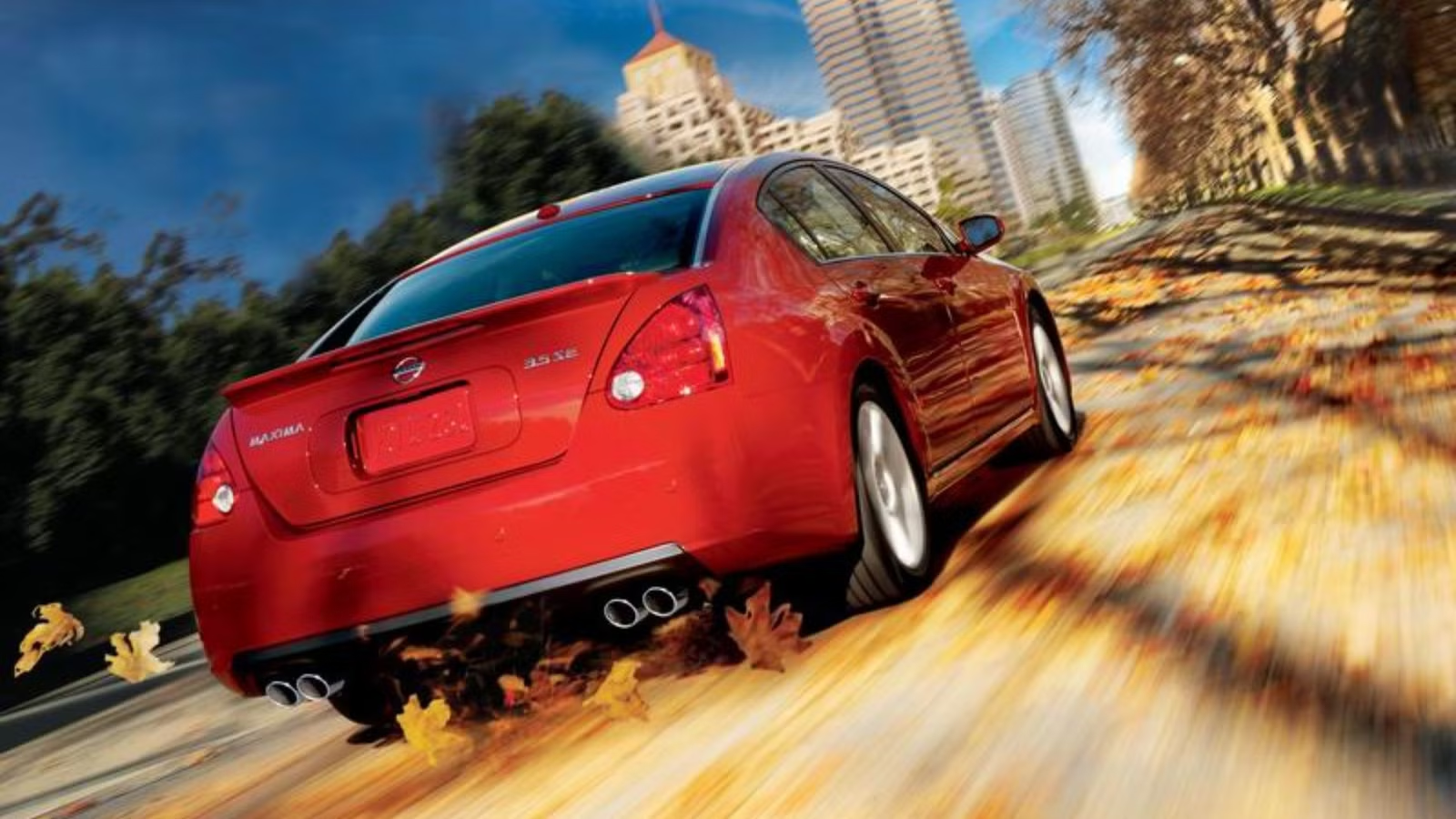
Buick stopped selling sedans six years ago when the Regal left the lineup to clear the way for new SUVs. The Nissan Maxima, a long-storied sports sedan defined by a range of famous V6 engines and decades of continuity, was also dropped from production for similar reasons in 2023. Chevrolet canned the Malibu after 2025, relegating the popular nameplate to the history books once again after years of fleet sales and piles of unsold inventory on dealer lots.
Related
10 Manufacturers Still Building Cheap Cars For America
The sub-$30k deals are out there, you just need to know where to look.
Volkswagen Passat? Gone after 2022. Mazda 6? Gone after 2021 as the brand focused on an up-market SUV model line that aimed to fill a gap between mainstream and premium brands. The aging Mazda 6 needed a costly update to be competitive, and sales were dwindling. It didn’t fit into the business plan, so it died.
2019 Toyota AvalonToyota
Kia Cadenza? Infiniti Q70? Dodge Dart? Toyota Avalon? Acura RLX? All met similar fates in the past decade. The Subaru Legacy, which also underpinned the pricier and far more popular Subaru Outback, left the market in 2025. At that point, shoppers were buying eight Outbacks in the time it took Subaru to sell a single Legacy.
Perhaps the first “canary in the coal mine” moment was Ford’s discontinuation of the once extremely popular Fusion sedan in 2020, a move that would leave the Mustang as the only remaining “car” in the automaker’s entire lineup. Today, few cheap sedans are left standing, and some are packing their bags as departures keep piling up.
How The Sedan Lost The Market
2008-2010 Saturn Aura SedanSaturn
As painstakingly calculated by The Autopian in a 2024 article, 2017 was the year in which SUVs officially overtook sedans by sales volume in the US market. Further EPA data adds additional context on what happened next: a report from 2025 (based on 2024 data), mentions that while sedans and station wagons made up more than 80% of vehicles produced in 1975, those same vehicles accounted for just a 25% market share in the mid 2020s.
The EPA also notes that in 2023, car-based and truck-based SUVs rose in market share to more than 50 percent, their highest level yet. Two years later, based on data from the 2025 EPA Trends report, car-based and truck-based SUV market share had climbed again, now landing at 60 percent.
How The Minivan Quietly Pre-Wired The Industry For The SUV Boom
1984 Dodge Caravan Bronze Side ViewDodge
It’s easy to say that the arrival of the SUV and ensuing SUV craze was responsible for the death of the cheap family sedan, but the whole story is a lot more complex. Let’s get you up to speed, technologically.
Interestingly, this all actually starts with the minivan craze of the late 80s and early 90s. In this era, people were tired of rear-drive sedans with poor performance and gas mileage, and they were looking for something new. The minivan was that new thing. The pack followed the success, and a multitude of competitors joined the scene. Here’s the important bit: most of these new minivans were using a yet-rare V6, front-drive architecture designed for multiple applications.
The minivan took this type of more-profitable driveline to the mainstream, and it wasn’t long before a long list of automakers commenced further tinkering to create a new generation of cheap, front-drive sedans to follow.
Related
The Sedan With The Best Resale Value After 5 Years – And The Runners Up
Which sedans will offer the least money lost when it’s time to resell? The answer may or may not surprise you.
Things might look different if the original minivans had made wide use of AWD. When minivans rose to fame, most didn’t yet offer it. If you needed four-wheel drive, you had to buy a heavy, V8-powered 4×4 of some sort instead, and it wouldn’t be very comfortable or easy on fuel. There was an opportunity to sell more minivans if you could offer shoppers four-wheel drive, though most automakers were happy with the sales volumes of front-drive minivans and didn’t pursue the AWD trend. Development cycles for driveline hardware were much longer back then, so a quick solution wasn’t within easy reach.
1969-Chevrolet-K5-Blazer1 towing caravanGM
A few models, notably the Dodge Caravan and Toyota Sienna, did, however, offer four-wheel drive over the years. Though AWD minivans were never the market’s biggest sellers, they, too, added vital technological DNA and experience in building the hardware that would eventually power modern AWD systems that could be added to front-drive applications with ease.
By the time the minivan era was winding down, a few factors were swirling in the marketplace. Front-wheel drive was mainstream, and demand for AWD was growing but largely unserved by the minivan survivors and cheap sedan options on offer at the time. There wasn’t much point in launching a new wave of AWD-equipped minivans, since competitors were leaving the market as interest in minivans faded.
Base Trim Engine
1.5L Turbo Inline-4 Gas
Base Trim Transmission
Continuously Variable Automatic (CVT)
Base Trim Drivetrain
Front-Wheel Drive
Base Trim Horsepower
192 hp
Base Trim Torque
192 lb-ft @ 1600 rpm
Fuel Economy
30/38 MPG
Infotainment & Features
9 /10
This left shoppers with a lot of cheap sedans to choose from, many drawing from the same gene pools as minivan models before them. The thing is, those shoppers were increasingly after four-wheel traction, and they loved the extra space and flexibility of the minivan, just not its shape. Station wagons weren’t big sellers either, and most weren’t AWD-equipped anyway. The timing, technology, and ingredients were once again right for a new type of vehicle to enter the scene and change the industry once again.
Did Profit Or Preference Kill The Cheap Family Sedan?
2026 Volkswagen Tiguan Turbo from the frontVolkswagen
In the early 2000s, the Honda CR-V and Toyota Rav4 paved the way for an influx of new “crossover” SUV models that would be that next major change. Now, shoppers had four-wheel drive in a package that handled and drank like a car, offered more flexibility than a sedan, and (importantly) was more useful in more situations. In the same way the minivan scene drew numerous competitors to the scene, so too did the emerging wave of modern SUVs, which began to flood in rapidly and fill virtually every corner of the market from compact to full-size, with mainstream and luxury brands represented.
Largely leveraging earlier advances in platforms and driveline tech, these SUVs mostly came with AWD as an optional feature if not included as standard, and many ran engine and transmission teams already proven from previous use in sedan and minivan models.
On one hand, an SUV was inherently more useful than a sedan: it could tow your boat, had more cargo space, worked better in the snow, and you could happily use it for some off-roading if you liked. This helped form the basis for a vehicle that would command higher prices, because it did more for its driver.
2026 Subaru Forester Hybrid front 3/4Subaru
The SUV also did more for automaker profit margins. The latest manufacturing advances meant that multiple products could be built on a single production line, powered by a single engine family, and scaled up and down in size to create new products while skipping over plenty of development time and cost.
The concept of a four-year life cycle was also fading, with mid-cycle deep updates applied to existing platforms and subsystems, instead of full do-overs every few years. Not only could automakers charge more for an SUV than a sedan, but the baked-in manufacturing efficiencies and life cycles helped drive improved profitability. To generalize widely, modern SUVs could command higher prices, but were also created in ways that made them cheaper to build.
2016 Nissan MaximaNissan
There’s also the capacity conundrum. Car manufacturers can’t build an unlimited number of vehicles. Every factory has finite space, finite labor, and finite tooling. Every model built comes at the expense of something else. Entire panels of planners, analysts, and regional experts spend years deciding which mix of vehicles to produce, where to build them, and how long to keep them alive. Countless millions are spent to make these decisions, and the goal is singular and universal: maximizing profits and shareholder returns for every hour of production.
1994 Chrysler
Intrepid ES
2012 Honda
Accord EX-L
2023 Toyota
Camry XSE
2010 Ford Taurus
Limited
Engine Type
3.3L V6 24V SOHC
3.5L V6 24V SOHC i-VTEC
3.5L V6 24V DOHC D-4S
3.5L V6 24V DOHC
Power
214 hp @ 5,800 rpm
271 hp @ 6,200 rpm
301 hp @ 6,600 rpm
263 hp @ 6,250 rpm
Torque
214 lb-ft @ 2,800 rpm
254 lb-ft @ 5,000 rpm
267 lb-ft @ 4,700 rpm
249 lb-ft @ 4,500 rpm
Transmission
4-speed automatic
5-speed automatic /
6-speed manual (Coupe)
8-speed automatic
6-speed automatic
That’s why some vehicles get killed off even while demand for them is strong. The Ford Fusion was killed to make room for the Ford Bronco Sport and Maverick. The Malibu died to make way for new electric SUVs. The Buick Regal was shelved to make way for Buick’s new all-SUV lineup. The Passat died to make way for the ID.4, an electric SUV. As reported by Autoblog.com in 2017, then Fiat Chrysler CEO Sergio Marchionne told a press conference that the Chrysler 200 and Dodge Dart sedans were, at the time, the worst investments the automaker had seen in the past eight years.
Red 2015 Dodge Dart GT frontDodge
But preferences played a role, too. Remember: it’s shopper dollars that ultimately dictate winners and losers in the marketplace. Shoppers were embracing the new wave of SUVs as a more exciting and spacious alternative to the sedan, though product planning and marketing departments worked in sync to help steer, shape, and amplify that growing demand, advertising aggressively and rigging product lineups to tempt sedan shoppers up-market into something even more pricey and profitable. Though some sedans remained popular for years longer than others, the form factor ultimately lost a business case, not a popularity contest.
Look For Pricing Reprieve In The Used Market
2014-2020 Chevrolet Impala Red Side Parked in CityChevrolet
You’ll find plenty of reprieve from high SUV prices in the used market, where shopping for a second-hand sedan basically makes you a genius. Not only does lower demand for sedans help keep prices reasonable, but long lifecycles mean some used sedans at several years old are exactly the same as their brand-new counterparts on showroom floors.
This could save you thousands of dollars. So, too, could finding a smoking deal on a leftover Chevrolet Malibu. With production stopped and inventories piling up, it’s highly likely that dealers with unsold Malibus would like very much to sell you one, probably at a discount.
Sources: The Autopian, EPA
