

There was a glimmer of hope late last week that Canada and the US would make some progress in trade talks, but ultimately the conversations grew even more acrimonious, saddling automakers with tariffs that are set to double from 25% to 50% on January 1, unless cooler heads prevail.
While President Trump sought to punish our neighbors to the north, the real victims are Americans who will likely pay more for vehicles built in Canada by American and Japanese companies, as well as Canadians who will pay more for US-built vehicles, because Canadian Prime Minister Mark Carney promised to match Trump’s tariffs “dollar for dollar.” Apparently, sticking points on HD pickup trucks and vehicle parts sent the whole house of cards tumbling.
2023 Ford F-Series Super DutyFord
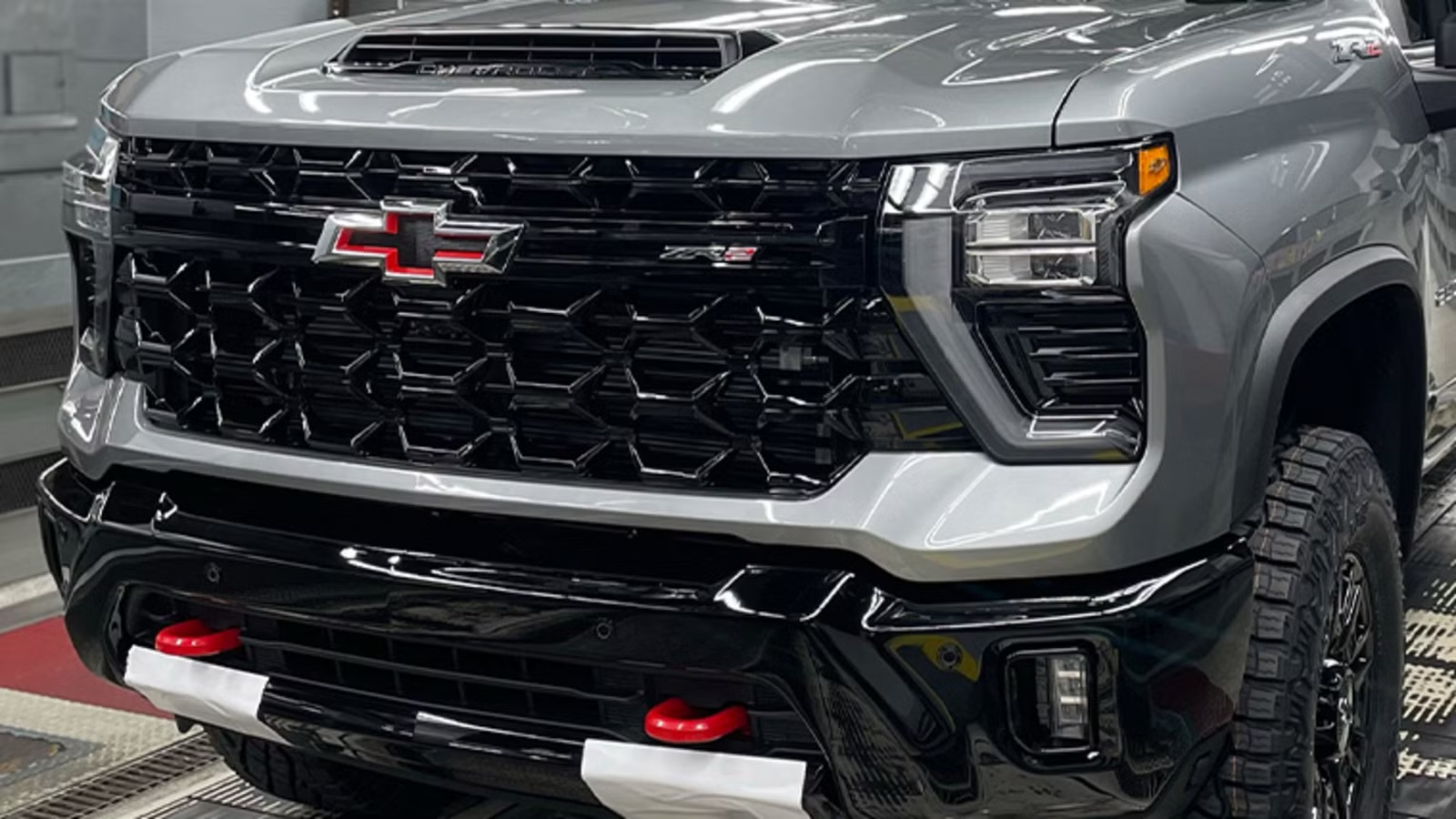
If the 50% tariffs roll out on time, the impact on customers and US automakers will be profound: General Motors produces light-duty and heavy-duty versions of the Chevrolet Silverado in Oshawa, Ontario, while Stellantis builds the Chrysler Pacifica minivan in Windsor, Ontario. As for buyers, it likely means higher prices for new vehicles, but also on the used car market as more people skip a new purchase for something previously owned.
Stacking Up Tariffs With Multiple Crossings
Ford’s plant in Oakville, Ontario, has been sitting idle about two years since production ended there for the Ford Edge and Lincoln Nautilus. The plant has been retooled and is now preparing to launch Super Duty pickup truck production. If the company was struggling to find a way to profitably sell Canadian-built trucks to Americans, well, that problem just got twice as difficult.
2025 – 2026 Chevrolet BrightDrop 400 Cargo VanChevrolet
The byzantine world of North American tariffs just got even more complicated. Duties placed on automotive components can be stacked several times as today’s integrated supply chains first ship, for example, a raw material across the border, where a company fabricates a grille opening reinforcement, which then goes back across the border for installation of the radiator, then back across the border for the fascia, then back again for headlights and grille trim, then finally back across the border as a complete module for final assembly in the vehicle, which would then face a tariff as a finished good.
Canada Fights Back While Mexico Doesn’t Bother
It’s because of this that the situation is not as simple as Trump says: “Build in the US and there are zero tariffs.” The problem is most severe in the north because Canada is fighting back, while Mexico isn’t bothering to impose tariffs on American goods. Meanwhile, the tariffs initiated by the Trump administration have prevented the three countries from solving some of these issues by renegotiating the US-Mexico-Canada Agreement for seamless free trade. An agreement on that front is now as elusive as ever.
Matt McAlear With The 2027 Chrysler PacificaChrysler
Looking closer at the Pacifica, which only comes from the Windsor plant, it is considered USMCA-compliant with 69% US/Canadian content and 21% Mexican content. That means just 10% of the Pacifica’s content is sourced from outside North America, so those components could fall under the new 50% tariffs, Sam Fiorani, VP of Global Vehicle Forecasting for AutoForecast Solutions, told CarBuzz in an email today.
“USMCA should prohibit the compliant Canadian parts from the 50% tariff, but that seems unclear at the moment.”
–Sam Fiorani, AutoForecast Solutions
Beyond American automakers, Toyota and Honda are also feeling the tariff pinch, building the Lexus RX and Honda Civic at plants in Ontario. But tariffs on them are murkier as their USMCA content is potentially less than the 75% limit set under the free trade agreement. “If a Civic or RX falls below that threshold, a significant portion of those models could fall under the new tariff, adding thousands of dollars to the cost of each vehicle,” Fiorani told CarBuzz.
Expect Higher Costs For Consumers, Lower Profits
Dodge Challenger Production At Brampton Assembly PlantStellantis
On social media, Trump said, “We don’t need Canada, they need us!” But Canada is our No. 2 trading partner (behind Mexico), and infuriated Canadians have spent a good chunk of 2026 boycotting US goods, which means American companies that did business with Canadians are suffering. As Fiorani sees it, neither country can compete on its own with the European Union and potentially even China. Add in Mexico, and the North American region becomes much stronger.
“Without its trading partners, the US market will see higher costs and lower profits across the automotive industry, ultimately leading to fewer jobs and an eroding stance in the global market.”
2015 Ford Edge Sport finished in orange with black interiorFord
‘Both Countries Need Each Other’
CarBuzz reached out to US-based automakers, as well as the Alliance for Automotive Innovation, whose job is to lobby the White House on behalf of automotive manufacturers, but Stellantis and the Alliance declined to comment. Ford and GM did not respond to our inquiry. However, the American Automotive Policy Council did provide us with the following statement:
“We urge US and Canadian negotiators to reach a deal that enhances North American auto competitiveness and brings about a successful USMCA review.”
Trump is wrong about not needing Canada, analyst Sam Abuelsamid told CarBuzz via email. “Both countries need each other. US tourism has taken a major hit with the drop-off from Canada and this won’t help,” he said. “US liquor producers and many other companies are also taking a hit, and everyone is paying the price for increased steel and aluminum costs. New homes are also getting more expensive due to tariffs on wood.”
2026 Chevy Silverado 2500 pickup assembled in Oshawa, OntarioGM Canada
CarBuzz Insight – Why This Matters
Where this saga goes next is anyone’s guess. Bill Ford Jr. is likely to be on the phone with the president, explaining why the “most American automaker” needs production in Canada, and elsewhere. It’s likely a message many people have tried delivering before, but we’ll know it sinks in if the new tariffs are scaled back before the November mid-term elections, and especially if USMCA talks resume.
But Abuelsamid is not hopeful: “I have no expectation that tariffs will be eliminated by January, and I’m doubtful they will resolve any of this by then,” he said.
Source: Automotive News
