

If you hear Carroll Shelby’s name mentioned in performance circles, it’s likely to be associated with Ford. After all, in the minds of legions of fans, the world-famous tuner is synonymous with legends like the 427 Cobra and the GT350. But by the late 1980s, Shelby had moved on and was deep into a run of working on Dodge performance cars. His tuning arm was trying to prove that these little turbo-four-cylinder cars could be far quicker and more entertaining than their economy-car roots might suggest.
During this period, Shelby also decided to breathe some life into a short-bed rear-wheel-drive Dodge truck. This experiment lasted only one model year and didn’t sell particularly well. Still, it might just have laid the foundation for the factory-backed performance pickups that would emerge soon after.
Shelby’s Dodge Years Were Stranger Than Most People Remember
1989 Shelby Dakota front quarterCars and Bids
1989 Shelby Dakota Specifications
Engine
5.2-liter OHV 90-degree V8
Transmission
Four-speed automatic with overdrive
Drivetrain
Rear-wheel drive
Power
175 hp
Torque
270 lb-ft
Shelby began a partnership with Chrysler in 1983 when his company produced the first Shelby Charger, which preceded a run of compact, turbocharged, front-wheel-drive machines. Chrysler needed some credibility, and Dodge wanted to inject some excitement into its range, so Shelby seemed like the perfect partner to weave some magic into the project.
In the years that followed, the Omni GLH-S and the CSX would follow the same formula as the Shelby Charger, with a lightweight, (eventual) turbocharging, and front-wheel-drive weirdness. So, Shelby took his weirdness to the next level in a different category altogether with something older and simpler in 1989: the Shelby Dakota.
The Shelby Dakota turned out to be a performance pickup truck with an engine far larger than most people expected to find under its hood. The donor Dakota was effectively a middleweight contender in the US truck wars and sold in reasonable numbers. However, Shelby had no intention of applying some simple modifications or a gaudy sticker package to a lifestyle pickup. Instead, he would go back to some of his rear-wheel-drive V8 roots and add an engine with plenty of character to this special Dakota. The result was not something you could easily compare to a muscle truck like the modern Ram TRX, but in 1989, it certainly wasn’t a modest proposition either.
The Dakota Was The Right-Sized Truck For A Shelby Experiment
1989 Shelby Dakota rear quarterCars and Bids
Dodge positioned its first-generation Dakota as something smaller and easier for consumers to live with than a full-size Ram. The Dakota was slightly larger than many compact pickup competitors, and Shelby had some room to add significant power without really stretching the formula. Engineers started off with a two-wheel-drive, short-wheelbase Dakota Sport that already had some extra equipment versus the base model. This variant had some rear-drive character of its own and enough chassis capacity to take the kind of engine that Shelby proposed.
Shelby ditched the standard 3.9-liter V6 engine, which made 125 hp. Instead, the tuner dug through the Chrysler parts department and found a 5.2-liter OHV V8 that used electronic dual-throat throttle-body injection. The V8 made 175 hp at 4,000 rpm and, notably, 270 lb-ft of torque at just 2,000 rpm. This torque gave the Shelby Dakota tremendous low-speed punch, while it weighed far less than a full-size truck and came in short-bed pickup form.
Shelby had to make some modifications to fit the V8 properly. These included removing the stock engine-driven fan and replacing it with twin electric fans mounted ahead of the radiator.
The Shelby Dakota Was More Than A V8 Swap
1989 Shelby Dakota V8 engineCars and Bids
Although the V8 engine made plenty of headlines, the entire package was also well-rounded. Buyers got a four-speed automatic transmission with overdrive, a high-stall torque converter, and an auxiliary cooler. A 3.90:1 limited-slip rear axle would make the most of the Dakota’s low-end torque and proved highly practical. Otherwise, with that amount of torque arriving at a very low RPM, the Dakota could easily have turned into a disco smoke machine instead of a usable performance truck.
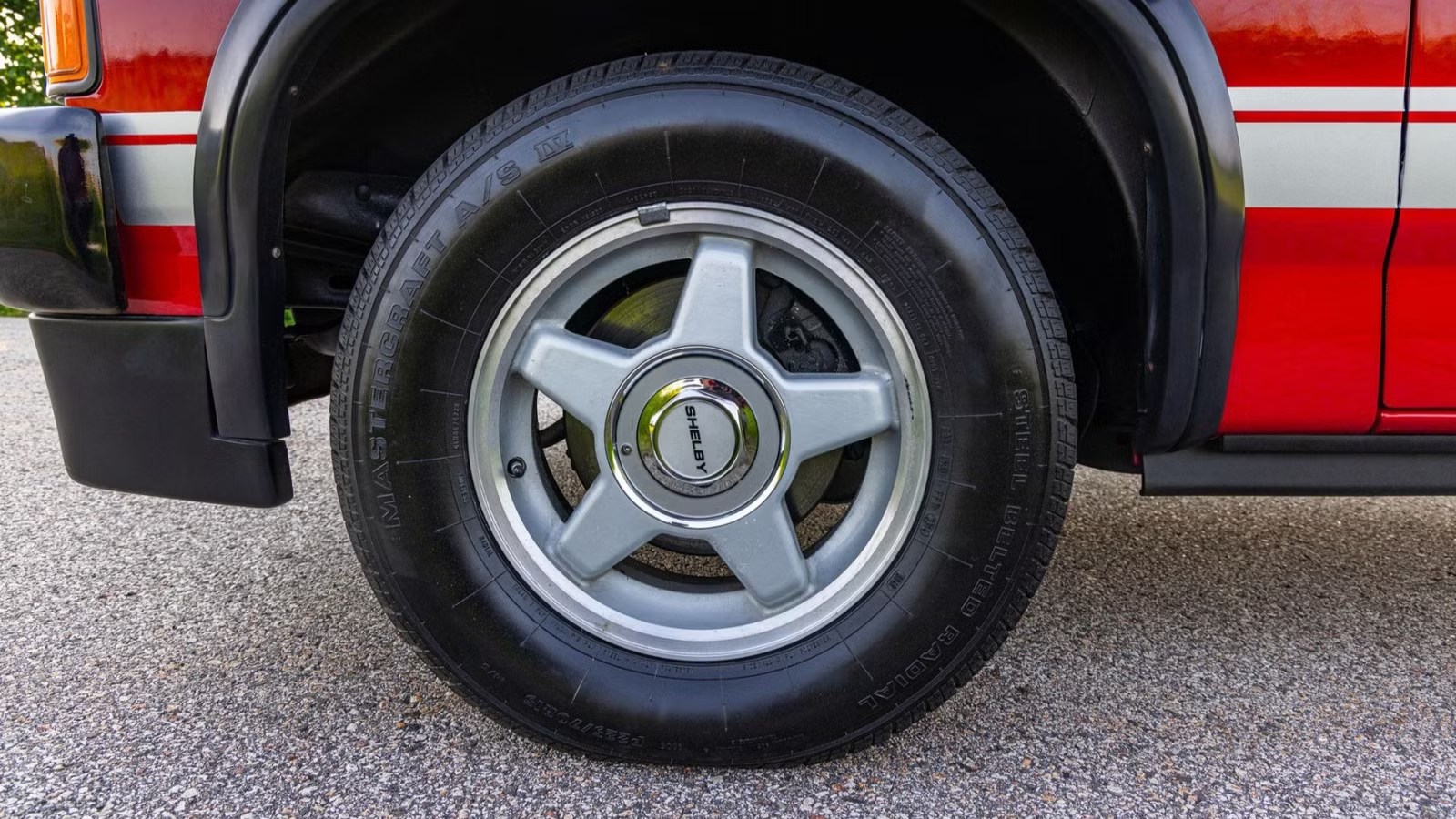
Shelby engineers also reworked the suspension with gas-charged shock absorbers, leaning on the heavy-duty Dakota Sport’s foundation. Up front, the suspension used upper and lower wishbones with coil springs and a stabilizer bar, and at the rear, you’d get semi-elliptical leaf springs with gas-charged shocks. The truck also had vented front disc brakes and rear drum brakes, plus rear anti-lock braking, and 15-inch Shelby hollow-spoke aluminum wheels with Goodyear P225/70R15 tires.
On the outside, the choice was between exotic red or bright white paintwork, along with recognizable Shelby graphics. And from the front, the truck looked purposeful enough, with its larger air dam, fog lamps, black trim, fender extensions, and bed-mounted light bar. Inside, there was a Shelby signature leather-wrapped steering wheel, an upgraded tachometer and instrumentation, and special cloth seat inserts to round everything off. Each truck had a serialized Shelby nameplate.
The Shelby Dakota Was Quick Enough To Make The Idea Work
1989 Shelby Dakota interiorCars and Bids
The Shelby Dakota was certainly not earth-shattering compared to modern-day performance trucks, but it was still relatively potent. For example, it would take 8.7 seconds to reach 60 mph, 16.5 seconds to reach the quarter-mile at 82 mph, and reach a top speed of 113 mph. These were acceptable figures for a sporty pickup at the end of the 1980s, especially for a vehicle that started as a practical Dodge truck. Behind the wheel, drivers would find usable, practical power across the range, making it lively enough in normal driving conditions rather than just testy at full throttle.
Related
How Shelby Tuned A Dull Hatch To Go Like Hell
The Dodge Omni GLH became one of the most unlikely hot hatches from the ‘eighties. Why did it turn heads?
Because of that ample rear-wheel torque, the Shelby Dakota had a very different personality than many of the turbocharged Shelby Dodges that preceded it. It also preceded larger, more powerful performance gains in the early 1990s. For example, the 1990 Chevrolet 454 SS was a full-size performance truck offering, and the GMC Syclone followed soon after with its turbocharged, all-wheel-drive pitch.
Ford turned its F-150 into a factory street truck called the SVT Lightning, and Dodge would eventually return to the formula with its Ram SRT-10. Of course, there’s nothing to say that those manufacturers took inspiration from the Shelby Dakota. However, this particular vehicle was still a serious attempt to produce a factory-backed performance pickup ahead of its time.
1989 Shelby Dakota rearCars and Bids
The Shelby Dakota disappeared almost as quickly as it arrived and never became an ongoing Dakota performance line. The Shelby Registry suggests a total production of 1,475 trucks, with 995 in red and the rest in white.
It’s a level of rarity that gives the truck an unusual market position today. There are few of these trucks out there, but they’re not going to command the same values as a blue-chip Shelby Cobra or GT350. However, the Shelby Dakota is not a dramatically fast machine by modern-day standards. It’s not as obvious a contender as the later Ford F-150 Lightning or Dodge Ram SRT-10 either, but it’s still a genuine Shelby-linked Dodge performance model.
Related
Ram’s History In The Midsize Truck Segment
Currently, Ram is without a mid-size truck in the US. However, it wasn’t always this way.
Values reflect its middle-of-the-road status. You can probably pick up a Shelby Dakota at auction for perhaps $13,000 or $14,000, which is reasonable money compared to better-known Shelby vehicles. Those examples with unusual stories or low mileage can still attract stronger bidding, but there’s no sign that the market is reassessing its initial valuation.
Buyers would find that the Shelby Dakota is perfectly understandable. It’s not overly complicated and is essentially a short-bed Dodge truck with a meaty V8 and a Shelby badge. The truck predated a niche that would eventually become valuable, but arrived too early for the party, and that’s probably why it disappeared so quickly.
The 1989 Shelby Dakota was never going to be the fastest Shelby product or even the most advanced Shelby Dodge. But it was a rather obscure one-year-only experiment that took Carroll Shelby back to his roots and celebrated V8 prowess. The experiment took full advantage of the Dakota’s useful middleweight size before its maker shoehorned a 5.2-liter V8 under the hood. And while the result had a real Shelby identity, the market never fully understood what it was looking at. Instead, Shelby just sketched the outline of the performance pickup story with this Dakota, before stepping back to let the rest of the industry fill in the colors.
Sources: Cars and Bids, Shelby Registry.
