

While Toyota and Honda have reigned supreme in the Japanese mass-market for decades, Mazda has always seemed to take a quiet seat just behind them in terms of popularity. However, that doesn’t mean Mazda has been without their fair share of widely-popular automotive hits, such as the RX-7 and RX-8 sports coupes. Unfortunately for Mazda, though, the RX-7 and RX-8 were known to be a bit finicky, and not exactly rock-solid in their dependability, which hurt Mazda’s reputation for reliability a bit.
There was, and still is, an extremely reliable Mazda model on the market today, however. In fact, it’s been around since part of the RX-7’s time, and all through the RX-8’s tenure on the market. The model in question, if you haven’t guessed, is the MX-5 Miata, the roadster responsible for bringing back the two-door, open-topped sports car’s popularity at the very end of the 1980s. These days, the MIata still sells well, and boasts an extremely reliable track record, as we’ll find out more about below.
A Classic Roadster For The Modern Day
1991 Mazda MX-5 Miata Limited Edition NA Top Down Green Front Angled ViewBring A Trailer
Quick Facts About The Mazda MX-5 Miata
- Introduced in 1989
- Currently in its fourth generation
- Requires just $429 per year on average in repairs according to RepairPal
- Received a 4.9 out of 5 stars for reliability from Cars.com during its 2016 model year
Before we dive into the nitty-gritty regarding the Mazda MX-5 Miata’s penchant for reliability as a whole, it’s important to endow you readers with some background knowledge of the little Mazda. The Miata was unveiled at the 1989 Chicago Auto Show, and went on sale later that year as a 1990 model. Basically, Mazda dreamed up the Miata in order to pay homage to the then-dead British sports car, a segment that served as an icon in both Europe and Japan during the 1950s, 60s, and 70s.
1991 Mazda MX-5 Miata Limited Edition NA Hard Top Up Green Rear 3/4 Angled ViewBring A Trailer
Because such a model simply didn’t exist anymore, Mazda execs were interested in bringing it back as early as the late 1970s, but work didn’t officially begin until 1981, when a man called Kenichi Yamamoto assembled a team of designers and engineers to begin building a car that captured the essence of the dead British sports car in the modern era. After roughly five years of design contests, executive floundering, and anxious patience, the MX-5 project was greenlit in 1986. Then, three years later, the Miata was finally shown to the world.
The recipe was simple. First, the Miata needed to be rear-wheel drive with a front-mounted engine in order to convey the classic British sports car feel. Next, the MX-5’s engine needed to be small, yet powerful enough to provide a bit of fun and also be a bit growlish at the top-end. Also, the MX-5’s chassis needed to be very well-sorted, and boast a near-perfect weight distribution in order to facilitate good handling. Of course, we now know in the present-day that Mazda got virtually all of these things right, and the Miata has been a hit since.
This Is Why The Last Quarter-Century Of Miatas Are So Reliable
1991 Mazda MX-5 Miata Limited Edition NA Top Down Green Front ViewBring A Trailer
While the first-gen Miata – also known as the “NA” – was very reliable itself, the Miata has retained its dependable nature throughout its entire 35-year tenure. This is largely thanks to Mazda’s ability to engineer a simple car while also making it robust and able to handle quite a lot of exuberance, as any small sports car will, inevitably, be subjected to at some point in its life. Below, we’ll take a look at the second (NB), third (NC), and fourth (ND) MX-5 generations and discuss why each is considered reliable.
Second-Gen (NB – 1998–2005)
1998 Mazda Miata front, three-quarterMazda
The Miata’s last 25 years have encompassed three generations, beginning with the second-gen NB version. This generation was notable for getting rid of the famous pop-up headlights that many folks loved. As far as its reliability is concerned, a large portion of that is due to its 1.8-liter inline-four engine, part of Mazda’s “BP” engine family. A simple, straight-forward design and cast-iron construction helped to propel the BP motors high into the reliability sky. Not to mention, both the five and six-speed manual transmissions offered on the NB generation were considered some of the best ever installed within a Miata.
Reliability Scoring (2005 MY):
- Cars.com: 5.0 out of 5
- Kelley Blue Book: 4.9 out of 5
- J.D. Power: N/A
Third-Gen (NC – 2005–2014)
Front shot of a 2013 Mazda MX-5 MiataMazda
Arguably the most disliked Miata generation, the NC debuted in 2005 for the 2006 model year, and was tasked with bringing the MX-5 further into the future with more tech and safety features. Unfortunately, the extra weight from these features coupled with its controversial styling led to the NC being considered the worst version of the Miata.
Regardless, it was still a reliable little sports car, partly due to its MZR engine, although early examples had slight issues with engine knock sensors going wrong prematurely. The main reason for the NC’s durability, however, was its stiffened chassis and improved production standards, which meant things like metal and paint quality were better than in previous generations, which basically means the NC rusts less, and its chassis can withstand more. While less reliable than the NB-gen, NC Miatas can still keep up.
Reliability Scoring (2014 MY):
- Cars.com: 4.9 out of 5
- Kelley Blue Book: 4.1 out of 5
- J.D. Power: N/A
Fourth-Gen (ND – 2015–Present)
2017 Mazda MX-5 Miata RF RoadsterMazda
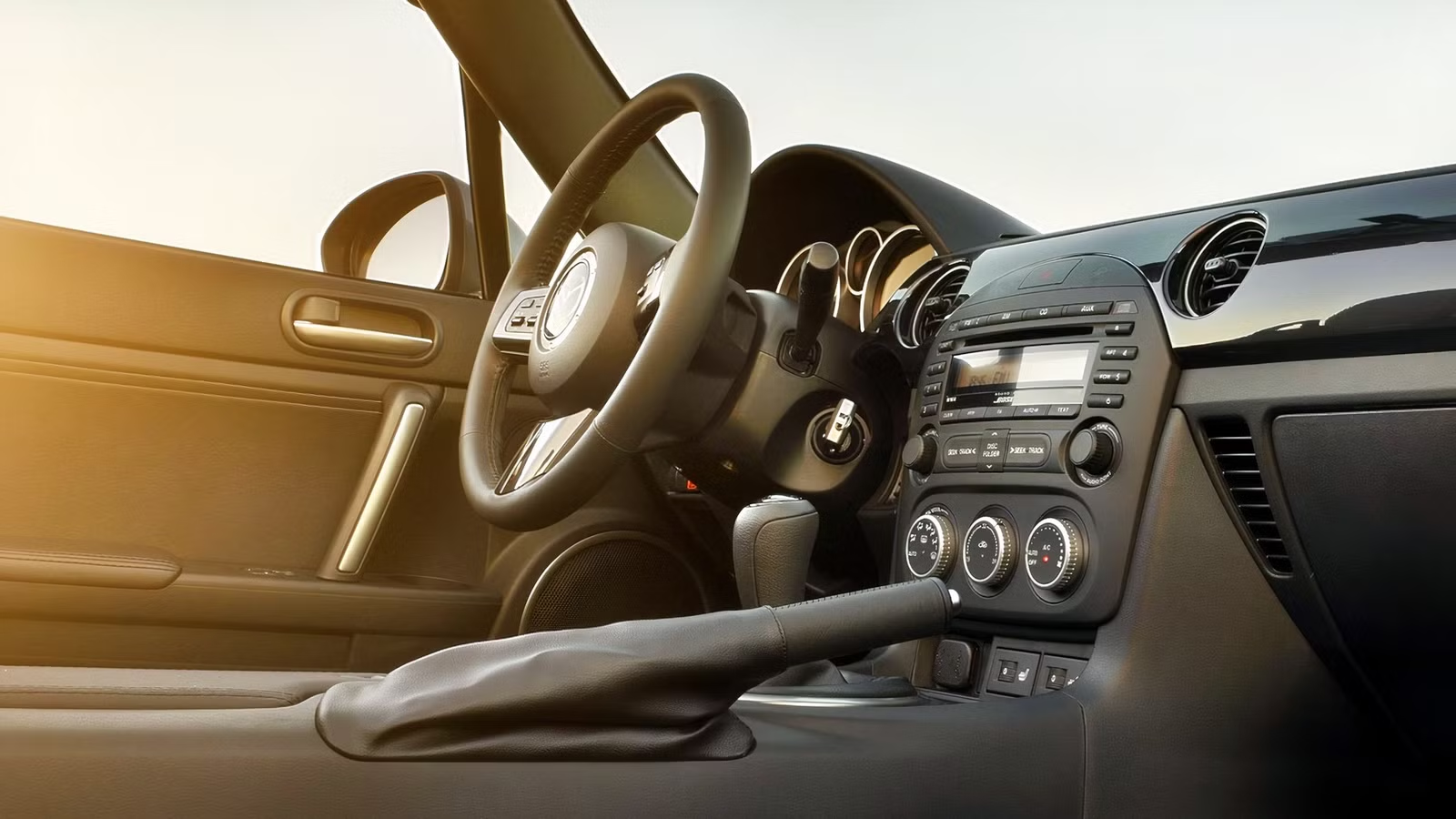
These days, we’re firmly planted within the Miata’s fourth generation. Introduced in 2015, the ND-gen Miata is known for bringing back some of the old-world charm that the NC iteration lost in its pursuit of technological and safety advancement. Not to mention, the MX-5’s styling improved tremendously with the ND generation, as well.
When it comes to reliability, the 2.0-liter inline-four belonging to Mazda’s SkyActiv engine family is known to be over-engineered. This means the motor in the Miata is under-stressed, lending itself to a longer lifespan – even the most powerful Miata sold barely cracks 200 horsepower. Its chassis, stiffened even more over the NC generation, is also beefed-up by the use of high-strength aluminum and steel. Electronics remain an achilles heel of the ND Miata. However, many who have owned both an NC and ND Miata report that electrical issues are less prevalent.
Reliability Scoring (2023 MY):
- Cars.com: 5.0 out of 5
- Kelley Blue Book: 4.8 out of 5
- J.D. Power: 76 out of 100
Want One? Here’s How Much You’ll Have To Pay
Ac action shot of the 2005 Mazda MX-5 Miata on a mountain roadMazda
If you’re like most gearheads, including this author, you’ve probably spent at least some time pining after some version of the Mazda MX-5. After all, it’s hard to beat an open-top, rear-wheel-drive roadster built in the modern era. And, based on testimony from loads of owners, the Miata is one of the best drives out there for the money.
Of course, even though the NB and, to a lesser extent, the NC generation Miatas are getting on a bit, they still fetch a decent sum of money. This is simply due to the MX-5’s sheer popularity and, as we’ve learned, impressive reliability over the last quarter-century. It’s worth adding that first-gen models can still prove to be hugely reliable too, but as they now approach classic status, an extra level of tender love and care is generally required in order to keep them in top condition.
Sources: Mazda, Supercars, Kelley Blue Book, Cars, J.D. Power
