

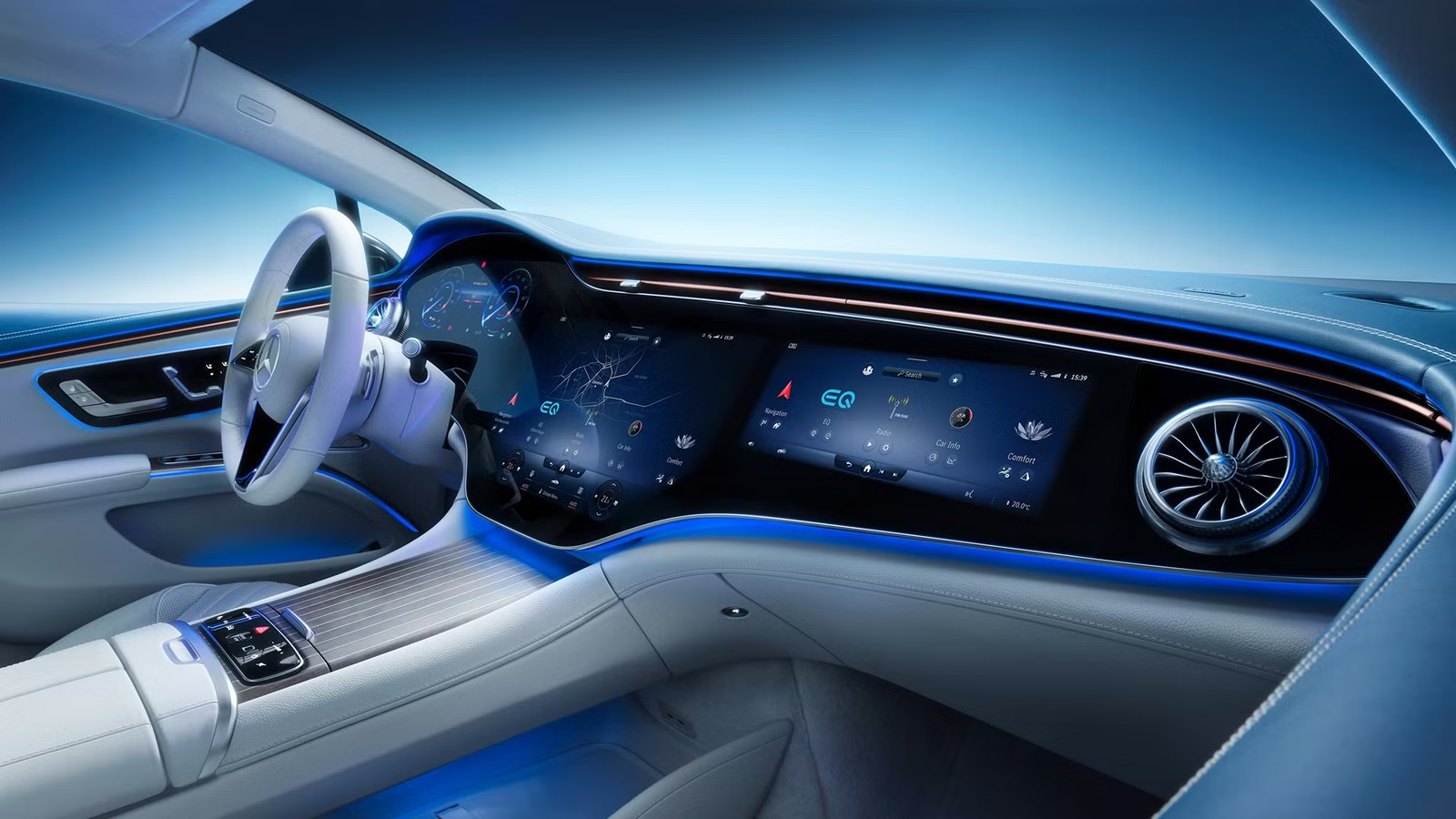
Mercedes-Benz was never alone in falling in love with the idea of touchscreens. Many OEM design teams decided that this was the future, especially in the luxury segment, and often pressed forward with new and wonderful ways to develop this tech. Some companies clearly went over the top, creating new dashboards dominated by glass.
Many of them became so intrigued by the possibilities that they lost sight of how customers actually wanted to use their cars. But now, Mercedes is starting to see sense. It’s admitting that not every commonly used function has to hide behind a touch-sensitive surface. What’s remarkable is how long it’s taken the firm to arrive at that conclusion.
Mercedes Finally Said The Quiet Part Out Loud
Mercedes-Benz Ridevu on HyperscreenMercedes-Benz
Mercedes-Benz CEO Ola Källenius has recently conceded that his brand sometimes pursues technology for the sake of technology, and that’s an unusually candid admission from a company that really went all in on screen-led interiors. Källenius has also suggested that future Mercedes models will concentrate more on physical buttons too. But it’s important to draw a distinction between screens and buttons, because Mercedes is not necessarily drawing away from the concept of screens themselves. It may still consider that large displays are a big part of any premium identity, even as it recognizes that customers want some features from a more analog world.
Mercedes may now agree that its customers are not as happy trying to interact with capacitive pads, software menus, voice commands, touch-sensitive steering wheel controls, or predictive interfaces that were supposed to help but often didn’t. And in the future, Mercedes will not necessarily require a driver to look at a flat piece of glass when that person needs to perform a frequent function. The company may be finally accepting that it’s never a good idea to require a driver to fully focus on that glass screen at any time when a car is moving.
To help with this repositioning, Mercedes has been poring over user data and has concluded that physical controls are better for some functions and for certain customer groups. It’s also been developing a steering wheel that has conventional buttons, rockers, and rollers that it will likely introduce across new vehicles and existing models during an upgrade.
The Hyperscreen Is Nearly As Wide As The Original Smart Car
2005 Smart Fortwo Coupe 450 Silver Side View City DrivingSmart
Perhaps the biggest expression of Mercedes’ screen obsession sits in the EQS, where the MBUX Hyperscreen stretches across a 56-inch span of curved glass. It has three separate displays with a digital instrument cluster, a 17.7-inch central touchscreen, and a separate 12.3-inch passenger screen. And the magnitude of this creation comes into sharp focus when you compare it to the size of another Mercedes-linked product. Or, to put it another way, the Hyperscreen is wider than a Ford GT40 is tall…
The original 1998 Smart City Coupe measured 59.6 inches wide, excluding the mirrors, and this means that the Hyperscreen panel is only about 3.6 inches narrower. It’s remarkably close to the width of a vehicle that includes an engine, suspension, door, safety structure, and luggage space, and can comfortably seat two people within almost the same measurement.
Interestingly, Mercedes describes the different 39.1-inch MBUX Hyperscreen fitted to its electric GLC as the largest continuous display across its range. But unlike the EQS arrangement, the GLC features a continuous screen that spans the dashboard, while in the EQS, Mercedes placed separate screens beneath one 56-inch glass panel.
Either way you look at it, Mercedes has invested a lot of time, effort, and money into its glorified glass dashboards. But while it may now start to focus on those buttons and analog devices again, it’s still likely to have a lot of dashboard glass as well.
MBUX Was Supposed To Make Everything Simpler
2027 Mercedes-Benz EQS sedan, yoke steering wheelMercedes-Benz
Mercedes’ MBUX has had an interesting history since it debuted in the A-Class in 2018. In that vehicle, Mercedes introduced a three-part control system with a touchscreen, a console touchpad, and touch-sensitive steering wheel controls. Those digital inputs supplemented other input methods rather than replacing all of them.
Following on from that, Mercedes came up with its “Zero layer” idea. Instead of forcing drivers to scroll through conventional menus, this software tried to predict relevant functions and display them on the main screen. With this approach, Mercedes was trying to help users, so they didn’t need to scroll through various menu levels to get to what they actually needed.
Meanwhile, underneath the surface, the hardware was quite elaborate. For example, the EQS Hyperscreen has 12 actuators underneath its touch surfaces to generate haptic feedback. The screen’s curved glass is formed at approximately 1,202 degrees Fahrenheit and has coatings to reduce reflections or fingerprints. Technically, the system had 8 CPU cores, 24 GB of RAM, and a variety of sensors that can adjust screen brightness to ambient conditions. And all this means that the display screen was a very sophisticated piece of automotive hardware with one of its primary goals being to reduce software complexity through prediction.
The Hyperscreen’s designers were as ambitious and technologically forward as they could be, but the final creation still didn’t automatically translate into effortless operation. And perhaps this means that you can only go so far when it comes to this form of digital communication. The touchscreens still have to move between menus or require the driver to confirm visually that they’ve pressed the correct virtual button. Alternatively, a physical roller can be found by touch and without looking at it because its position is always fixed, and its movement usually communicates what it’s doing.
Cars Are Not Smartphones With Steering Wheels
2025 Lexus RZ. Interior. Infotainment. TouchscreenLexus
In many respects, the incredible growth of smartphone culture should have made the automotive touchscreen an easier proposition. After all, consumers already understood the basic language of smartphones, where they can rearrange icons, swipe left or right, tap, or scroll to their heart’s content.
But there is a significant difference between using a touchscreen while you are sitting comfortably on a sofa and trying to mess with one while traveling at highway speed. It’s very hard and certainly not advisable for a driver to take their eyes off the road to interact with other gadgets or deal with other disruptions. And this is why bodies like the NHTSA strongly encourage manufacturers to limit visually and manually demanding tasks whenever a vehicle is in motion.
So, even though a touchscreen can often offer vastly more capability, such an interface may still be inferior for some of the simplest repetitive tasks. Physical controls will often perform better for high-frequency functions, and Mercedes-Benz seems to have finally reached the conclusion that one interface is not always universally superior.
Mercedes Is Keeping The Screens And Fixing The Controllers
2027 Mercedes-Maybach GLS 680 InteriorMercedes-Maybach
Evidence of Mercedes’ change of direction is now evident in some of its products. The latest GLS uses a large MBUX Superscreen that has three 12.3-inch displays underneath one glass surface, but the steering wheel has a rocker and roller arrangement that’s somewhat like earlier operating concepts. The electric GLC goes a bit further, and while it still has the company’s enormous continuous 39.1-inch display, it also gets new steering wheel controls.
Mercedes may be attempting to assign each type of interface to the task that it does best. But the important takeaway here is that it’s still betting on big screens, and it believes that they can still perform several jobs that physical buttons simply can’t. Those screens can display camera images, charge information, detailed navigation, driver assistance visualizations, and entertainment options, as well as delivering software features that might not have existed when the car left the factory.
And those big screens are definitely a part of the vehicle’s overall theater, as a dashboard-wide display is the first thing that a customer sees when they open the door. These solutions do give the manufacturers a form of visual differentiation that conventional instruments may struggle to duplicate.
The Best Interior Is Not The One With The Fewest Buttons
2024 Mercedes-Benz EQS SUV standard driver’s display and main touchscreenMercedes
In the world of digital interiors, minimalism is not the same as simplicity. But designers may want to make a dashboard look as clean as possible and this means that there’s every temptation to remove switches and other devices wherever possible. That approach doesn’t automatically make a vehicle any easier to operate and, in return for visual simplicity, a driver is often confronted with something which is more operationally complex.
While many manufacturers were probably guilty of taking things a little too far with their touchscreens, Mercedes seemed to go further than most. It slowly but surely eliminated the tactile controls that its customers had used for decades and ended up with a glass panel that was almost as wide as the original Smart City Coupe. But the latest evidence seems to show that Mercedes is dialing back on the idea of minimalism to a degree. It’s keeping the screens that are excellent at displaying information and adapting to new software, but it’s also reintroducing buttons that are reassuringly and refreshingly simple.
Sources: Mercedes-Benz, NHTSA.
