

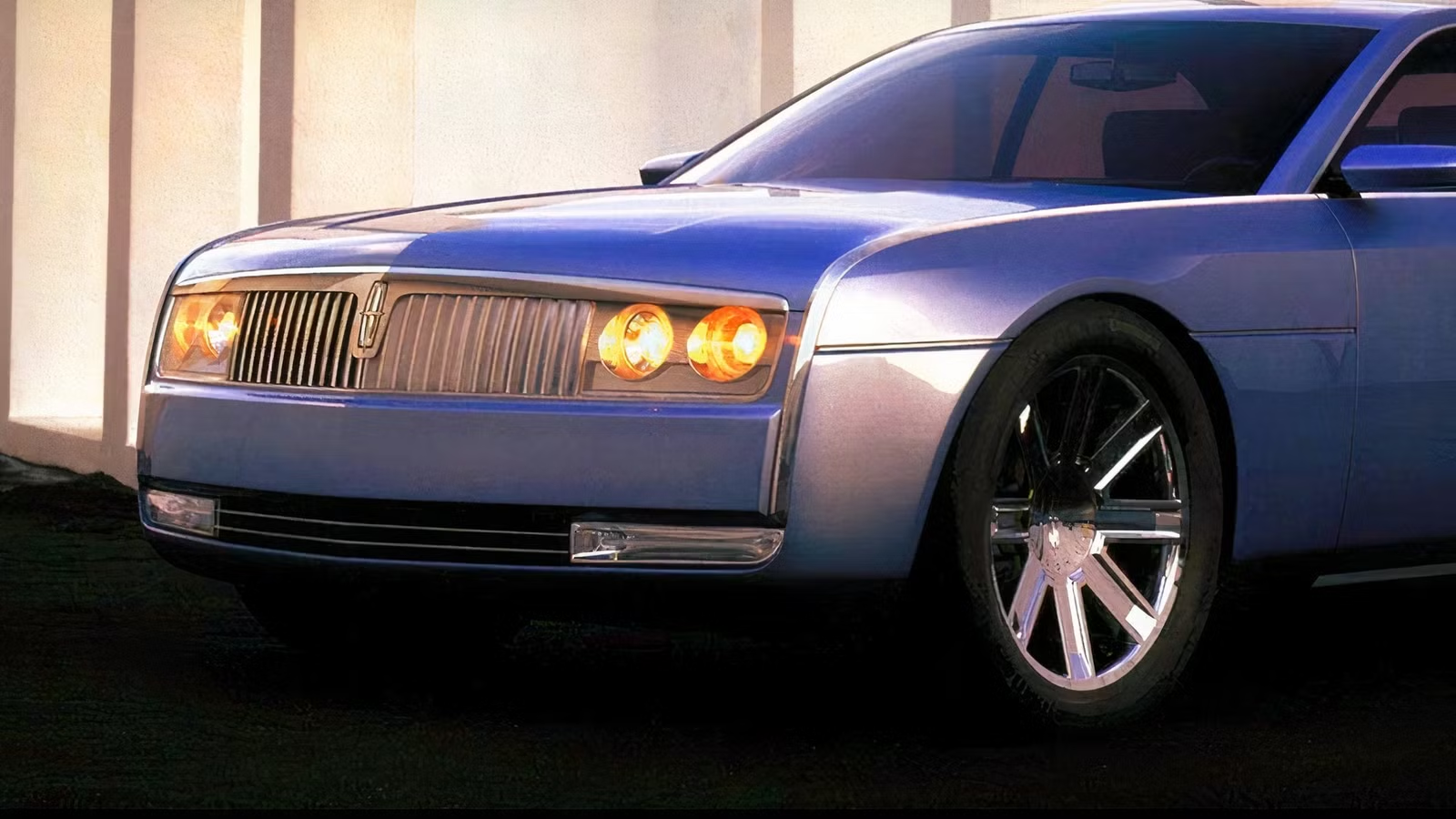
At the 2002 Los Angeles Auto Show, Ford showed up with something the world hadn’t been expecting. It was a Lincoln concept carrying the fabled “Continental” namesake, and it was supposed to show everyone what Ford could do when it let its engineers loose, targeting Mercedes-Benz directly. The Continental concept was a completely functional concept to boot, and had all the trappings expected of a production car already installed.
Sitting under its hood was an Aston Martin V12 engine hooked up to a rear-wheel-drive platform. It also sported the ever-important Lincoln Continental rear-hinged rear doors, along with the extremely long sort of proportions you’d expect from a flagship luxury sedan. Lincoln’s main goal — alongside competing with Mercedes — was to formally introduce the brand as a venerable luxury marque in the international market.
Ford Took A Parts-Bin V12 And Chucked It Into The Continental Concept
The Aston Martin DB7 started life with a supercharged straight-six engine, but a magnificent V12 followed, upgrading the DB7 for the better.Bring A Trailer
Pictured above is the same sort of V12 found in the ’02 Continental Concept, it just so happens to be carrying Aston Martin logos on its intake runners. At the time, Ford held a majority stake in the bespoke English automaker, giving it full authority to rummage through its parts surplus pile. A 6.0-liter V12 was chosen for the Continental Concept — the same engine also found in the Aston Martin DB7 Vantage and the V12 Vanquish.
When the big V12 found its way into the concept, it produced 414 naturally aspirated horsepower and 413 pound-feet of torque — plenty to give the car enough power to tackle even the most powerful standard S-Class of 2002, the 362-horsepower S 600. Mated to the Aston V12 was a six-speed automatic that sent power to the rear wheels. Thus, the traditional big-engine-up-front, rear-wheel-drive formula of a luxury car was achieved.
The decision to put a V12 into the Continental concept carried more than just a marketing-driven appeal. During the 1930s and 1940s, Lincoln chose V12s to power its flagship models, it selling the last American V12-powered car over 75 years ago now. Ford wanted to call back to those iconic model years with the 2002 Continental concept, while also giving it real-world viability at the hands of a 12-cylinder engine. Heritage meets modern competition, and Ford didn’t even have to engineer the engine from scratch to do it; it simply borrowed one from Aston.
The Continental Concept Was Designed As A True Flagship Sedan
2002 Lincoln Continental V12 ConceptFord
In order to give it its low-and-long proportions, Ford decided to stretch the existing Ford Thunderbird’s platform by roughly 30 inches, giving it a total overall length of 214.3 inches. That’s approximately 11 inches longer than a long-wheelbase S-Class measured in 2002. Complementing its lengthy proportions was its slab-sided styling, reminiscent of Continentals built throughout the mid-1960s, ’70s, and early ’80s.
Ford designed even more period design cues into the mix, too. Its rear-hinged rear doors, for example, explicitly called back to those found on the 1961 Continental. On top of that, the doors also allowed for easier entry and exit for rear-seat passengers. As a rear-seat passenger in a flagship sedan, one must look dignified while exiting the vehicle, and the special doors facilitate that.
2002 Lincoln Continental V12 ConceptFord
The Continental concept was also well-appointed technologically. It boasted a full array of rear-seat entertainment, unique storage areas, and it was even supposed to come with fully customizable luggage to match the car itself. Fiber-optic lighting bathed the cabin, and LED technology helped illuminate features such as its jewel-beveled gauges and buttons. Its trunk was power-operated, too, and it even had a pair of power-reclining rear seats.
The Business Side Of Things Quickly Fell Apart
2002 Lincoln Continental V12 ConceptFord
Lincoln had a fully functional, well-appointed flagship sedan that could likely have entered production if given the green light. That green light, sadly, would never come. When the Continental concept entered the scene, Ford’s Premier Auto Group (PAG) — which encompassed brands like Aston Martin, Jaguar, Land Rover, and Volvo — was trying to absorb Lincoln and Mercury into its ranks in an attempt to elevate the brand to a more international status.
The concept was positioned to serve as the first flagship model to hit the streets as part of the PAG’s absorption of Lincoln. In an abrupt turn of events, all aspirations of Lincoln joining the PAG’s ranks were wiped away. Adding insult to injury, just one week after its Los Angeles Auto Show debut, Ford canceled any further development of the Continental concept and shelved whatever had already been done for an indefinite amount of time.
Shortly afterward, Ford removed both Lincoln and Mercury from PAG contention, returning them to the oversight of Ford’s domestic management team. Once this move was completed, any and all reason to develop a future V12-powered flagship sedan was thrown out the window. Ford likely saw no reason to build a V12 luxury car, as Lincoln’s domestic competitors didn’t have one and, as far as the brand knew, weren’t planning on developing one, either.
Lincoln Never Got Its S-Class Fighter, And The World Forgot
2002 Lincoln Continental V12 ConceptFord
Without a production model, the world never got to see what a V12-powered Lincoln in the modern era would have meant for the international luxury sedan market. Mercedes-Benz and BMW were left to dominate the segment with their V12 sedans, along with Audi and its W12-powered A8, unfettered. The Continental concept was an extremely bold aspiration for Lincoln, as it would have meant stepping far outside its domestic market comfort zone and into the high-stakes world of German-class luxury cars — a world where only a few automakers have succeeded.
It’s reported that only two Continental concepts were built, and only one was mostly functional. The other served as a static, display-only model. Thankfully for Ford, the program wasn’t a total waste. Some elements of the Continental concept popped up on later Lincolns down the road. For example, the 2006 Lincoln MKZ sported a chrome, vertical-finned front grille, much like the concept.
2002 Lincoln Continental V12 ConceptFord
The only surviving, functional prototype wound up being sold at auction in 2025. A private collector paid $110,000 for it at Mecum Chicago, allowing the failed concept a second life. As of this writing, it’s currently on display at the Martin Auto Museum in Glendale, Arizona. There, it can show the world that it had the ingredients to be a truly viable contender for the international, ultra-luxury market. It just so happened that a shift in corporate strategy stood in the way of its potential.
Sources: Ford, AutoEvolution.com, Martin Auto Museum, Ford Authority.
