

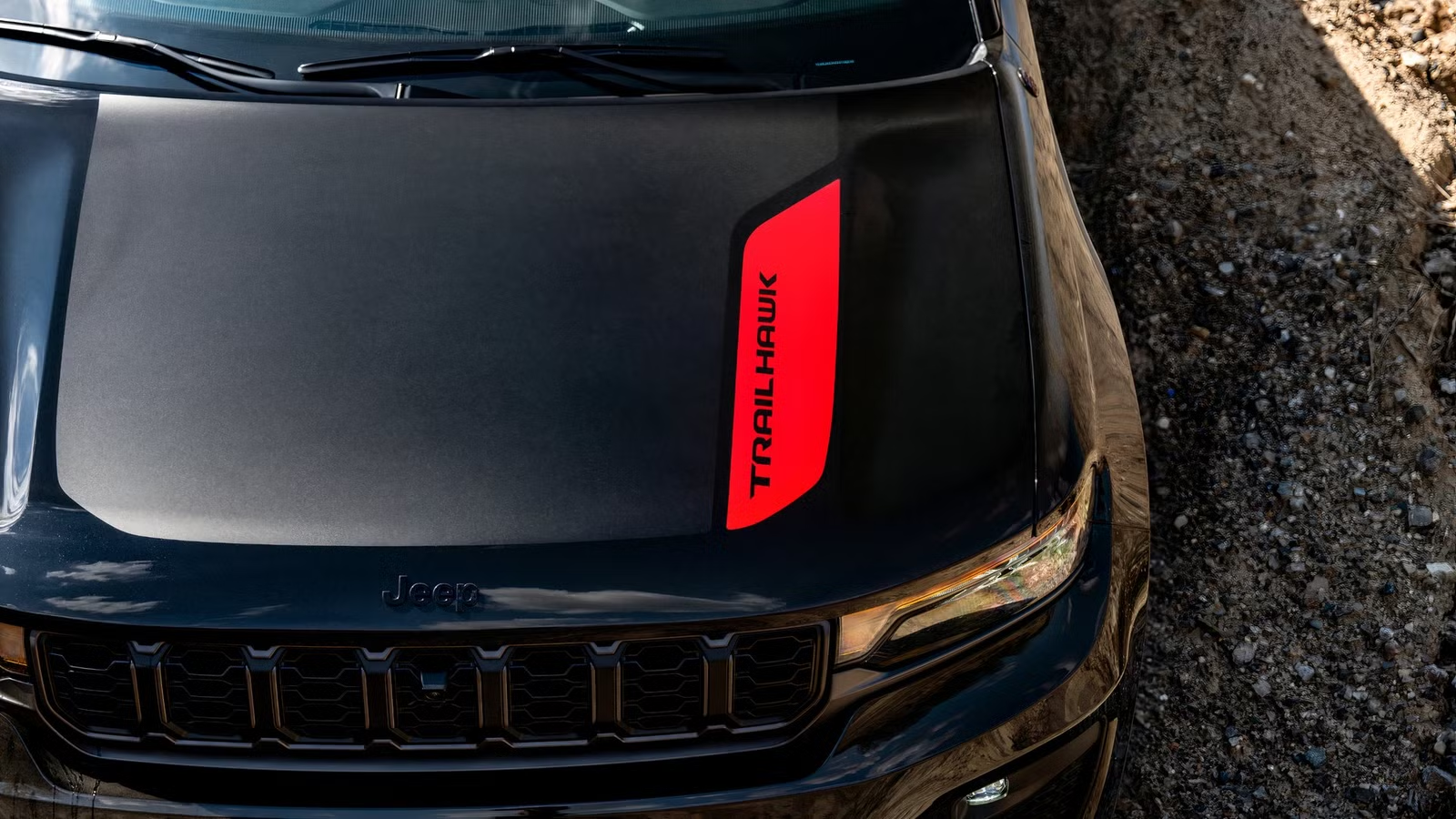
We’ve seen how gung-ho Stellantis is with its engines, and we’ve witnessed the pushback that comes with it, too. This time around, Jeep is being much more cautious with how it introduces its new Hurricane engine. Rather than wipe the slate clean of the 15-year-old Pentastar 3.6-liter V6 for a 2.0-liter turbo-4, Jeep is slowly introducing it into the Grand Cherokee’s lineup in higher trims.
The V6 is still available on the base Laredo and Laredo X, with higher trims getting the new turbo engine. Just like the Hemi getting trumped by the Hurricane turbo-6 engine on paper, the little 4-cylinder engine has something to prove and is more than up to the task. Here’s how it stacks up against some of the other engines employed by the Grand Cherokee.
The 2.0-liter Hurricane Engine Is A Category 5 Storm
Stellantis Hurricane 4 EngineStellantis
More often than not, the method chosen by automakers to boost power from low-displacement engines is by slapping a turbocharger on it. In this case, Stellantis chopped off two cylinders of the 3.0-liter Hurricane inline-6 to make a 4-cylinder variant and found new ways to ignite its air-fuel mixture to maximize power. The little engine is good for 324 horsepower and 332 pound-feet of torque, numbers that are only possible thanks to Stellantis’ new turbulent jet ignition (TJI) technology.
A total of eight spark plugs (two per cylinder) are put to work in the Hurricane 4, where one is used in a familiar manner to ignite the mixture in the combustion chamber and the other in the TJI chamber placed in the middle of the four valves. Port fuel injection and high-pressure direct injection (350 bar) are used to spray fuel into the cylinders, where it runs on the Miller Cycle for increased fuel economy. The TJI chamber uses its own spark plug to ignite the mixture prematurely and disperse combustion evenly across the piston head. The result is a 12:1 compression ratio in an engine built for maximizing power and economy.
2027 Jeep Grand Cherokee TrailhawkStellantis
The added 35 PSI of boost from the variable geometry turbo goes a long way in this application for a few reasons. The first is the higher-than-usual compression ratio for a turbo engine (for example, Ford’s 2.3-liter turbo in the Mustang is 10.6:1) and its ability to provide low-end torque as well as sharp acceleration for a turbo-4 when cruising. Stellantis says it’s able to accomplish both with a variable geometry turbo rather than the more common twin-scroll design, the latter of which provides better low-end power but sacrifices acceleration when cruising at higher speeds.
If any of the new features sound futuristic and high-tech for a brand like Jeep, remember who its owners are. Chrysler built its brand on being the most engineering-forward automaker to hail from Detroit, something that it instilled in all the brands it picked up along the way before its mergers with Daimler, then Fiat, and most recently Peugeot to form Stellantis. The Hurricane 4’s high-tech-ness doesn’t come from within one of the original Chrysler brands, however. It comes from Maserati’s Nettuno V6 engine, where the idea of a pre-chamber ignition system stems from Formula 1 power units.
Where Does It Stand Against The Pentastar V6 And Hemi V8?
2026 Jeep Grand Cherokee SummitJeep
On paper, the Hurricane 4-cylinder crushes the Pentastar V6 in every category. It offers 31 extra horsepower over the V6’s 293 ponies, and 72 more pound-feet of torque than the 260 put up by the old 6-cylinder. The Hurricane returns equal towing figures with the V6, too. It’s able to haul 6,200 pounds when put to work in the Grand Cherokee, with both engines surpassed only by the 2021-2023 5.7-liter Hemi V8-powered Grand Cherokees, which are good for 7,200 pounds when properly equipped. The new engine even comes equipped with the same TorqueFlite 8-speed automatic gearbox Jeep has been using for quite some time.
Separating the Hurricane 4 and the Hemi in terms of output is just 33 horsepower and 58 pound-feet of torque, and the Hurricane 4 earns better fuel economy at 21 city, 26/27 highway (4WD/2WD), and 23 combined. The V8 was rated at 14 city, 22 highway, and 17 combined with its standard 4WD drivetrain. Despite lacking the sizzling V8 sounds Jeep fans enjoy from their SUVs, the Hurricane 4 makes for a better everyday vehicle for owners who prioritize economy before all else.
2026 Jeep Grand CherokeeJeep
The Hurricane 4 was built to do more with less. That’s prevalent with its small displacement and low cylinder count, but inside the engine, it’s the same story. This engine is able to trounce the outgoing 2.0-liter turbo-4 by squeezing 20% more power out of 2.0 liters, all while consuming 10% less fuel in the process. Putting all that aside, the fact that it can produce 162 horsepower per liter from the same displacement as a Honda Civic Type R (which can only muster 157.5 per liter) is both intriguing and unheard of in a utility-focused application. Even large-displacement V8s with high horsepower numbers don’t achieve the same level of power density within each liter of displacement.
Grand Cherokees equipped with the Hurricane 4 still pack the same 23-gallon fuel tank models that the V6 and older V8 models came with. Stellantis says this will allow the SUV to roam 529 miles on a single tank. If that figure is accurate (and if you pack light), you could take the Grand Cherokee from Washington D.C. to Boston, Massachusetts—a nearly 440-mile trip along Interstate 95—with range to spare. The Pentastar V6 will drain its tank after 506 miles, both of which beat the now-discontinued 4xe model’s 470 miles of gasoline/electric range thanks to the PHEV’s smaller tank to make space for the hybrid battery.
Why Is Jeep Keeping The 3.6-liter On Sale For 2026?
2026 Jeep Gladiator Mojave X 3.6L V6 engine pentastarStellantis North America
Likely wary of severe pushback from owners, Jeep is looking to calm the waters as it begins to roll out more fuel-efficient engines. The 3.6 remains as the only engine option on the Laredo and Laredo X, but is not available on the Laredo Altitude and up. A few reasons contributing to the Pentastar’s life being extended into 2026 (Jeep has not announced its plans for the future of the V6) include consumer perceptions of the new engine, and likely a large stockpile of parts to build new V6 engines.
The Hurricane 4 is also a brand-new engine for Stellantis despite the twin-turbo 3.0-liter straight-6 entering the scene in 2023. Aside from its missing two cylinders, the Hurricane 4 has different internals which differentiate it from larger 6-pop mills. The F1-derived pre-chamber ignition (in a Jeep!) is a novel application in an engine built not for all-out performance, but for economy and a robust torque curve. The 3.6-liter V6 has history, too, which we’ve covered at length for its reliability and versatility over the last 15 years.
With the V8 revival underway at Stellantis, the question is no longer if Jeep will ever put a V8 back in the Grand Cherokee, but when. The 3.6 will likely be phased out to make room for the V8, which would slightly increase the average fuel economy of the entire Grand Cherokee lineup with just a 4-cylinder and a V8 on offer. Other models still employing the Pentastar V6 in 2026 are the Wrangler, Gladiator, Ram 1500, Dodge Durango and Chrysler Pacifica.
The Hurricane 4 might not be replacing the 3.6 just yet, but more models will likely start to join in on the fun. Anything that currently uses the V6 (save for the Ram 1500) is up for discussion, but the Maserati V6-derived engineering leads us to wonder what the performance applications are for this little 4-cylinder. The upcoming Dodge GLH, which harkens back to Carroll Shelby’s work on the Omni GLH (slang for “goes like hell”), is more than likely where we’ll see the first performance application of this engine in one of Stellantis’ mainstream brands. The Hurricane 4 wasn’t built for the gas-hungry V8 enthusiasts, nor was it made to replace the beloved 3.6 from the outset. It was built to prove the 4-cylinder engine could be the sweet spot that combines economy with power in the modern era without any mention of the word “hybrid.”
20
Base Trim Engine
2L I4 ICE
Base Trim Transmission
TorqueFlite 8-speed automatic
Base Trim Drivetrain
Rear-Wheel Drive
Base Trim Horsepower
324 HP @6000 RPM
Base Trim Torque
332 lb.-ft. @ 3000 RPM
Base Trim Fuel Economy (city/highway/combined)
19/26/22 MPG
Segment
Midsize SUV
Sources: Jeep
