

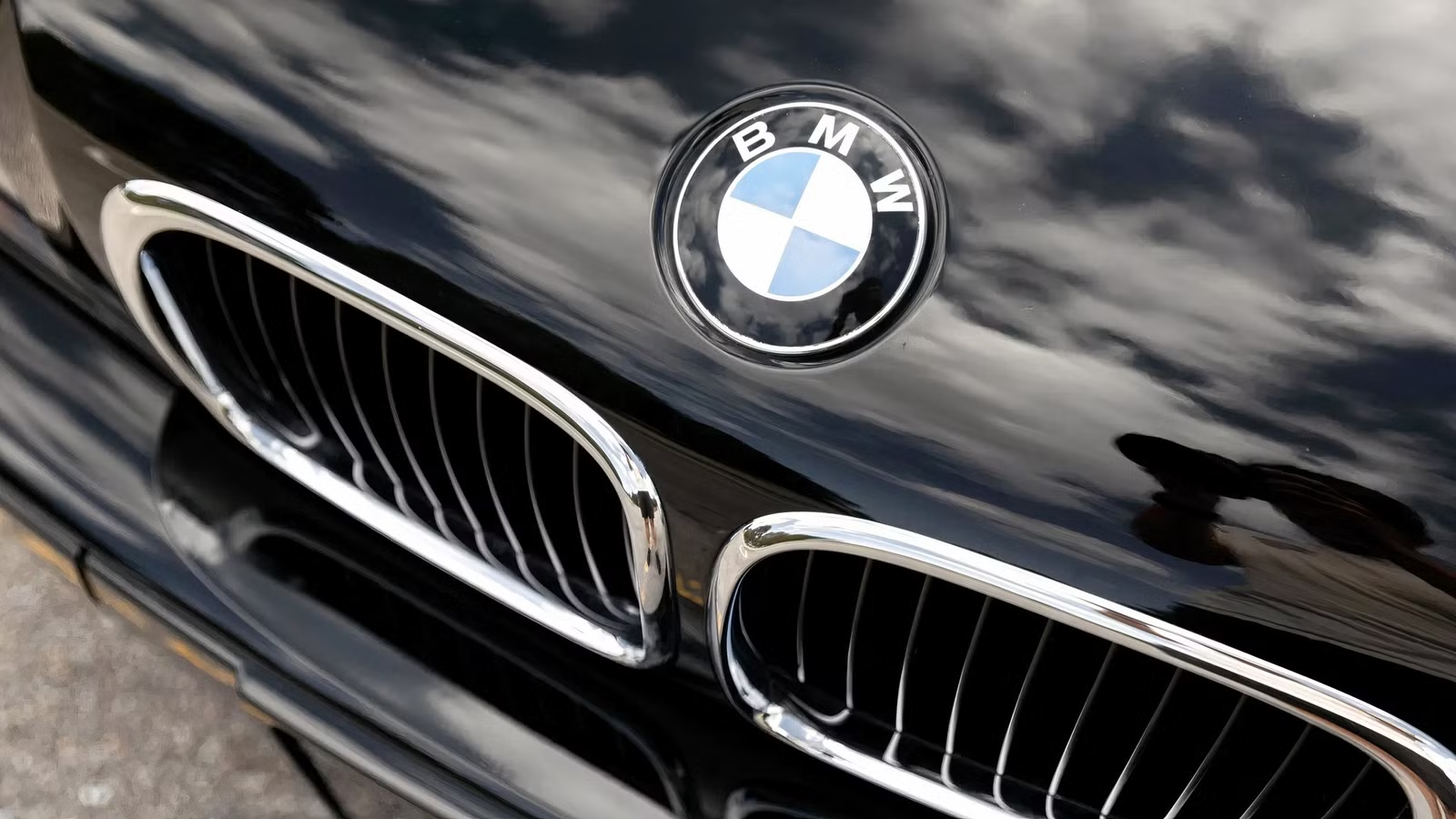
The allure of a luxury executive sedan can be very strong when new. After all, what’s not to love about a BMW 5 Series for example, a car that sits in the heart of the premium market and comes with a fine naturally aspirated inline-six, a proper manual transmission option, and rear-wheel drive. Yet the specter of depreciation is large and can quickly turn such a fabulous asset into a liability, coming back to bite when the first owner wants to move on. And elements like age, maintenance risk, and luxury brand repair costs certainly punish this type of vehicle, representing both a risk and a potential opportunity in the used car market too.
This is where a vehicle like the E39 generation BMW 530i can expose the strange logic of luxury car depreciation. Used buyers need to be careful, as the wrong one can feel as if it’s a financially reckless old BMW. But if those buyers find a great example, then it must surely be one of the most satisfying used German sedans within reach.
The E39 530i Is What Happens When Depreciation Misses The Point
2001 BMW E39 530i front quarterBMW
2001 BMW 530i Sedan, E39 Generation Specifications
Engine
3.0-liter M54 inline-six
Transmission
Five-speed manual or five-speed automatic
Drivetrain
Rear-wheel drive
Power
225 hp
Torque
214 lb-ft
From a distance, an old luxury sedan may appear to be alluring, and it may still look every inch the executive car, even though depreciation may have stripped it of its dignity. That depreciation may have been far crueler to its first-time owner than it should have been, as many of these E39 530is are still premium in terms of their presentation. In other words, they may not have aged like an appliance as depreciation might have you think.
When new, a 2003 BMW 530i sedan sold for $41,100, although options would often push real-world prices higher. Today, you may be able to find a clean example for around $10,500 in the used car market, while for a driver-grade car the price is often dramatically lower. And this is for a car that’s a genuinely handsome, rear-drive BMW from the times before the 5 Series became heavier, larger, more digital, or more complex. It’s not an M5 in any shape or form, but it still gives an owner plenty of revered BMW DNA with good chassis character, excellent stance, and well-designed cabin logic.
The 530i Was The Sweet Spot Of The Late E39 Lineup
2001 BMW 530i sedan rear quarterBMW
BMW revised the 5 Series range in 2000 and the 530i replaced the 528i as its most powerful six-cylinder version. The 530i went on sale through May 2003 and came equipped with BMW’s 3.0-liter M54B30 inline-six. This produced 225 hp at 5900 rpm and 214 lb-ft of torque at 3500 rpm, paired with a five-speed manual transmission as standard and rear-wheel drive. The naturally aspirated inline-six produced enough power to make the 530i feel smooth and effortlessly premium and the car fitted into the range well, alongside the 540i with its V8 and the legendary M5. For many, it was the better everyday choice because it avoided the complexity and weight of the V8 models and kept the classic BMW inline-six identity.
The M54 Inline-Six Is The Reason This BMW Still Has A Following
2001 BMW 530iBring A Trailer
BMW has come up with some redoubtable engines over time, but the M54 inline-six may be one of its best. It’s got a good reputation for durability and longevity, just as long as its owners take care of it properly. This reputation carries over into the used car marketplace, if the vehicle comes with good documentation. Potential used buyers will want to look carefully for any evidence of overheating, cracked cooling components, or deferred maintenance along the way.
The 530i’s 3.0-liter engine may work so well because it is mechanically simple by modern luxury standards. It features a very conventional six-cylinder layout and delivers its performance perfectly well in naturally aspirated form without the benefit of turbos or hybrid assistance. To help achieve its goals, BMW increased the piston stroke to reach the 3.0-liter displacement versus the earlier 528i engine, and this 24-valve DOHC features variable valve timing.
2001 BMW 530iBring A Trailer
Still, prospective owners need to be aware of potential challenges related to these M54-era cars. For example, the plastic expansion tanks on six-cylinder E39 models may need to be replaced, as the heat in the engine bay can make the plastic particularly brittle. Other age-related concerns could include tired suspension bushings, sticky window regulators, oil leaks, broken display pixels, dodgy sensors, and worn interior electronics.
None of these problems will automatically ruin a car, but they may well alter the buying equation. A particularly cheap E39 may not turn out to be a bargain if it has tired shocks, odd warning lights, old tires, or an unknown cooling history. By contrast, a documented 530i that has good suspension, clean fluids, refreshed cooling parts, and a smooth idle is another matter altogether.
The E39 530i Still Drives Like A Proper Executive Sedan
2001 BMW 530iBring A Trailer
The engine may be the headline maker for this car, but there’s far more to enjoy as well. Admittedly, the E39 530i isn’t fast by modern sports sedan standards, with technical data showing that the 530i manual takes 7.1 seconds to 62 mph and the automatic 7.4 seconds. But the car still feels very capable along its path to those numbers. It features double-pivot front suspension, four-link integral rear suspension, ventilated anti-lock disc brakes, and dynamic stability control, while some examples will also have M Sport suspension. So, this car doesn’t represent just a luxury shell with a decent engine but has a chassis that’s central to its overall identity.
2001 BMW 530iBring A Trailer
Also, the 530i is very purposeful on board. There’s a slim-rimmed steering wheel with a dashboard that’s angled towards the driver without becoming theatrical. The cabin architecture seems sensible in a way that many newer luxury interiors may not be, and there’s enough sound insulation and equipment to feel executive.
Related
The G30 BMW M550i Costs Half As Much As A New M5, And Is Just As Quick
If a quick BMW sedan is what you’re after, you don’t need to spring for a new M5 when you have this as an option.
For everyday use, the 530i hits all the markers with the features that matter. It comes with automatic climate control, cruise control, power seats, stability control, and a moonroof. There are also heated mirrors, an available navigation system, leather sport seats, xenon headlights, and parking sensors, depending on the equipment level. While some of that technology may feel a little dated today, everything is still there. This is not a car BMW engineered around showroom spectacle but around everyday usability and long-distance confidence instead.
The Bargain Only Works If The Maintenance History Is Better Than The Price
2001 BMW 530iBring A Trailer
Spend some time browsing through used market classifieds, and you’ll quickly see a tale of two markets. At the bottom end, you’ll find rough examples that seem very attractive in terms of their price, but where deferred bills could quickly eat up the savings. At the top, there are plenty of clean manual cars, as well as some rare color examples, Sport Package cars, and well-documented low-mileage vehicles that appeal to enthusiasts.
On the auction circuit, individual 530is can still be approachable. One sold for only $6,600 in February 2026 with 147,000 miles on the clock, but it did come with several asterisks, including a non-working sunroof, damaged pixels, a missing spare tire, and some cosmetic flaws. The moral here is that it’s often better to look for a $10,000 car than to opt for a $5,000 car that may have $5,000 worth of suspension, oil leak, cooling, and other fixes in the future. And this means that the purchase price is only the entry ticket because the service history is the real valuation document.
Related
BMW’s M70 V12 Anchored An Entire Generation Of 8 Series Loyalists
Three decades on, this V12-powered sporting cruiser continues to attract enthusiasts.
The E39 530i has predictably depreciated, just like any unfortunate luxury sedan. But having said that, the right one can still offer the design restraint, mechanical honesty, and six-cylinder smoothness that defined BMW’s reputation in the first place. That said, the wrong one can surely be a money pit. And the idea that this car can run forever only applies if a previous owner has maintained it with more care than its market value might suggest.
But for a prospective buyer willing to perform the right amount of due diligence, there may be a prize at the end. That buyer may be able to find a once-expensive German executive sedan for relatively modest money, and it’ll still have enough engineering depth to make depreciation hang its head in shame.
Sources: BMW, Cars and Bids, Bring a Trailer, Classic.
