

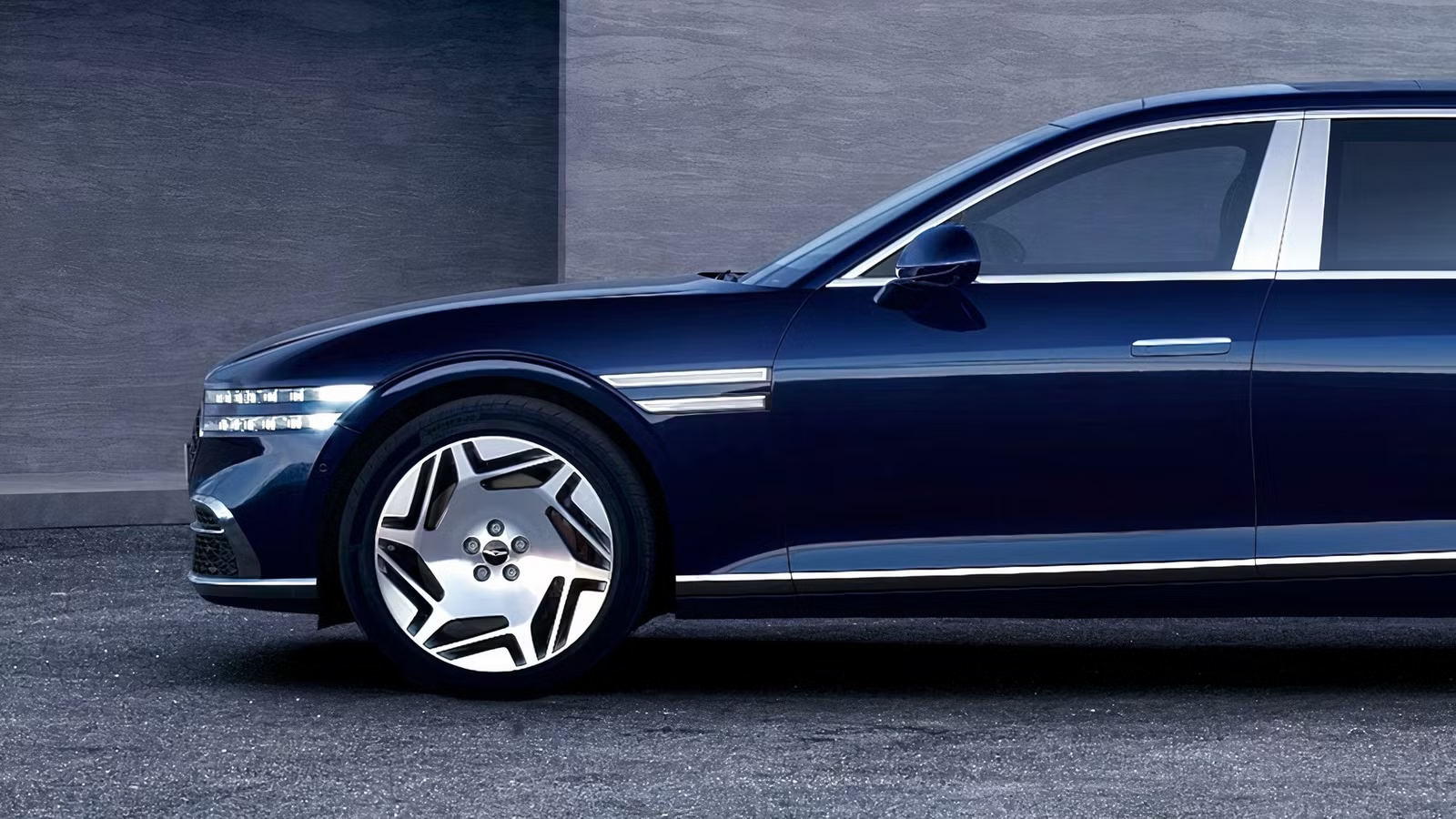
Traditionally, large flagship luxury sedans are equipped with powerful V8 engines. For some examples, imagine the Audi A8/S8 with their 4.0L twin-turbo V8s, the Jaguar XJ Supercharged and its 5.0L supercharged V8, the Lexus LS and BMW 7 Series both used V8s not long ago, and so on.
The world is changing, to say the least. Through a combination of emissions regulations, and the simple fact that smaller, boosted engines can offer the same performance as older V8s, some luxury automakers have abandoned their V8 roots. Genesis is one of those automakers, but it took a different approach. Its flagship G90 started life 10 years ago with an optional 5.0L V8 — today it uses tech that no other flagship sedan copies.
All specs have been pulled directly from the manufacturers. Pricing is correct at the time of writing, and excludes destination, options, taxes, incentives, and dealer fees. Automakers reserve the right to change prices at any time, without notice.
Electric Supercharger V6 VS Twin-Turbo V8
2025 Genesis G90 Silver High Front Angled ViewGenesis
Genesis isn’t the only brand to forego its V8 heritage in favor of smaller engines. The 2026 Lexus LS uses a twin-turbo V6 and the base model BMW 7 Series is reduced to a hybrid inline-six-cylinder. Those two examples use fairly normal configurations, though. Genesis, on the other hand, uses a unique electric supercharger to top its V6.
At its most basic, the G90’s entry-level trim comes with a 3.5-liter twin-turbo V6 that makes 375 horsepower and 391 lb-ft of torque. Its two more expensive trims compete with its V8-powered rivals by way of twin-charging. The automaker took the G90’s twin-turbo V6, then added an electric supercharger on top to boost power output to 409 hp and 405 lb-ft of torque. The base model can sprint to 60 mph from a standstill in about 5.5 seconds, while the supercharged variant reaches the 60 mph mark in about 5.1 seconds, according to independent testing.
It’s not like any other supercharger, though. While most superchargers are belt-driven, the G90 uses a 48-volt battery pack (hence the “e” in the “e-SC) trim levels. This removes any sense of lag from its purely turbocharged variant, resulting in the smoothest, quickest ride a buyer can have in a G90.
“It eats up lumps and bumps with ease while keeping the chassis reasonably flat in corners, which adds up to a lovely, smooth ride – despite riding on those 21-inch wheels. As the engine is supercharged, there’s no lag from turbos spooling up whatsoever, and power comes on smoothly and, if need be, urgently.”
– Ian Wright, Senior Road Tester, CarBuzz (2024 Genesis G90 Drive Review)
2027 Mercedes-Benz S-Class front 3/4 angle in black while drivingMercedes-Benz
The G90 is built to compete with the S-Class. Mercedes-Benz’ flagship sedan is getting a total refresh for the 2027 model year, including new interior features, new styling, and a V8 for the S 580 trim. At its most basic, the S 500 still uses an inline-six. However, the brand is reinventing its best sedan by making the S 580 the first luxury sedan with a flat-plane V8.
Traditional cross-plane cranks are arranged at 90 degrees to help eliminate secondary vibrations while delivering an even firing sequence that feels and sounds smooth. A flat-plane crank is arranged at 180 degrees, which feels, sounds, and looks like two inline-fours connected at the crankshaft. It revs faster with lower rotational mass and has sharper throttle response at the cost of higher-frequency vibration and louder engine noise.
Nevertheless, the S 580 4Matic uses this 4.0-liter twin-turbocharged V8 dubbed the M177 Evo. It makes 530 horsepower and 553 lb-ft of torque, which gets sent to all four wheels via a nine-speed automatic transmission. Mercedes-Benz claims a 3.9-second 0-60 mph sprint.
Genesis G90 VS S 580 Reliability Compared
2023-2025 Genesis G90 Sedan side angle in whiteGenesis
When taking recalls and complaints to the National Highway Traffic Safety Administration (NHTSA) into account, the G90 is one of the most reliable flagship luxury sedans on the market. When it debuted, the model used either a 3.3-liter turbo V6 or a 5.0L V8. However, it switched to a 3.5-liter V6 starting for the 2023 model year. The 2023 model has six recalls and only five complaints, while the 2024 and 2025 models have four recalls each. Complaints are so minimal that we wouldn’t consider any issues even remotely common.
That doesn’t mean the G90 is entirely free from problems, though. The 2023 model year’s recalls include fixes for problems including a fuel leak at the pipe connection between the fuel pipe and fuel rail, loss of drive power from fuel pump failure, and a small handful of units were affected by a recall pertaining to sudden unintended braking due to a faulty highway drive assist radar.
As long as owners take care of those recalls at their local dealerships free of charge, there aren’t many other notable issues surrounding the current G90. In other news, CarEdge’s data shows that the G90 isn’t actually too expensive to maintain when compared to rivals. Owners can expect to spend an estimated $2,822 on maintenance and repairs over its first five years on the road.
2027 Mercedes-Benz S-Class rear 3/4 angle in blackMercedes-Benz
Since the S 580’s engine is new for 2027, we don’t have any data on how it might stand up to the test of time. Flat-plane engines are typically reserved for sports cars that undergo more abuse, so the M177 Evo should be built plenty strong to handle a luxury sedan driver’s behavior. That said, there’s plenty of data from previous S-Class model years to judge potential reliability.
Firstly, CarEdge’s data shows the S 580 as costing almost double the money to maintain it over five years. Owners can expect to spend $4,362 on average just to keep their S-Class running in good condition. While some S-Class years are highly reliable, like the 2008 model year, they fail to hold value over time due to those expensive maintenance costs. Previous generations’ air suspension has been known to leak — replacing them can cost around $500 per corner in parts alone.
Other expensive S 580 repairs, according to RepairPal, include:
- Throttle Body Replacement: $3,471 – $3,934
- Brake Caliper Replacement: $1,798 – $1,883
- Brake Vacuum Pump Replacement: $901 – $1,079
- Radiator Hose Replacement: $570 – $627
- A/C Refrigerant Pressure Switch Replacement: $430 – $480
Again, the 2027 model hasn’t had a chance to prove itself yet. We might be pleasantly surprised by its reliability five years from now, but the model has historically had some expensive common problems.
The G90 Keeps Up While Remaining The Budget Option
2025 Genesis G90 Front Wheel Detail ShotGenesis
To be completely fair, it sounds ridiculous to call a new Genesis G90 a “budget option.” However, it’s still tens of thousands of dollars cheaper than the 2027 S 580. The G90 is available in three trim levels; the 3.5T AWD kicks it off at $92,700 before destination, options, and fees. The 3.5T E-SC AWD is the cheapest trim with an electric supercharger, since it starts at $103,000, then the 3.5T E-SC Prestige Black AWD tops the lineup at $105,750.
The S-Class is getting more expensive for the 2027 model year due to its refresh. The most basic version you can buy is the S 500 4Matic, which starts at $112,550. It comes with a 442-horsepower 3.0L turbocharged inline-six mild hybrid powertrain that most drivers will feel is adequate. That said, the S 580 is the reason many buyers walk in the door. It starts at $134,600 before destination and options, and its new V8 may make it all worthwhile.
Both Are Nice To Drive And Be Driven Around
2023-2025 Genesis G90 Sedan interior view of the front cabinGenesis
Both models’ prices start to make more sense once you actually step inside them. Either model would make for a great driving experience, or a great place to be driven to your next corporate meeting or golf session. Let’s start with the G90’s cheaper E-SC trim. The driver will navigate in comfort knowing they’re protected by a suite of safety features including: forward collision avoidance, lane keep assist, lane following assist, driver attention warning, blind-spot collision avoidance, and much more.
As for comfort and luxury features, the E-SC AWD model comes with Nappa leather upholstery, matte wood and carbon fiber trim, heated, ventilated, and massaging front and rear seats, front seat power bolsters, a heated steering wheel, tri-zone climate control with rear controls, active noise control, a Bang & Olufsen 3D audio system, and more.
2027 Mercedes-Benz S-Class Sedan front cabin viewMercedes-Benz
The 2027 S 580 is the most advanced S-Class sedan to date. Sure, the new V8 makes waves, but the safety and luxury features are what most owners care about. Standard safety features include MB Drive Assist (a suite of driver assists that help with steering and lane changes), traffic sign assist, speed limit assist and warnings, crosswind assist, active brake assist, evasive steering assist, and more.
As for the model’s standard luxury features, buyers are automatically graced by Nappa leather upholstery, heated, ventilated and massaging front seats, heated front armrests and seatbelts, dual-zone climate control, a panoramic roof, heat- and noise-insulating glass, and more. While the G90 comes with these features as standard, buyers must pay extra to heat, cool, and massage the rear seats, among other more luxurious add-ons.
The G90 Is Unique, Even If It’s Not Cheap
2025 Genesis G90 Silver Rear ViewGenesis
Both the G90 and new S 580 have unique powertrain situations. The G90 is the only flagship luxury sedan to offer an electronic supercharger in addition to its two turbochargers, while the 2027 S 580 is the first luxury sedan to feature a flat-plane V8 that’s typically reserved for sports cars. Either way, buyers will be more than comfortable with their power outputs and driving experiences. They’re some of the most luxurious sedans that money can buy before reaching into Maybach territory.
Sources: Genesis, Mercedes-Benz, NHTSA, CarEdge, RepairPal
