

Motorcycle pricing usually follows a reasonably predictable rule. More money buys more power, better hardware, or some combination of the two. The present-day middleweight adventure class apparently missed that memo. Among three of Japan’s biggest players, the least expensive bike also happens to have the strongest engine, while spending another $800 to $1,600 actually buys fewer horses. That sounds backward until you start looking at what these manufacturers are really selling.
Middleweight Adventure Bikes Are No Longer Chasing The Same Goal
Rider aboard the Yamaha Ténéré 700 navigating off-road terrainYamaha Motorsports
Adventure bikes used to be fairly easy to understand. You wanted something comfortable enough for highway miles, durable enough for bad roads, and capable enough to keep going after the pavement ended. Midweight ADVs still do all of those things, but the category has become specialized enough that manufacturers are now choosing very different compromises. Engine output is only one of them, and increasingly, it isn’t even the most important.
Off-Road Riding Exposes What Spec Sheets Can’t Tell You
Close up action shot of the 2026 Suzuki V-Strom 800 EngineSuzuki
Adventure riding has an annoying habit of exposing specifications that street riders can mostly ignore. An extra 15 horsepower sounds fantastic until you’re wrestling a motorcycle through loose rocks at walking speed. Suspension travel, ground clearance, wheel sizes, weight distribution, throttle response, ABS settings, and ergonomics suddenly become considerably more important than what happens near redline.
The Price Ladder Runs Backward From The Power Numbers
Suzuki V-Strom 800DE sliding in the dirtSuzuki Cycles
The cheapest of these three current 2026 US-market motorcycles starts at $10,199. Move up the ladder and the next one costs $10,999. The most expensive reaches $11,799 before destination charges and accessories. Yet their engines don’t follow that same progression at all. Instead, published international outputs spread from roughly 72 horsepower at one end to nearly 92 horsepower at the other.
Even displacement doesn’t cleanly explain the pricing. These bikes use parallel-twins ranging from 689cc to 776cc, and all three have six-speed transmissions, wire-spoke adventure wheels, long-travel suspension, and real off-pavement intentions. What you’re paying extra for isn’t simply a larger engine or a bigger number on a dyno chart. The strange part is that the strongest motor belongs to the motorcycle asking for the smallest check.
Paying More Actually Gets You Less Peak Power
Action shot of the Yamaha Tenere 700 World Raid off roadYamaha Motorsports
Exact horsepower figures vary slightly because American manufacturers don’t always publish them and international sources sometimes quote PS rather than mechanical horsepower. The overall order, however, doesn’t change. The least expensive bike is rated at 67.5 kW, commonly quoted as about 90.5 horsepower or 91.8 metric horsepower. The $10,999 machine sits around 72.4 horsepower, while the $11,799 contender produces roughly 83 horsepower.
Torque narrows the gap without reversing anything. The lowest-powered bike produces about 50.2 pound-feet, while the most expensive motorcycle makes around 57 pound-feet. The powerhouse of the trio is rated at roughly 55.3 pound-feet. So if price were simply buying engine performance, somebody has arranged the shelf labels incorrectly. The explanation only appears once we finally look at which motorcycles those numbers belong to.
The Honda Transalp Delivers The Most Engine For The Least Money
Front shot of a 2026 Honda Transalp E-Clutch Sliding In The DirtHonda Powersports
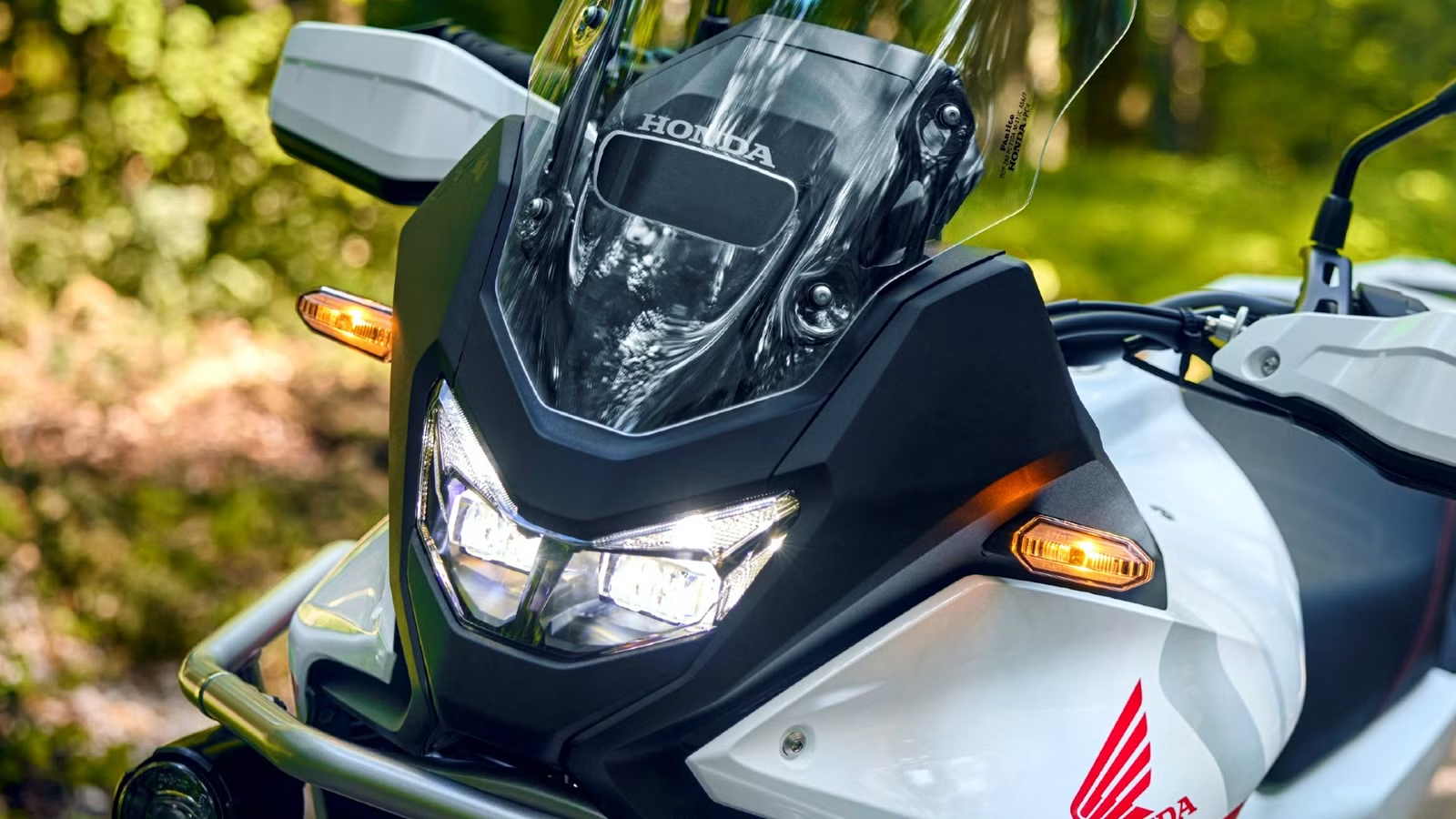
That motorcycle is the Honda Transalp E-Clutch. Honda asks $10,199 for it in the US before destination charges, making it cheaper than both rivals despite its 755cc Unicam parallel-twin producing 67.5 kW overseas. That’s roughly 90.5 mechanical horsepower, or 91.8 metric horsepower depending on the convention being used, at 9,500 rpm. Peak torque is 55.3 pound-feet at 7,250 rpm.
There’s plenty beyond the engine, too. The US bike gets Honda’s six-speed E-Clutch transmission, a 43mm Showa SFF-CA fork with 7.9 inches of travel, a Pro-Link Showa rear shock with 7.5 inches, 21-inch front and 18-inch rear wire-spoke wheels, and switchable rear ABS. Seat height is 33.7 inches, fuel capacity is 4.4 gallons, and Honda lists curb weight at 468 pounds.
Honda Optimized For Pavement First, Which Is Exactly Why It Leads On Power
2026 Honda Transalp cruising comfortably along a winding road, front third quarter rolling shotHonda Powersports
The Transalp isn’t some bargain-bin horsepower delivery system, either. It has five preset riding configurations plus two customizable User modes, Honda Selectable Torque Control, a five-inch display with RoadSync connectivity, and the ability to deactivate rear ABS off-road. The E-Clutch can handle clutch operation automatically during starts, stops, and gear changes, while still leaving the lever there whenever the rider wants conventional control.
Its personality explains the price-power advantage. Honda built a versatile ADV that happensto be particularly strong on pavement. The engine revs harder and produces considerably more peak power than Yamaha’s, while the suspension and 21/18-inch wheel combination still give it legitimate dirt credentials. It’s the logical choice for someone whose adventure riding includes long highway stints, back roads, commuting, and occasional trails.
Yamaha Charges More Because The Ténéré 700 Is Built Around The Dirt
Side shot of a rider jumping a 2026 Yamaha Ténéré 700Yamaha Motorsports
Then there’s the Yamaha Ténéré 700, and this is where horsepower-per-dollar stops being particularly useful. Its $10,999 MSRP buys a 689cc CP2 parallel-twin producing roughly 72.4 horsepower and 50.2 pound-feet in European specification. That’s nearly 20 horsepower behind the Honda despite costing $800 more. Yamaha clearly isn’t trying to win the same argument.
Instead, the Ténéré gives you a 459-pound wet weight, 34.4-inch seat, 9.4 inches of ground clearance, and 21/18-inch wheels. Its fully adjustable 43mm KYB fork provides 8.3 inches of travel, while the rear gets 7.9 inches. Yamaha also added YCC-T ride-by-wire, Sport and Explorer throttle maps, switchable traction control, three-mode selectable ABS, and a 6.3-inch vertical TFT with smartphone connectivity.
Static outdoor shot of a Yamaha Tenere 700 World Raid parked on the roadYamaha Motorsports
The key difference is packaging. Yamaha keeps the body narrow, the tank slim, and the seat relatively flat so a rider can move around while standing. Its tubular steel chassis and long suspension are designed around rough terrain rather than maximizing road performance. Someone buying a Ténéré because they actually intend to spend weekends picking lines through ruts probably isn’t going to care that the Transalp makes considerably more horsepower.
Suzuki Charges The Most For A Bike That Tries To Do The Most
Action shot of a Suzuki V-Strom 800DE being ridden off-roadSuzuki Cycles
At $11,799, the Suzuki V-Strom 800DE sits at the top of this particular price ladder. Its 776cc, 270-degree parallel-twin produces about 83 horsepower and 57 pound-feet in published testing, placing it neatly between the Honda and Yamaha on output. Suzuki pairs it with a six-speed transmission and its Cross Balancer system, with an emphasis on smooth, usable torque rather than chasing the Transalp near the top of the tach.
The DE is also the biggest bruiser here at 507 pounds. It carries 5.3 gallons of fuel, has an 8.7-inch ground clearance and 33.7-inch seat, plus 8.7 inches of suspension travel at both ends. Its wheel combination is unusual beside the other two, with a 21-inch front and 17-inch rear. Suzuki’s electronics add multiple power modes, traction control with a Gravel setting, adjustable ABS with rear-wheel deactivation, a bidirectional quickshifter, and a five-inch TFT.
Two Suzuki V-Strom 800DE models parked on top of a mountain, ariel cinematic shotSuzuki Cycles
That extra weight becomes harder to ignore as terrain gets more technical, especially beside the lighter Yamaha. But the Suzuki isn’t trying to impersonate a rally bike. It’s built to cover huge distances comfortably, carry fuel and luggage, deliver useful midrange thrust, and still have enough suspension and ground clearance to go considerably farther off pavement than a conventional touring motorcycle.
The Cheapest Bike Wins On Power, But That’s The Wrong Way To Score This Race
2026 Honda Transalp E-Clutch Closeup shot of the Tail SectionHonda
Which brings us back to that upside-down price chart. If your definition of value is maximum horsepower for minimum money, the Transalp makes an almost comically strong case for itself. Yet that doesn’t automatically make the Ténéré overpriced or the V-Strom irrational. Yamaha charges for specialization. Suzuki charges for breadth. Honda happens to offer the strongest engine while splitting the difference.
The weirdest thing about this comparison isn’t that the cheapest motorcycle is the most powerful. It’s that horsepower might be the least revealing number here. Once adventure bikes become this capable, the expensive engineering isn’t necessarily making more power. It’s deciding what happens after the road disappears, and that ultimately determines which of these three is actually worth paying for.
Sources: Various Manufacturers
