

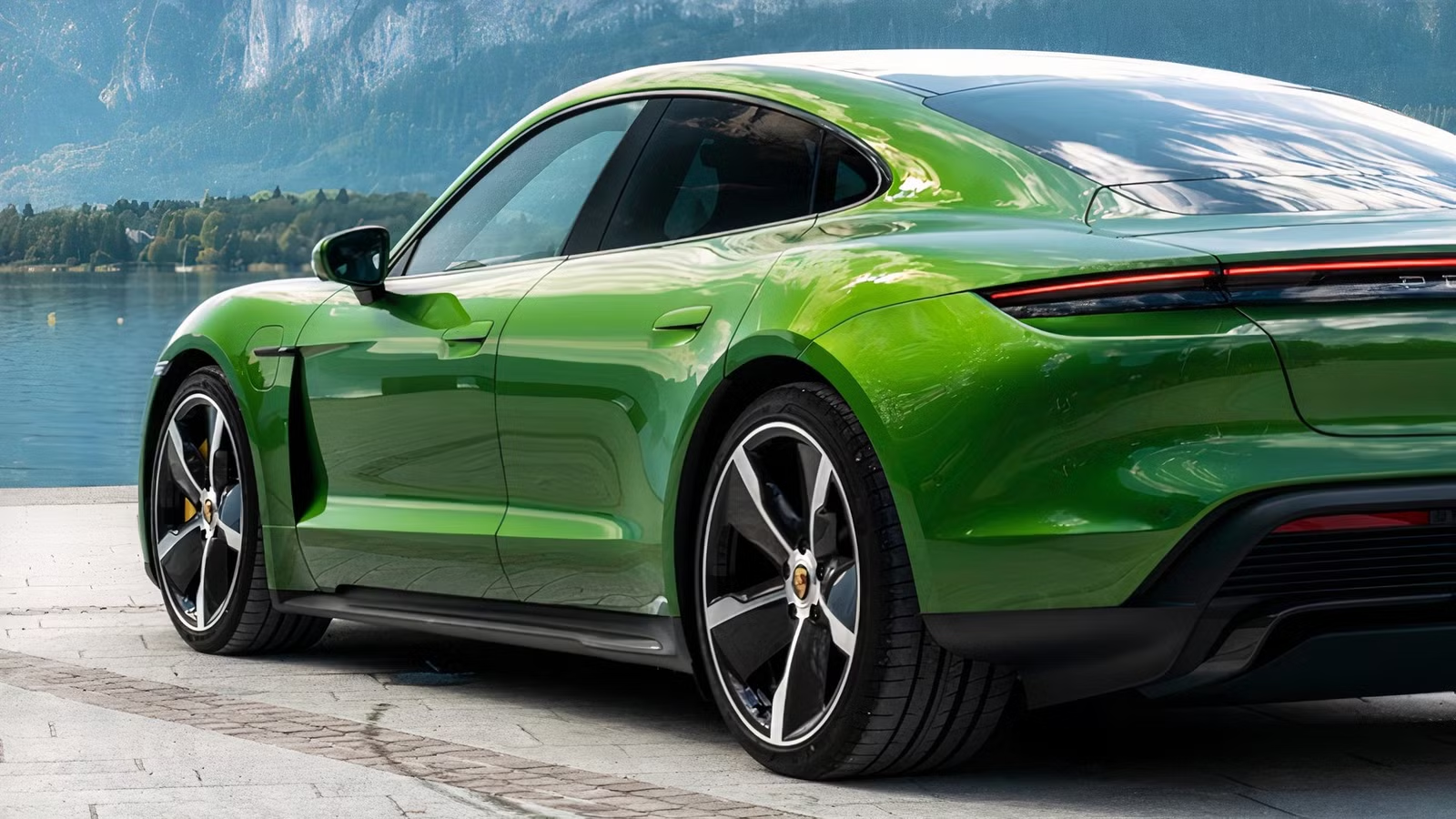
To thinkPorschewould wipe the slate clean of combustion engines in favor of electric motors is a thought so chilling it keeps us up at night. The knee-jerk reaction of most purists wasn’t one of excitement, as the skepticism was warranted given Porsche’s efforts to save combustion engines for future use.
What the firm conjured up as its first all-electric sedan, however, was one of the fizziest and most engaging EVs that dams any thoughts cast to spite its propulsion system. What was a $106,500 electric sport sedan just a few years ago is now a $50,000 bargain thanks to the used EV anomaly that spares no badge. Are Taycans worth the hype at half-price? Have we got news for you…
How a $107,000 Porsche Became A $50,000 Bargain – And Why It Still Drives Like One
2022 Porsche Taycan GTS SPort Turismo Exterior Finished In RedPorsche
A quick drive behind the wheel of any large or medium-sized electric vehicle will provide its driver with a lesson in all three of Sir Isaac Newton’s laws. EVs are better described as “dense” more than “heavy”. The latter is used often when describing electric cars, but it conjures thoughts of something the size of a Toyota Camry handling like a Chevy Tahoe.
That’s not always the case. It’s much easier to pinpoint where the weight of a vehicle is hiding when it has an electric powertrain, since they all have a battery beneath the floorboards and, in some cases, act as a structural support for the vehicle if built on a dedicated EV platform. But if any company were to take a crack at fixing the way an electric car behaves on both road and track, it would be Porsche.
Electric vehicles offer horsepower in bulk and the curb weight to match, which sounds like the blueprints for something horrible if you’re not prepared. Modern performance-oriented EVs aren’t controlled with the same spaghetti-thin reins other powerful EVs might use to keep a car at bay. But Porsche – with its ability to make the wrong things work flawlessly – turns the tables on how EVs should handle, and the Taycan is living proof of its hard work.
What We’d Buy: 2020–2024 Taycan 4S
2025 Porsche Taycan Sport Turismo – rear 4s badge
Porsche
The 4S sits smack in the middle of the Taycan range without suffering from middle-child syndrome. It’s got enough power to defend itself and doesn’t post a premium for five little letters spelling out “Turbo” across the trunk. New, 2020 Turbo models were $150,900. Now, they’re between $60,000–80,000. Its 670 horsepower and 626 pound-feet of torque are better felt than read aloud, especially now that new models produce 874 hp and carry a $184,600 base MSRP.
The base 2026 Taycan offers slightly better value at $105,800, with its single-motor RWD system producing 402 hp. Base models from 2021-2024 produced just 321 hp from the same drivetrain layout and cost nearly the same as the potent 4S. For the same money, the 4S offers AWD and extra power thanks to the same value retention statistics as every other Taycan.
$50,000-70,000 gets you the best concoction of useable power and balanced performance from an electric sedan that just happens to be a Porsche. Oh, it also comes in the shape of a wagon, if you’re into the idea of an electric Porsche station wagon – which we very much are.
2024 Porsche Taycan Cross Turismo rear 3/4 view on roadPorsche
Not since it decided to build the Panamera in a long-roofed version did Porsche make a station wagon. Granted, Audireceived a little advice from one engineering consulting firm to build the original RS2 Avant. If it weren’t for that, Porsche’s decision to make its own wagon would’ve been met with the same pushback as the Taycan.
The Panamera proved valuable to saving the brand, just as the original Cayenne did. To keep the run of sports cars going until the bitter end, it needed a product to fund such dreams in modern times. That meant going electric, but that didn’t mean it had to stop being a Porsche.
The bonus of being a station wagon is that it’s both usable and immensely cool. The 2023 Cross Turismo 4S is one of the best station wagons available for the price. It just happens to be electric. 60 mph comes faster than you think at 3.9 seconds.All 482 hp is used on each intoxicating jab of the accelerator, activating the primal part of the brain that wants to keep touching the fire or poke the bear.
Poke it too long, and it’ll quickly turn its occupants green. It’s mysteriously light, noticeably more docile than the Tesla Model S or even the equivalent Panamera, and braking doesn’t bring about fears of outrunning its tires (especially when those six-piston calipers are the size of a brick phone).
Before you start browsing listings, there are a few ownership costs that don’t show up on the window sticker — and one of them could shift your calculus entirely.
Hidden Costs of Taycan Ownership
The 4S might be the bargain buy, but used Porsche ownership comes with costs that don’t show up in the listing price — here’s what to budget for. Besides the premium the Porsche crest calls for, the Taycan is still the better of the two options when discussing the similarAudi RS e-tron GT, which uses the same underpinnings to offer a similar experience tuned by the four rings.
Like any EV, the cost to add a charging station to your home will be a substantial fee for first-time EV owners. Wiring a 240-volt outlet (if needed) can drive the price up by a few thousand dollars, but houses with sockets already in the garage keep costs between $800–2,000.
Registration and document fees vary by state, with some charging extra for PHEVs and EVs to supplement lost revenue from tax levied on gasoline. Insuring an EV is a complicated venture as well, even if you bought it at a discount on the used market. Powertrain components that might need to be replaced are a little more expensive than gasoline cars, which can be reflected with higher premiums.
Specific to the Taycan, however, there are fewer issues than you might expect. It earned 4.4 out of 5 stars in reliability ratings submitted by owners to Kelley Blue Book. The largest cut of the cost of ownership, depreciation, has already taken effect, which is how we’re able to shop for them on a budget. Without it factored in, repairs, insurance, and maintenance all ring up to a few thousand dollars a year.
Porsche’s factory warranty coverage for high-voltage batteries is eight-years/100,000 miles, and its certified pre-owned bumper-to-bumper warranty starts after the vehicle’s original four-year/50,000-mile warranty ends. An additional one-year warranty can be purchased for Porsche CPO cars as well at the time of purchase.
Why EV Depreciation Is A Buyer’s Market – And Why It Won’t Last Forever
2024 Porsche Taycan Turbo parked together diagonallyPorsche
The depreciation of EVs is an alchemy straightforward enough that it makes sense to everyone, yet no one understands why it happens. It’s a multi-pronged school of thought that pulls together consumer input, technological advancements, and the overall market to depict a clear enough picture of why they take massive hits. The gap between residual values of combustion engine cars and EVs is closing, but the ones that have already fallen through can be picked up for quite the steal.
The biggest culprits, which set a precedent for all others to follow, were short-range, small electric vehicles whose batteries degraded so much they couldn’t achieve their original mileage estimates. Range was cut significantly in excessively hot or cold climates and was comparatively worse than gasoline counterparts, if it had any. Tesla came along to flip the script with the 2012 Model S, which offered near-alien levels of range for the time, and it continued to innovate and push forward with the idea of EVs for everyday use.
Flash-forward to the end of the 2010s, when the Model S and Model X crossover were the golden examples of what electric mobility would be, with others following the charge. It, however, would not be saved from the depreciation that all EVs suffer because of battery degradation, range depletion, and quality issues. The new EVs of the time, however, were boasting bigger and stronger batteries, with more power available and increased range.
This continues today, with battery technology increasing exponentially each year, and the marathon races proving more important than the quarter-mile sprints. Even if the battery technology is strong one year, the fact that the next round will be even more robust still dings the value of shiny-new cars with barely any miles on them.
The reason we don’t see this in ICE-powered vehicles is because that technology hasn’t changed as drastically as EVs have in the last 15 years. Once the innovation curve starts to even out, we will certainly see similar depreciation rates. Until then, luxury vehicles with electric powertrains that normally cost twice as much on the used market can be had for a bargain simply because they run on electrons and not premium unleaded.
Sources: Porsche, Kelley Blue Book, iSeeCars
