

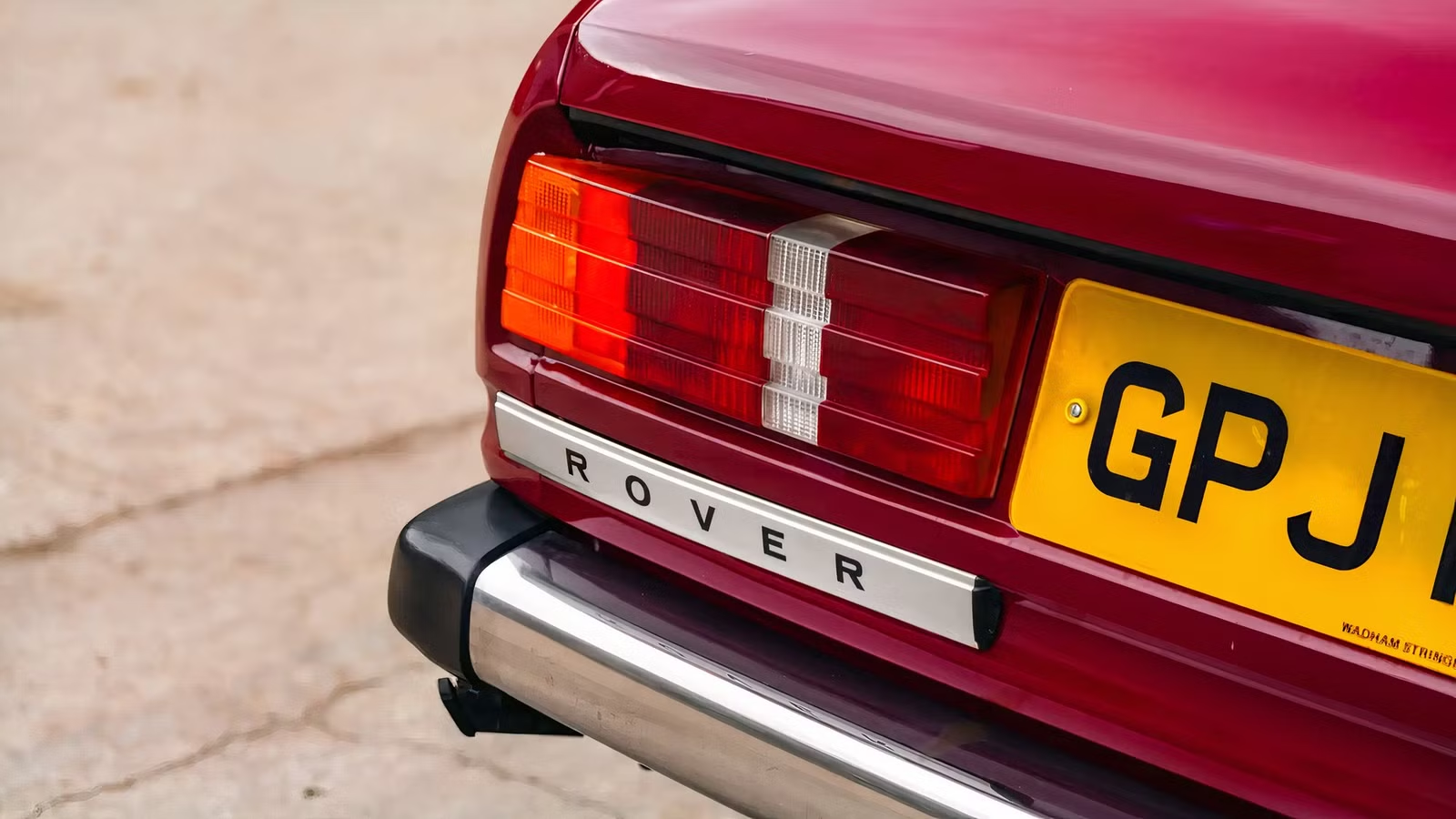
The 1970s provided us with a whole host of potent V8-powered sports sedans and grand touring coupes. The Rover SD1 was not one of them. It was a rather handsome fastback sedan with a well-equipped and superbly comfortable cabin. Unfortunately, the model fell short on power.
In fact, competitors from elsewhere in Europe got close to matching the eight-pot Rover’s grunt even with efficient diesel engines. Rover’s poor reputation for reliability didn’t help matters either.
The Rover SD1 Was A Solid Offering For Executive Buyers
1980 Rover SD1 3500 V8 Series 1Iconic Auctioneers
Arriving on the scene in the mid 1970s, the Rover SD1 was an important car for the brand, and for parent company British Leyland. It served as an executive flagship, effectively replacing the aging P6 and Triumph 2000/2500 sedans. To impress, the SD1 boasted a sleek fastback shape, which was very in vogue at the time, along with a series of compelling engine options.
Aside from the range-topping 3.5-liter V8, the powertrain options included a duo of inline-sixes. An inline-four and a turbodiesel arrived nearer the SD1’s end. Audiences in the US only got the V8, and the model was only available for the 1980 model year.
The SD1’s initial reception was warm. The British finally had a luxurious offering that could battle ever more relevant German rivals without having to shell out for a Jaguar. While the SD1 got off to a grand start in life, it would only be a matter of time before it began falling behind the competition.
1980 Rover SD1 3500 V8 Series 1Iconic Auctioneers
While a V8 helped convey a sense of affluence and importance to the vehicle, it was the same V8 the P6 and P5B had used before, and in virtually the same state of tune, too. By the point of the SD1’s launch, these models were already 10 years old. While Rover was recycling old powertrains, German rivals BMW and Mercedes-Benz were busy preparing to debut bold new units that would soon make the SD1 look more like a relic than a contemporary.
A Closer Look At The SD1’s V8
1980 Rover SD1 3500 V8 Series 1Iconic Auctioneers
1980 Rover SD1 3500 Specifications
Engine
3.5-liter V8
Transmission
3-speed automatic, 5-speed manual
Power
155 horsepower (Euro), 133 horsepower (US)
Torque
198 lb-ft
Top speed
123 mph
0 to 60 mph
c. 9 seconds
Rover’s V8 — which, of course, is actually a Buick V8 — was not a bad engine, not by any stretch. Over the years, it has powered just about everything from Land Rovers through to TVRs and no shortage of kit cars too. It performed admirably, was reliable when maintained correctly, was easy to work on, and sounded great, too.
At launch, the European-market SD1 V8 produced a maximum of 155 hp. Later models would switch from carburation to fuel injection, and here output would be boosted to a more compelling 190 hp. The version in the US also had fuel injection, but two catalytic converters choked the unit down to a miserable 133 horsepower.
1980 Rover SD1 3500 V8 Series 1Iconic Auctioneers
Because they were only available for one model year, performance specs for US models are scarce. Still, early European carbureted models could manage the 0-to-60-mph sprint in about 9 seconds and boasted a top speed of about 123 mph.
Related
Best V8 Sedans Of 2026
There are many great V8 sedans you can buy in 2026, but most of them require deep pockets.
German Competition Found A Replacement For The Rover’s Displacement
1984 Mercedes-Benz 300D TurboBring A Trailer
While the British were sticking to recipes that had worked in the past, BMW and Mercedes-Benz were exciting customers with new ideas and technologically advanced models. During the SD1’s production run, from 1976 through 1986, the BMW 5 Series, across multiple generations, posed serious competition.
Arguably the Rover’s fiercest competition came from Mercedes, though, with its midsize W123 generation of models. The W123 managed to trump the SD1 everywhere it mattered. Its build quality is legendary — these were made for immensely popular taxis, and it’s not uncommon to find examples with hundreds of thousands of miles. They also had excellent corrosion resistance; their interiors were wonderfully hard-wearing yet still sumptuously comfortable; and the powertrains on offer had Rover beat no matter which way it turned. At the top-end, Mercedes offered its 280E. Under the hood sat a fuel-injected 2.8-liter twin-cam straight-six, which produced up to 185 horsepower, eclipsing the Rover’s output with fewer cylinders and a far lower capacity.
1984 Mercedes-Benz 300D TurboBring A Trailer
While the SD1 attempted to keep its inline-four engine range relevant across Europe, the Mercedes had it beat here as well. Humble grades like the 200E and 230E were fair competition, whereas diesel models were slow, albeit incredibly efficient, and immensely durable.
Rover was late to the game, bringing a diesel into the mix, a full six years later than Mercedes. At the top of Mercedes’ diesel tree sat the 300D Turbo. It kicked out 125 hp from a boosted inline-five, a full 35 horsepower more than the SD1 2400TD of 1982, alongside 185 lb-ft of torque, notably more than the Rover’s 142 lb-ft.
1980 BMW 528iBring A Trailer
While BMW’s first-gen 5 Series didn’t offer a diesel, the second-generation of the sedan did. Dubbed the 524td, it wasn’t a match for the Mercedes, but it outpaced the SD1’s diesel effort. As for rivals to the V8-powered SD1, BMW offered the E12 528i with 181 horsepower and, later, the E28 M5, both of which would show any iteration of the cumbersome Rover a clean pair of heels.
Related
The Best Mercedes-Benz Ever Made Is 50 Years Old
One of Mercedes’ most beloved and enduring classics celebrates a milestone birthday.
The SD1’s Shortcomings Were Plentiful
1980 Rover SD1 3500 V8 Series 1Iconic Auctioneers
So it’s clear that German competition trumped the Rover in terms of grunt, but if that wasn’t bad enough, the SD1 also developed a pretty poor reputation for reliability, too. These issues affected almost every corner of the car you could imagine, so it wasn’t just a case of keeping an eye out for one or two common issues.
- The V8 would deteriorate quickly if maintenance was neglected. Camshaft wear was common if oil change intervals were ignored, whereas cooling system issues led to many a blown head gasket. Oil starvation at the top end has also ended the run of many a six-cylinder model.
- Electrical gremlins were the SD1’s real plague. Everything was susceptible to failure, from interior accessories through to looms feeding into the engine bay; many surviving examples have been treated to a full rewire out of necessity.
- Rust sent many an SD1 to the graveyard. British Leyland products from this era were notoriously prone to rotting away, the SD1 being no different from its cheaper stablemates.
Meanwhile, classic BMW and Mercedes-Benz models are among the most reliable classic cars available to buy today. Many still use such models, particularly the E28 and W123, daily, as an interesting alternative to modern models. Any SD1 owners driving their cars daily must either work for a recovery firm, or enjoy a commute that’s downhill both ways.
That’s a little unfair. The SD1 can be trusted, although only in the hands of a serious enthusiast who understands the car’s weak points and can therefore pre-emptively tackle them. Those Germans, on the other hand, are very much get-in and go.
This Handsome Wedge Is Pleasingly Affordable
1980 Rover SD1 3500 V8 Series 1Iconic Auctioneers
Naturally, a V8-powered 1970s sedan with hideous reliability woes and lackluster performance will not be a wallet-buster. The model still has its appeal though. The SD1 is a great cruiser and a striking thing to look at too, so owners aren’t exactly giving them away.
Basket-case projects can be had for just a few thousand dollars, and in all honesty, unless a buyer is particularly keen on sinking a lot of money into scarce parts, welding equipment, and electrical gear, these are really best avoided. Solid drivers can be picked up for not much more, under $10,000 and up to $15,000, with V8 models carrying a slight premium over six-pots.
At the higher end, exceptional cars — especially the latest V8 models with higher outputs and more aggressive bodywork — can fetch up to $30,000. These models are few and far between and are often cherished by their owners, so they seldom crop up for sale. At this level, expect a thoroughly restored car, or a remarkable, low-mileage survivor. Finding one in the US can be tricky. Only a handful were ever sold, exclusively as 1980 model years, and only with the V8. Still, thanks to the 25-year import rule, many have been bought over from Europe, although V8 cars are still by far the easiest to find there.
Despite Everything, The SD1 Still Makes For A Tempting Buy
1980 Rover SD1 3500 V8 Series 1Iconic Auctioneers
The conclusion is a simple one. Its German competition simply outsmarted the Rover SD1. They made it look dated; their performance was more impressive; they lasted far better, and as a result, buyers preferred them new, and they still do now. Still, the SD1 shines on as an interesting alternative to the more obvious choices, as a laid-back V8-powered classic that continues to steal attention, regardless of its shortcomings. For anyone handy with a wrench, the SD1 makes for a sharp 1970s classic with heaps of character.
Sources: Hagerty, Classic & Sports Car, BMW, Mercedes-Benz.
