

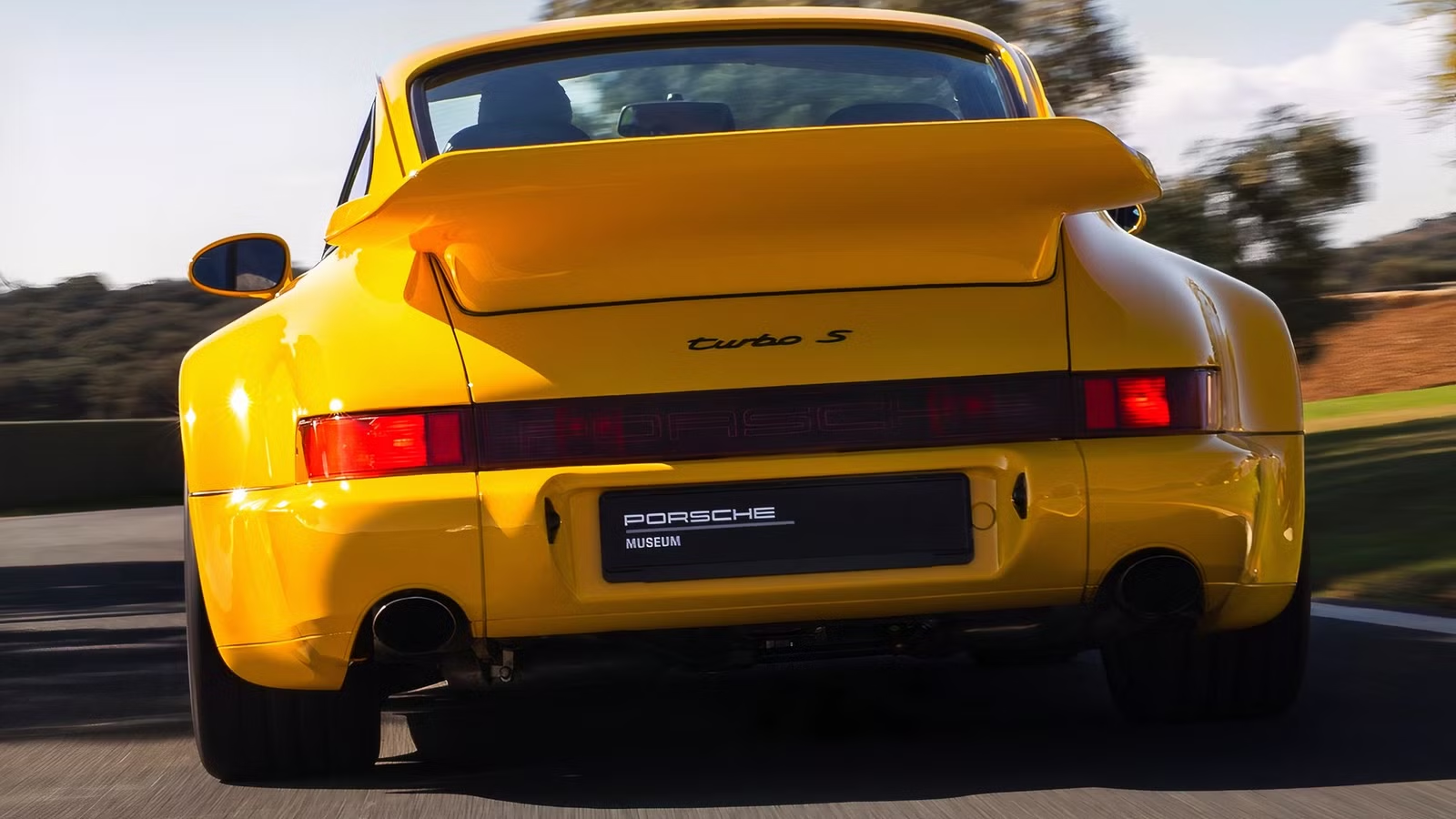
A Porsche 911 Carrera at full chat is a sensory joy for any true automotive enthusiast. And the recent sight of a 1995 993-generation car burning up the track at Virginia International Raceway must have been a particular delight for those present. A capable owner covered VIR’s Grand Course in just 3:16.6 and pulled 0.94 g through turn one, so they clearly knew how to make the most of the vehicle. This demonstrates how a 31-year-old 993 can still be exercised hard, providing a clear example of how air-cooled systems worked so well in an era when water cooling was not the dominant solution.
A Thirty-One-Year-Old 911 Just Proved It Still Likes Being Worked Hard
1995 Porsche 911 993 GT2 quarterPorsche
The engine that Porsche fitted to the 993-generation 911 was so impressive because it was never meant to be a low-stressed economy unit tuned for durability rather than exertion. Instead, in the US-spec 1995 Carrera form, this naturally aspirated 3.6-liter aluminum flat-six turned out 270 hp at 6,100 rpm and 243 lb-ft at 5,000 rpm. According to independent testers, it could get to 60 mph in 4.7 seconds, cover a 13.4-second quarter mile at 104 mph, and reach 162 mph at the top end. And the 993’s engine was the final evolutionary stage as far as the company’s air-cooled six-cylinder line was concerned.
For the 1996 model year, the 911 also gained the VarioRam variable length intake system, which pushed US output to 282 hp and 250 lb-ft. Porsche then put this engine under even more pressure when it attached two turbos to a 3.6-liter version in order to extract as much as 424 hp for its Turbo S and upgraded Turbo models. And with all that activity and power to deal with, heat management was always going to be fundamental in making the system work efficiently.
Air-Cooled Doesn’t Mean Porsche Simply Pointed A Fan At It
Porsche 911 air-cooled enginePorsche
Many conventional engines rely on an engine block with water-filled passages surrounding the cylinders, and this has proven to be a particularly effective way of keeping temperatures in check. Air-cooled Porsche flat-sixes, however, use copious amounts of airflow around the cylinders and heads, which work together with the engine oil to carry heat away and manage temperatures effectively.
An engine-driven fan can deliver around 1,010 liters of air per second at 6,000 engine rpm, while the dry sump lubrication system pushes oil through a thermostatically controlled cooler mounted in the right front fender. The cooler itself has its own two-stage electric fan. Increasing engine speed also increases cooling airflow, while rising oil temperatures can then bring the remote oil cooler into the equation. This represents the approach taken by Porsche engineers in helping the car to shed the extra heat created when its driver works that flat-six hard.
The engine’s horizontal cylinder bank layout also helps expose the separate cylinders to airflow, and the boxer’s cylinder spacing does its bit with air cooling, allowing them to receive a direct flow of air. Notably, the engine-driven fan forces air through carefully designed shrouding and across the cooling fins on the cylinder barrels and heads. While all of this is going on, oil circulates through the engine and the external cooling system to provide another means for heat to escape.
This relatively simple approach worked even though the 993 Carrera’s engine was certainly not simple at all. After all, it incorporated twin spark ignition, electronic engine management, and, on the later cars, VarioRam. Porsche added hydraulic valve clearance compensation to boost service intervals for its later models. It also introduced lighter pistons and connecting rods, expanded intake ports, lighter valves, and a crankshaft with increased torsional stiffness.
At the same time, this engine didn’t rely on a conventional engine coolant loop, and that removed several components that can sometimes create challenges for water-cooled machines. There was no coolant that could leak or cause contamination, and no engine-coolant radiator that could be punctured and spring a leak.
However, the 993 still offers up some challenges for its owners, who will clearly need to keep an eye on oil levels, oil condition, air flow, and cooling hardware. They may not have to focus on any of those specific water-cooled engine challenges, but they still need to pay attention elsewhere.
Porsche Spent 35 Years Making This Apparently Simple Idea Work
1963 Porsche 911 in redPorsche
Since the first Porsche 911 appeared in the 1960s, the company came to rely on air-cooled flat engines, accumulating considerable experience along the way. By the time the 993 took over as the final expression of this evolutionary process, Porsche had learned to manage the complexities of cooling an increasingly powerful rear-mounted boxer engine. In fact, the company became so successful in this area that it eventually turned out almost 70,000 examples of the 993 when production came to an end in 1998.
The 993’s retirement also marked approximately 35 years of air-cooled 911 production, even if the 911 was, by then, a very different machine compared to its 1960s predecessors. In the end, the 993-generation car featured the LSA multi-link rear suspension system and a substantially redeveloped flat-six engine, but it still relied on Porsche’s air-cooling approach, even though the company was clearly investing heavily elsewhere to modernize.
Today, collectors are recognizing Porsche’s persistence and the importance of its air-cooled approach. While the final air-cooled 911s may not have the sheer output, emissions, performance, or even temperature precision of a current 911, these cars are nevertheless in good demand. 993 Carreras are serious collector cars, and a 1995 version in good condition may even command six figures. The fact that it is the last air-cooled 911 will probably contribute to those values, but the actual car itself is a formidable machine in any case. After all, it combines that old cooling philosophy with a six-speed manual, a sophisticated multi-link rear suspension system, and some genuinely usable performance.
Durable Doesn’t Mean You Can Ignore A 30-Year-Old Porsche
Porsche 993 911 Turbo Cabriolet interior.Robin Adams/RM Sotheby’s
A 993 Porsche like this can be very attractive, and it’s still a remarkably robust old sports car. But those who assume that its air-cooled design means nothing can go wrong could find themselves facing a costly lesson. Instead, they should be aware of several potential engine-related trouble spots, such as engine-case through-bolt O-rings that can leak oil and an internal belt in the dual ignition distributor that can fail. Naturally aspirated cars could develop clogged secondary air injection passages, and valve guides could wear if oil enters the exhaust side and leads to carbon accumulation in secondary air passages.
Problems like these can lead to substantial work, despite the absence of a water-cooling system. And potential owners should be particularly aware of possible oil leaks. After all, an engine that inherently relies on both air and oil to cool itself will also depend heavily on its lubrication circuit.
Still, there is no doubt that a properly maintained 993 can have an exceptionally durable performance engine, but it is important for prospective buyers to consider age, maintenance history, and 993-specific weaknesses. They should also engage the services of an expert who knows all about an air-cooled 911 to conduct a thorough pre-purchase inspection before they act.
Porsche Finally Had To Turn To Water Cooling
2003 Porsche 911 Turbo 996 exteriorPorsche
Some may wonder why Porsche eventually stepped away from its air-cooled approach if it had proven to be so effective. But Porsche did switch in any case, and confirmed that the 911 could better control its heat when it finally turned over to H2O. The 996 generation was the first series-production water-cooled 911 when it appeared in 1997, and the shift came down to increasingly stringent exhaust regulations. These effectively required the company to choose a four-valve cylinder head approach and Porsche felt that this configuration could only be cooled reliably through all operating conditions with water.
Porsche also said that water cooling gave engineers more precise control of engine temperatures to improve efficiency and durability. It also gave them the thermal control necessary for increasingly powerful 911 engines. So, effectively, the company didn’t have enough developmental headroom to continue with its air-cooling approach. The demands of more power, tighter emissions limits, four-valve heads, lower noise, and finer temperature control simply required a different approach.
The 993-generation 911 still presents a compelling approach to the ever-present automotive challenge of heat management. And while Porsche never proved that air cooling was superior to water cooling over all those years, it did show just how far it could push the approach before physics and regulation finally won.
