

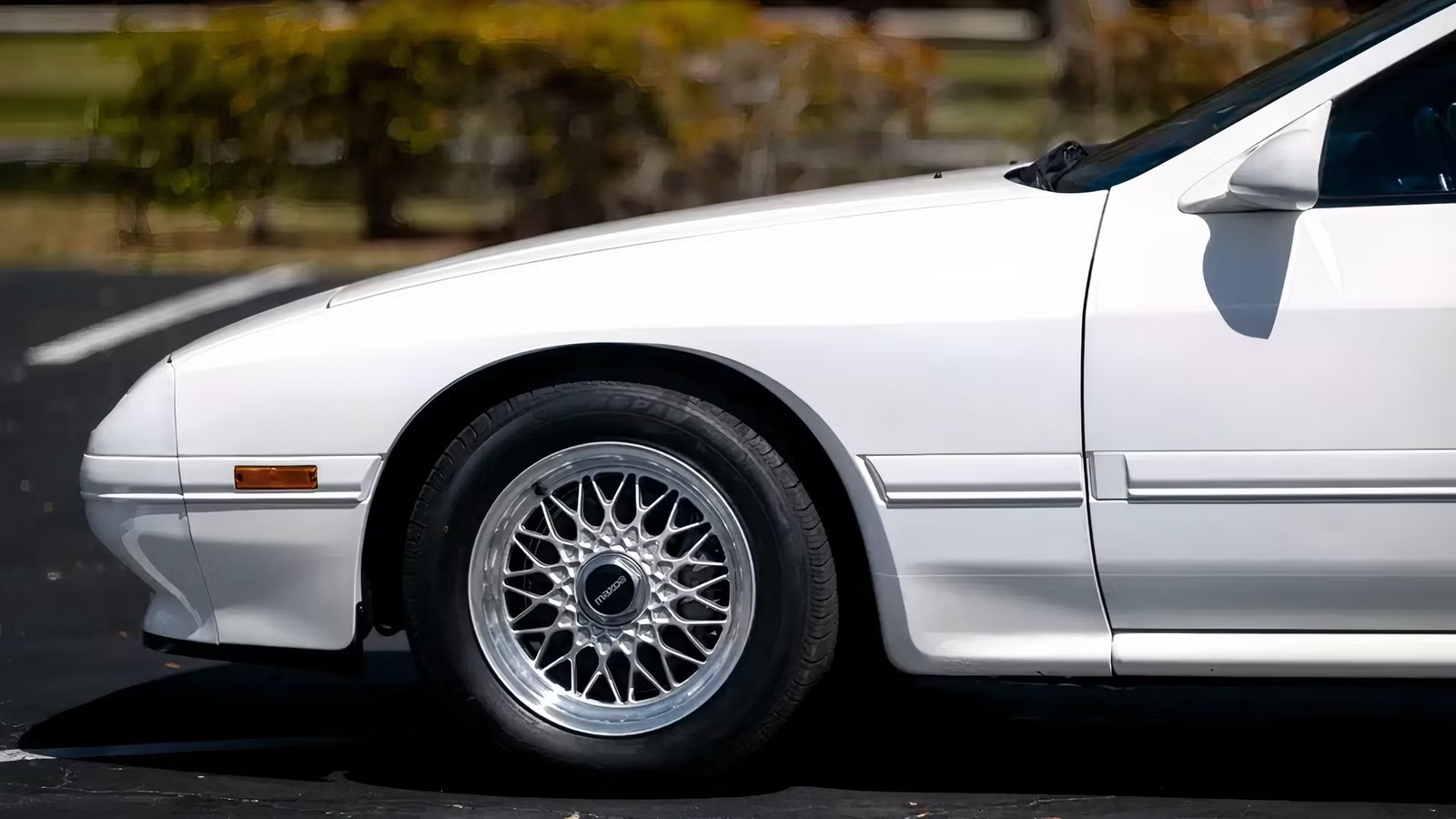
The 1980s gave birth to some of the most iconic sports cars the automotive world has ever seen. Posters of Ferrari, Lamborghini, and Porsche covered bedroom walls, while Hollywood and motorsport helped cement certain machines into legendary status almost overnight.
But beneath all that noise, other sports cars were quietly building loyal followings of their own. Some did not wear exotic Italian badges. Some were not the fastest cars of their era. And some never received the same level of attention as their European counterparts. Yet decades later, enthusiasts still speak about them with enormous affection. One Japanese sports car in particular perfectly captures that idea.
Why Some 80s Sports Cars Were Overlooked
Living In The Shadow Of Bigger Names
Before diving into the lightweight sports car itself, it is important to understand the era that shaped it. During the 1980s, the sports car world was heavily dominated by image, prestige, and European performance brands. Brands like Ferrari and Porsche controlled much of the conversation through magazines, films, and motorsport success.
Front and side view of a 1986 Porsche 911 TurboBring a Trailer
Cars such as the Ferrari Testarossa, Porsche 911 Turbo, and Lamborghini Countach became symbols of excess and aspiration during the decade. They looked dramatic, sounded exotic, and carried price tags that made them feel completely unattainable to ordinary enthusiasts.
Japanese Sports Cars, Meanwhile, Were Still Fighting For Global Recognition
A front 3/4 profile view of a green 1990 Toyota Supra TurboBring A Trailer
During the early and mid-1980s, many buyers associated Japanese brands primarily with economy cars and reliability rather than serious performance machines. Cars from Toyota, Nissan, and Mazda were often viewed as affordable alternatives instead of legitimate rivals to their European counterparts.
That perception caused several brilliant Japanese performance cars to fly under the radar. Unlike today — where Japanese classics regularly command enormous auction prices and widespread enthusiast attention — many of these cars were initially underestimated during their own era.
Related
Mazda’s Forgotten Masterpiece: A 2000s Icon Revisited
With big power in an affordable and practical package, the Mazdaspeed3 was a hot hatch ahead of its time, and here’s why it deserves a comeback.
The Mazda RX-7 FC Deserved More Attention
A Perfect Balance Of Style And Engineering
1988 Claret Metallic Mazda RX-7 SE Front ShotBring A Trailer
And that is precisely where the Mazda RX-7 comes into the story. Overshadowed at the time by bigger names and more expensive machinery, the FC RX-7 quietly delivered one of the purest sports car experiences of the 1980s. It became known for its lightweight engineering, balanced handling, sharp styling, and one of the most unusual engines ever fitted to a production car.
1988 Claret Metallic Mazda RX-7 SE Rear ShotBring A Trailer
While it may never have dominated headlines, many drivers who experienced the RX-7 remember it more vividly than supposedly superior sports cars from the same era. The second-generation RX-7 became one of the clearest examples of that phenomenon. Released for the 1986 model year, the FC arrived during a highly competitive performance-car era.
Official Giveaway
🔥 Limited Time
Enter The Weekly Giveaway
Win Car Guy Gear
Sign up to our newsletter to enter. Follow on socials for more entries.
New giveaways every 2 weeks
Enter the Giveaway
No purchase necessary. Open to US residents 18+. Full giveaway details on the page.
How The FC RX-7 Stood Out Next To Performance Rival
Front 3/4 shot of 1990 Nissan 300ZX in silver parkedBring A Trailer
Buyers could choose from turbocharged European coupes, American V8 muscle, and increasingly advanced Japanese rivals such as the Toyota Supra and Nissan 300ZX. Yet the RX-7 approached performance from a very different angle.
Rather than chasing massive horsepower figures or outright straight-line dominance, Mazda focused heavily on balance, steering precision, lightweight engineering, and driver engagement. That philosophy may not have generated the loudest headlines at the time, but it is exactly why the RX-7 has aged so gracefully among enthusiasts today. Compared to the sharper and more compact first-generation Mazda RX-7, the FC-generation RX-7 looked smoother, lower, and noticeably more sophisticated. Many enthusiasts immediately noticed similarities between the Mazda RX-7 and the Porsche 944, particularly in the proportions, long hood design, and pop-up headlights.
Porsche-Inspired Styling That Aged Beautifully
Blue 1991 Porsche 944 S2 front 3/4 shotPorsche
Mazda specifically targeted sports cars like the Porsche 924 and Porsche 944 when developing the FC-generation RX-7, helping explain the car’s more refined grand-touring character and European-inspired proportions. And honestly, that comparison was not necessarily a bad thing. The RX-7 looked expensive for its era. Long hood proportions, muscular rear haunches, and clean wedge-shaped styling gave it a timeless appearance that still looks remarkably elegant decades later.
Related
The Japanese Sports Car With Bulletproof Reliability And Low Running Costs
This Japanese sports car is renowned for being fun to drive and cheap to run. What better combination could you ask for? This is a real JDM legend.
The Rotary Engine Made The RX-7 Feel Different
1991 in Crystal Mazda RX-7 Engine BayBring A Trailer
The engineering underneath the bodywork was arguably even more impressive. Mazda designed the RX-7 around near-perfect weight distribution and lightweight construction. The car’s low center of gravity and near 50:50 weight distribution became central to its agility and cornering composure. The engine also sat low and far back in the chassis, helping improve handling balance and steering response.
1991 in Crystal White Mazda RX-7 convertible Side ShotBring A Trailer
That engine also happened to be one of the most unusual powerplants available in any sports car at the time. Instead of using a traditional piston engine, Mazda continued refining its signature rotary-engine technology. Power-wise, naturally aspirated FC RX-7 models used the 1.3-liter 13B rotary engine producing around 146 horsepower and 138 pound-feet of torque in U.S.-specification form. Turbocharged variants later raised output significantly, with the turbocharged 13B producing approximately 182 horsepower and 183 pound-feet of torque in North American markets.
How The FC RX-7 Gained An Enthusiast Following
1991 in Crystal White Mazda RX-7 convertible Rear ShotBring A Trailer
Those figures may not sound extraordinary by modern standards. In a contemporary comparison test, Car and Driver praised the RX-7’s “excellent steering, great stability” and noted that “going fast is a snap,” reinforcing why the car developed such a loyal enthusiast following.
Mazda FC RX-7 Specifications
Production Years
1986–1991
Engine
1.3-liter 13B rotary
Naturally Aspirated Output
146 hp / 138 lb-ft
Turbocharged Output
182 hp / 183 lb-ft
Transmission
5-speed manual / 4-speed automatic
Driveline
Rear-wheel drive
Curb Weight
2,700–2,800 lbs
0–60 MPH
6.5–7.8 seconds
Top Speed
130–145 MPH
Suspension
Fully independent suspension
Weight Distribution
Near 50:50
Key Rivals
Porsche 944, Toyota Supra, Nissan 300ZX
The FC-generation RX-7 weighed roughly 2,800 pounds, depending on specification, allowing it to remain agile and responsive in a way heavier sports cars often struggled to replicate. Mazda also equipped the RX-7 with fully independent suspension and balanced chassis tuning — all qualities that helped cement the car’s growing enthusiast reputation throughout the late 1980s and early 1990s.
Related
10 Japanese Cars That Are More Fun To Drive Than A Porsche 911
The Porsche 911 is the gold-standard of sports cars, but it might not be the most fun car to drive. These ten Japanese sports cars might be more fun.
What Made The RX-7 FC So Special
A Driving Experience Unlike Anything Else
1988 Mazda RX-7 front 3/4 shotBring a Trailer
What truly separated the RX-7 from many rivals was its personality. The rotary engine immediately gave the car a completely different character from traditional sports cars. Unlike conventional piston engines, Mazda’s rotary powerplant was known for its smooth, high-revving nature and distinctive power delivery. Contemporary reviewers frequently highlighted how differently the RX-7 behaved compared to traditional sports cars, with the engine’s unique sound and willingness to rev becoming central to the car’s identity.
1988 Mazda RX-7 rear 3/4 shotBring a Trailer
Motortrend described the RX-7’s rotary engine as a “smooth, high-revving” unit and noted how the lightweight chassis helped amplify the experience, reinforcing why the car stood apart from many conventional sports cars of its era. The RX-7’s steering was frequently praised for its precision and directness, while the chassis earned a reputation for predictable handling and strong cornering balance. In turbocharged form, the RX-7 also became quick for its time.
1988 Claret Metallic Mazda RX-7 SEBring A Trailer
Mazda’s turbocharged rotary engine helped give the car strong mid-range performance, while the relatively compact engine design allowed engineers to keep weight low and centralized within the chassis. Near-perfect weight balance became one of the RX-7’s defining characteristics. That approach has become a major reason the RX-7 remains so highly respected among enthusiasts today, particularly as many modern performance cars have grown larger, heavier, and increasingly technology-focused.
Related
The Bulletproof Japanese Sports Car You Can Actually Daily Drive
A lightweight, rear-wheel-drive coupe with a naturally aspirated engine proves that bulletproof engineering and everyday usability can still coexist.
Mazda RX-7 In Motion
Raw, Engaging, And Rewarding
If you look at the FC Mazda RX-7 today, it feels refreshingly analog. There are no large digital screens, adaptive drive modes, or layers of electronic driver assistance constantly filtering the experience. Instead, the RX-7 relies almost entirely on mechanical interaction and driver input — something that has gradually become increasingly rare in modern performance cars. And that simplicity is precisely what makes the RX-7 so special.
The steering was frequently praised for its precision and immediacy. In a contemporary comparison test, Car and Driver described the RX-7’s controls as “light and extremely direct,” while also praising the car as “a clean and lean little machine that knows exactly why it exists—for the fun of driving.”
There Were Some Drawbacks
1987 Black Mazda RX-7 Turbo II headlampsBring A Trailer
The RX-7 was far from perfect. Like many rotary-powered Mazdas, reliability concerns occasionally followed the car throughout its lifetime. Rotary engines require careful maintenance and proper lubrication, while long-term durability could become a concern if owners neglect servicing or oil upkeep.
1987 Black Mazda RX-7 Turbo II Rear ShotBring A Trailer
Fuel economy also remained relatively poor compared to many conventional four-cylinder rivals of the era, partly because rotary engines consumed fuel differently from traditional piston engines. Despite the rotary’s compact size and smooth power delivery, owners often accepted higher fuel and oil consumption as part of the ownership experience.
1987 Black Mazda RX-7 Turbo II Front ShotBring A Trailer
Turbocharged models could also become more demanding when pushed aggressively, particularly in poor conditions. Like many lightweight rear-wheel-drive performance cars from the late 1980s and early 1990s, the RX-7 rewarded smooth inputs and disciplined driving technique. But for experienced drivers, that slightly edgy personality only added to the car’s appeal. The RX-7 demanded respect, rewarding precision and patience rather than simply flattering the driver.
Related
Complete History Of The Nissan 300ZX
The ultimately cool Nissan 300ZX is one of the most iconic sports cars from Japan or anywhere else.
Why Drivers Still Remember It Today
Character That Modern Cars Have Lost
1987 Black Mazda RX-7 Turbo II rear endBring A Trailer
The reason enthusiasts still remember the Mazda RX-7 so fondly comes down to character. Modern performance cars are objectively faster, safer, and far more technologically advanced than the RX-7 ever was. But many enthusiasts argue they no longer deliver the same level of mechanical connection and driver involvement.
Low-angle 3/4 side view of 1986 Mazda RX-7Bring a Trailer
Cars like the RX-7 emerged during an era when manufacturers still prioritized lightweight engineering and genuine driver interaction over digital interfaces and artificial driving modes. That philosophy has become increasingly rare today, which is partly why the RX-7 continues to resonate so strongly with enthusiasts decades later. Enthusiast demand for clean FC RX-7s has also grown steadily in recent years. Much like the Toyota Supra, Nissan 300ZX, and later Mazda RX-7, the FC has become increasingly appreciated as younger buyers rediscover analog Japanese sports cars from the 1980s and 1990s.
A Strong Enthusiast Base That Values Raw, Yet Unique Driving Experiences
1988 Mazda RX-7 Turbo 10th Anniversary side shotBring A Trailer
Recent auction results on Bring A Trailer reflect that growing appreciation. Clean turbocharged FC RX-7 examples have recently sold in the $20,000–$30,000 range, while exceptionally well-preserved low-mileage cars have attracted even stronger bidding from collectors and enthusiasts. The RX-7 may never have enjoyed the same celebrity status as certain Ferraris or Porsches from its era. But for many drivers, it delivered something arguably more important: a sports car experience that felt pure, accessible, and genuinely unforgettable. And perhaps that is exactly why the RX-7 remains so loved decades later.
Sources: Mazda, Bring A Trailer, Classic.com
