

The 2020s have already been an innovative decade for technology. There have been a lot of hype cycles, but the one that stuck was engine downsizing. It started with regular passenger vehicles, as automakers moved to smaller engines and turbocharging to compensate for the loss of power. The result was better fuel economy with comparable performance, and automakers, of course, applied the same idea to pickup trucks. However, the added complexity was a breeding ground for problems.
JD Power isn’t the only publication to rate the F-350 as one of the most reliable full-size pickup trucks on the market, but amid all the accolades, Ford’s F-Series Super Duty with the 7.3-liter Godzilla V8 option gets overlooked. However, those who know how relentlessly durable the engine is are willing to pay a huge premium to use the giant V8.
There’s No Replacement For Simplicity
2027 Ford F-Series Super Duty Carhartt PackageFord
It turns out there is a replacement for displacement: a turbo or two. But there’s still no replacement for simplicity. A good example is the failures that have plagued downsized turbocharged engines, such as Toyota’s V35A twin-turbo V6, which led to the recall of 170,000 Tundra models for main bearing failures.
Ford has become the king of recalls, yet the Ford F-350 is rarely mentioned – although the Super Duty pickup series isn’t recall-free. While the Ford 7.3-liter Godzilla V8 isn’t perfect, its simplicity sidesteps many of the issues associated with turbocharging.
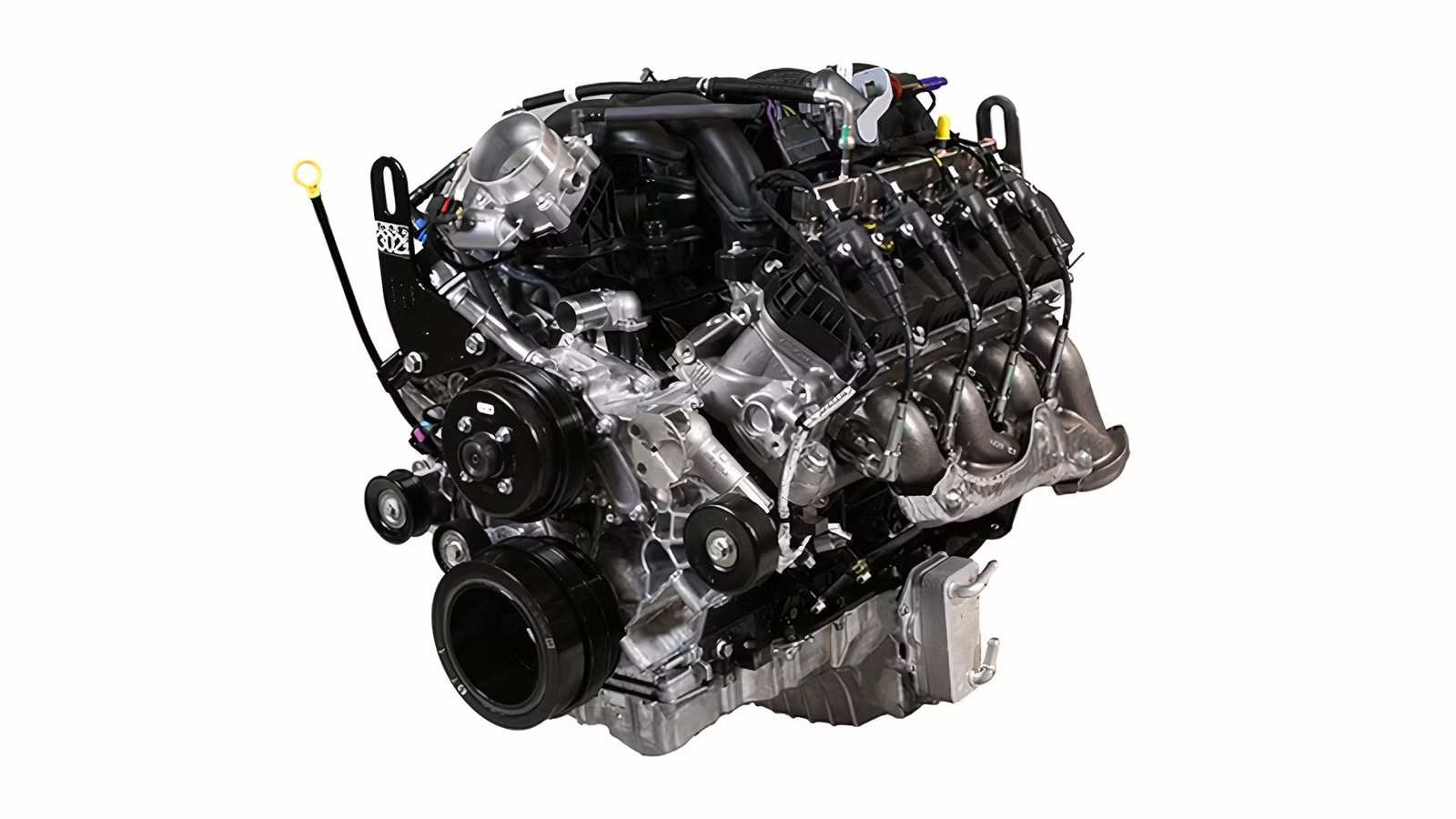
At its heart, the Ford 7.3-liter Godzilla V8 is a naturally aspirated pushrod engine that uses port fuel injection and is built upon a cast-iron block. Introduced in 2020, Godzilla is intended to replace the larger versions of Ford’s Modular powerplant family, such as the 6.2-liter Boss V8 and 7.3-liter Triton V10, whichthe Blue Oval has used since the late 1990s. In the Super Duty lineup, the 7.3-liter Godzilla engine makes 430 horsepower with 485 lb-ft of torque. It’s also available for commercial vehicles, but we’re focusing on the Super Duty pickups here.
Why Ford Super Duty Customers Are Upgrading
Godzilla V8 fact sheetFord
The standard engine for most of the Ford Super Duty lineup in 2026 is the 6.8-liter V8 engine – a smaller eight-cylinder introduced in 2023 to replace the 6.2-liter Boss engine. However, a Ford representative confirmed to us that both the 6.8-liter gas V8 and the low-output 6.7-liter turbo diesel V8 would both be discontinued by 2027. The party line for Ford was that the decision was to “better align with the needs of our customers.”
And the company seems to have a good argument. The 7.3-liter Godzilla engine has proven itself to be one of the most reliable engines available for purely utilitarian purposes. The company designed it to be robust above everything else. And as a result, Ford has been going directly against the trend of downsizing pickup truck engines by making the larger engine standard in its Super Duty lineup. In 2027, the step-up in engine power would likely be the high-output 6.7-liter Power Stroke diesel with 500 hp and 1,200 lb-ft of torque, which is very much a specialist towing engine.
The Ford 7.3-liter Godzilla V8 fits the bill as a strong, simple, and reliable alternative to diesel engines, which tend to come with a higher up-front cost and higher fuel prices. It’s currently an $11,495 option for the low-output diesel option and a $13,495 upgrade to the high-output 6.7-liter turbodiesel V8.
Ford 7.3-liter Godzilla V8 Reliability Issues
2021 Ford F-250 Super Duty Godzilla engineCarBuzz/Valnet
As we’ve said, the Ford 7.3-liter Godzilla V8 isn’t perfect. Failed lifters tend to show up when the engine suffers from poor maintenance, including low-quality oil, prolonged idling, and extended high-RPM operation while towing. Like any engine, the key to the 7.3-liter Godzilla V8 lasting a long time is care and maintenance. However, reports that the variable-displacement oil pump doesn’t provide enough pressure at low idle speeds are out there, and problems can show up between 70,000 and 150,000 miles.
Otherwise, a 7.3-liter Godzilla V8 has the potential to go over 300,000 miles with proper care and attention. The keys are using a high-quality synthetic-blend oil every 5,000 to 6,000 miles and keeping the cooling system clean and properly maintained for towing.
The Caveat To 300,000 miles
We should note that the word “potential” is important here – the 7.3-liter Godzilla V8 was introduced in 2020 for the 2021 model year. For even the youngest 7.3-liter Godzilla to have hit 300,000 miles here in the middle of 2026, it would have to have covered over 50,000 miles per year. While work trucks cover a lot of miles, it’s unlikely many hit a thousand miles a week for six years.
Facing The Premium Price
Godzilla 7.3-liter V8 engineFord
For 2026, the upgrade to the 7.3-liter Godzilla V8 costs $1,500, and whether Ford would simply increase the price of the 2027 model-year Super Duty trucks accordingly remains to be seen. For those thinking about waiting to see what happens, it’s going to be a roll of the dice whether the price increases or not. Either way, the reality is that downsized engines are much cheaper to keep refueled.
So far in 2026, gas prices have only risen, and there’s no end in sight to the war with Iran. While the 7.3-liter Godzilla engine is basic by modern standards, it has tech like variable valve timing, a variable-displacement oil pump, and electronic fuel injection, but the fuel economy isn’t great.
The EPA doesn’t rate the fuel economy of pickups this big, but expect around 6 to 15 miles per gallon, depending on load. Anecdotal online reports suggest folks might get about 11.5 mpg in town and 14.5 mpg on the highway under normal driving conditions. Owners can push to 16 mpg on the freeway, but only with a careful right foot, a steady 65 mph, and favorable conditions. Which, for a big pickup truck, means no headwind, a lack of hills, and a mild ambient temperature.
Simplicity Is Not The New Luxury
Godzilla 7.3-liter V8 engineFord
It’s not as simple as claiming simplicity is best. The 7.3-liter Godzilla V8 isn’t as complicated as its contemporaries. Ford is simply choosing its technology conservatively, for the most part, with durability and the intended workload in mind.
“Simplicity is the new luxury” is going to be a term we hear a lot over the next year or so, but cost is only part of the luxury equation, and a Ford Super Duty is not a luxury vehicle. It’s a workhorse you can buy with luxury features added. An engine that lasts 300,000 miles isn’t a luxury either – it’s a long-term economic benefit. But that is where the problem lies.
The Benefits
2023 Ford F-350 Super DutyFord
The 7.3-liter Godzilla V8 delivers diesel-like consistency without the initial cost and with long-term durability. However, the current price of gas to fuel a big V8 to get an engine that goes 300,000 miles takes the edge right off. Toyota’s turbocharged 3.4-liter V6 high-output engine makes 389 hp with 479 lb-ft of torque while getting 17/22/19 mph city/highway/combined, which adds up over the lifetime of a truck – even more so when it leads a life heavy on towing.
Toyota has a habit of fixing durability issues and building durable engines, and it looks like it moved too soon to downsize. That doesn’t mean the future isn’t a smaller displacement, but with added turbocharging for heavy-duty trucks. Far from it – Toyota is incredibly good at fixing reliability issues quickly and building durable engines.
Hybrid power is also coming to pickup trucks, but for now, simple is still looking best. It may cost more in the long run to go 300,000 miles, but a truck that’s out of commission because of a major engine failure can also be incredibly expensive when time is money for a business. And that is why we suspect Ford’s Super Duty trucks will remain the gold standard for heavy-duty work trucks for the foreseeable future.
Sources: Cummins / Motor Reviewer / Ford Trucks / BizzyCar / Jay Malone Ford
