

BMW‘s straight-six engine is alive and well today. The modern S58 mill, found in the M4 CSL, chucks out 550 horsepower like it’s no problem. Armed with two turbochargers, 350-bar injection, and a closed-deck block design, the S58 represents one of the pinnacles of current BMW engineering. Having such a strong dedication to the inline-six power plant didn’t happen overnight, though.
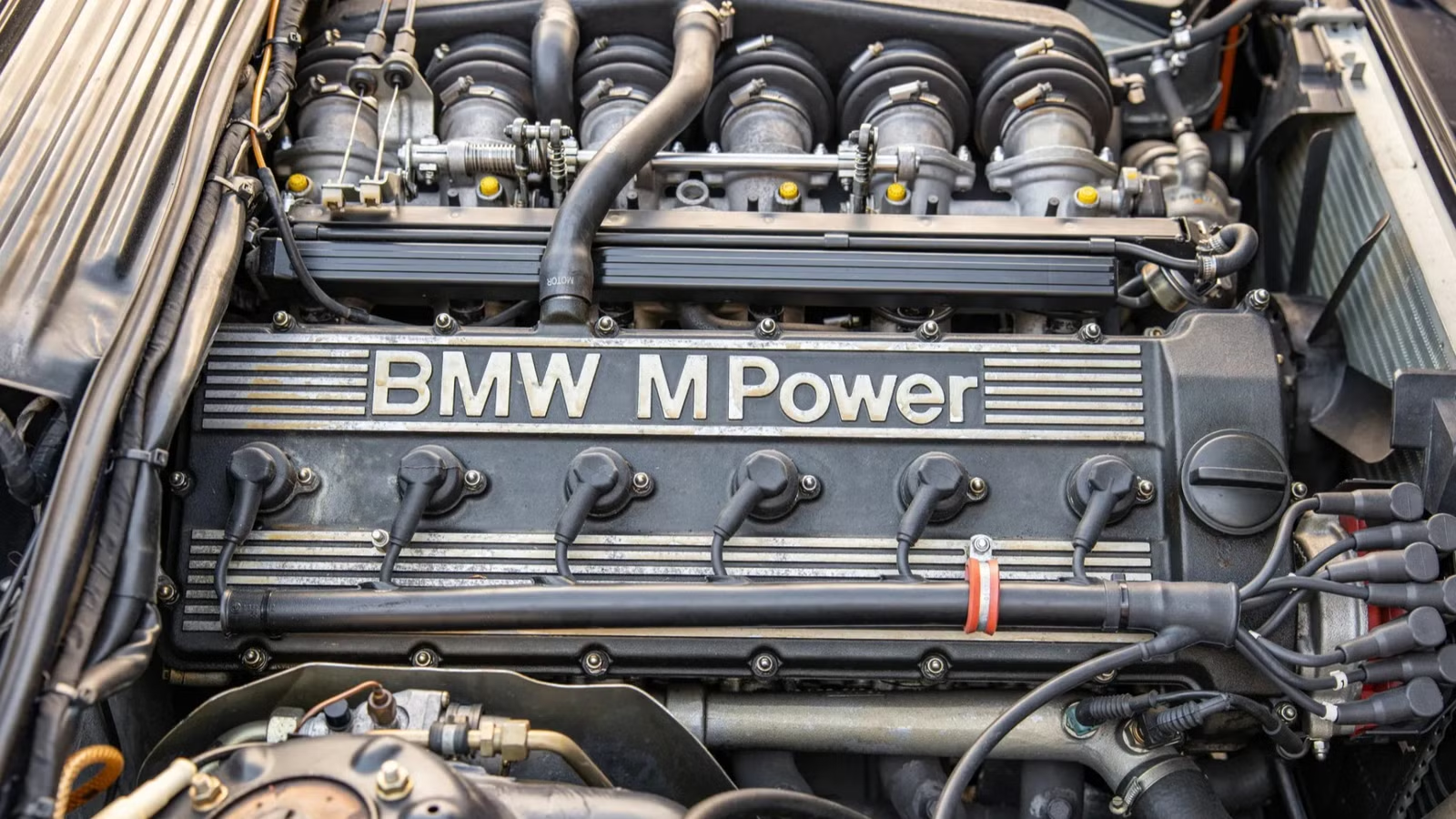
If we travel back roughly four decades, we can find one of the founding products of the Bavarian automaker’s M-Powered straight-six obsession: The M88/3. It produced 286 hp from a 3.5-liter displacement without any sort of forced induction. It came equipped with a four-valve, twin-cam cylinder head, an electronic fuel injection system, and loads of other goodies that set it apart from most road-going engines built during its time. Surprisingly, the differences between the M88/3 and the modern S58 aren’t as extensive as you might think.
BMW Built A Supercar Engine That Ultimately Ended Up In A Family Car
1986 BMW M635CSi Exterior Finished In BlackBMW
Beginning in the mid-1970s, BMW Motorsport GmbH began developing a high-performance straight-six for use in the BMW M1, which was developed alongside the mill. Instead of springing for some sort of exotic, supercar-like engine configuration – like a V12, for example – BMW decided to keep it simple with just six cylinders arranged in a row.
According to BMW itself, the M88 was based on the then-existing M30 engine block. Iconic models like the BMW 3.0 CSL utilized the M30, so it’s not like the engine wasn’t up to the task of supercar duty. With that in mind, BMW Motorsport set to work reworking the M30 extensively anyway.
What resulted was a 3.5-liter inline-six sporting a cylinder bore of 3.68 inches, a piston stroke of 3.31 inches, and a radically redesigned cylinder head with enough space for 24 valves. When the BMW M1 debuted in 1978, the M88 found within was capable of producing 277 hp and 243 lb-ft of torque. Dry-sump lubrication and a unique mechanical fuel injection system made by Kugelfischer were present, as well. The BMW M1 as a whole only weighed about 2,866 lbs, of which the M88 made up roughly 400 lbs.
Once the M1 was scrapped in 1981, BMW was looking for a place to put its M88 engine design. It found it in 1984 with the E28 M5, the first model of its kind to hit the market. The M88 was tweaked a bit, gaining a higher compression ratio and refreshed ignition and fuel injection systems. The new internal nomenclature became “M88/3”, and it went on to find a home in the Euro-market E24 BMW M635CSi. Both applications boasted 286 hp and 251 lb-ft of torque. South Africa also received its own M88/3-equipped model, the E23 745i.
But 286 hp is only part of what made the M88/3 remarkable – the engineering decisions behind that number are where things get genuinely strange.
286 hp Is Only Half The M88 Story
BMW M88/3 straight-sixBMW
BMW’s S58 engine – with just 3.0 liters at its disposal – takes the cake by a wide margin in terms of sheer power output. In modern times, a 3.5-liter engine producing 286 hp isn’t something you’d shout about from the rooftops. It’s respectable, but most automakers can produce six-cylinder engines with that much power with ease. Over 40 years ago, though, 286 horsepower from a naturally aspirated six-cylinder was a heck of a lot more impressive.
That incredibly high figure was helped by a multitude of small things working in tandem for the greater good. For example, the M88/3 utilized individual throttle bodies, one for each cylinder. A setup such as this allows for near-instant throttle response, as well as better airflow. Its fuel injection was state-of-the-art, with a special Bosch Motronic fuel injection system replacing the original mechanical injection setup found in the M1’s M88. The M88/3 also ditched the dry-sump lubrication in favor of a wet-sump configuration.
1984 BMW 745i European market Spec Exterior Finished In BlackBMW
As state-of-the-art as the M88/3 sounds, it’s still a 40-year-old engine. Instead of hydraulic tappets, it uses shim-adjusted valve clearances, which require semi-regular maintenance to ensure proper operation. It goes without saying that the modern S58 does not require its owners to adjust its valves. But, for the right sort of gearhead, tearing into your valve covers every so often may be a source of joy, rather than tedium.
When Car and Driver tested the BMW M635CSi’s performance, it found the same exact 286-hp, 251-lb-ft-of-torque figure that BMW touted. The publication also found that the model’s peak horsepower output came at 6,500 rpm and peak torque came at 4,000 rpm. For comparison, modern turbocharged engines typically hit their maximum outputs much lower than that.
In other words, drivers have to actually use the M88/3’s rev range to get the most out of it, and they can experience a more direct relationship between throttle, rpm, and acceleration than with a modern turbocharged mill.So if the M88/3 was already this sophisticated, why did BMW abandon its principles entirely – and does the replacement actually feel like progress?
Now, BMW Has Replaced The M88’s Mechanical Purity With More Performance
2024 BMW M3 CS 3.0L Twin-turbo S58 I6 EngineBMW
If BMW meant for the M88 to answer one engineering question, the modern S58 answers it in the exact opposite fashion.
The S58 is half a liter smaller than the M88/3, and it features an undersquare orientation made up of a 3.31-inch bore and a 3.54-inch stroke. Its top deck is closed – the section of the engine block that mates with the cylinder head – which helps bolster the mill’s structural integrity. Its crankshaft is forged, its fuel injection is direct, and a pair of Mitsubishi Heavy Industries-bred turbos handle up to 28 psi of boost.
Depending on the application, the current S58 engine can produce anywhere from 480 to 550 hp. Models like the BMW M4 Competition xDrive produce roughly 530 hp and 479 lb-ft of torque. Overall, the S58 was designed for high-pressure, heavy-use circumstances, and its closed-deck block and forged internals are evidence of this mindset. Because of this, it’s also well-positioned for tuning. BMW itself has highlighted a drift build making up to 1,000 hp on the stock crankshaft, pistons, and block.
Of course, the S58 makes all of this power while also meeting today’s ever-tightening emissions standards, something the M88/3 would not be able to achieve. It’s also important to note that the S58 is not some sort of technological, emotionless antithesis to an older, soulful M88/3 engine. Rather, it shows just how far the performance-oriented straight-six has come under BMW’s stewardship. The S58 likely isn’t the last stop, either.
The M88’s Most Compelling Legacy Might Be In The Cars That Few Remember
BMW E23 7 SeriesBMW
The M88, while old, hasn’t been completely forgotten about. After all, the BMW M1 was one of the most advanced cars of its time, and one of the first supercars that tried to be daily driver-friendly. The E28 BMW M5 also deserves a spot in the history books as the first 5 Series to don the “M” badge, and the M635CSi was the first performance-oriented 6 Series.
However, virtually no one remembers the BMW 745i SA. That is, unless you’re South African. The “SA” iteration of the 745i was produced due to engine packaging issues with the standard 745i’s turbocharged inline-six. The South African market required the use of a right-hand-drive setup, and the 745i’s standard motor got in the way. So, BMW fitted the naturally aspirated M88/3 into the model and called it the 745i SA.
The resulting model was an unusual one, in that it was a normal family sedan with a supercar engine hiding underneath its hood. BMW reports it only made about 278 examples of the 745i SA between 1985 and 1987. It’s reported that it could reach speeds of up to 150 mph; virtually unheard of for a normal, full-size sedan in the 1980s.
When the M88 was finally axed completely in 1989, BMW’s S38 swooped in to replace it. It managed to carry forth the same basic concept found in the M88, that being the ability to adapt across a wide range of vehicles while still offering a good amount of performance. Today, that lineage has reached the S58. While it’s a huge leap ahead, the S58 still exists within a straight-six lineage that BMW began building decades ago.
2021 BMW M4 Competition Coupe RWD
Year
2021
MSRP
$74,700
Engine
3.0L Twin-Turbo Inline-6 Gas
Drivetrain
Rear-Wheel Drive
Transmission
8-Speed Automatic
Horsepower
503 hp
Torque
479 lb-ft @ 2750 rpm
Expand
Sources: BMW, BMW M models South Africa, Car and Driver.
