

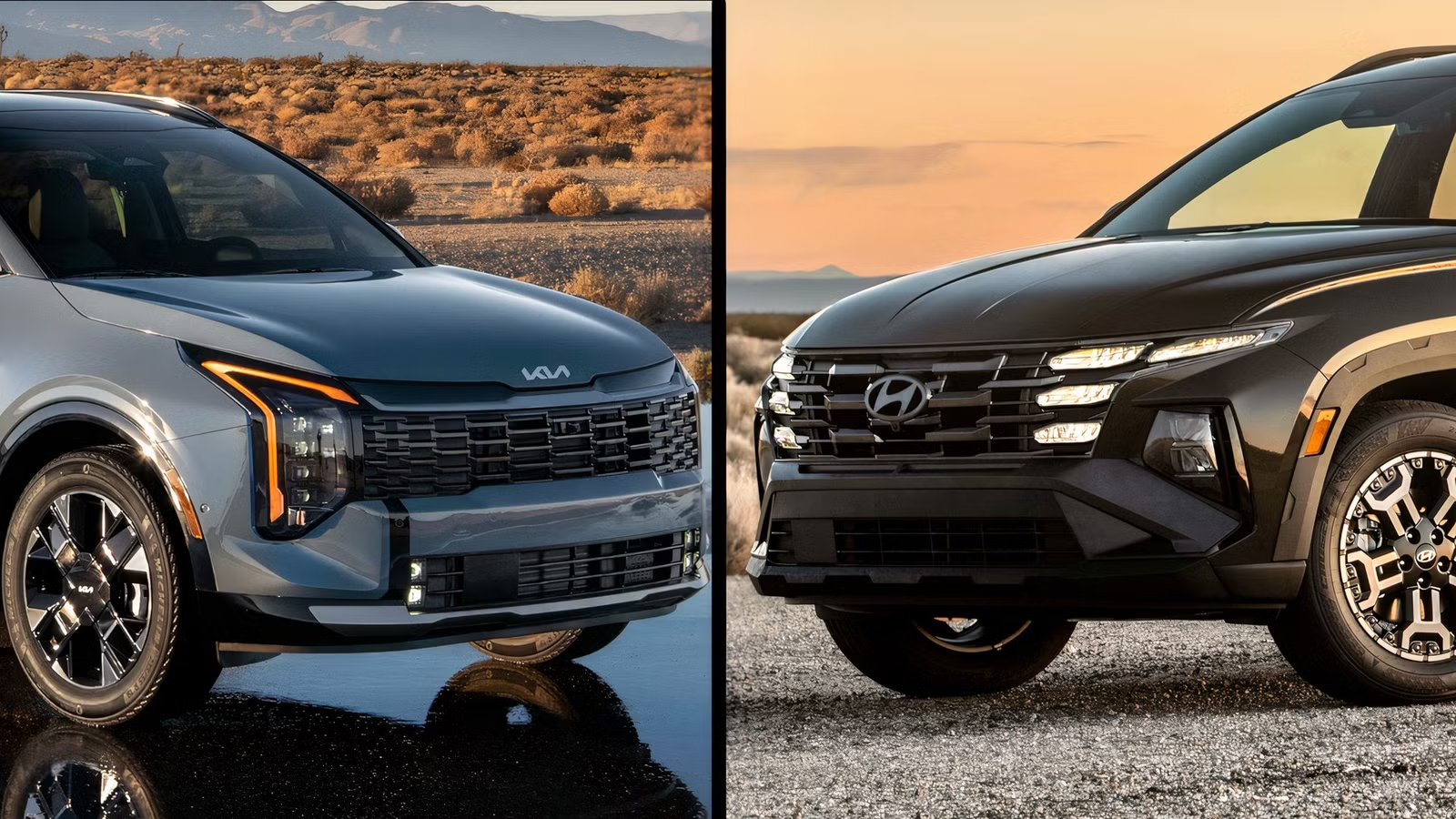
It’s fascinating to see the rise of South Korean manufacturers over the last few years, and it’s Hyundai and Kia that keep dominating sales charts in the US. With popular hybrid powertrains at the forefront of their product lineups, it’s no wonder that customers are choosing these manufacturers for their next family haulers. Two of their most popular models, the Tucson and Sportage, may share the same platform in the compact crossover SUV segment, but there’s a clear winner when it comes to sales.
The Kia Sportage Is The Brand’s Biggest Seller
The Sportage has become Kia’s best-selling vehicle with only their next biggest success, the K4, lagging quite a bit behind. In September alone, the brand managed to shift 16,033 units of the crossover to new driveways, which represents a 10% growth over the same time last year. Over the course of this year so far, however, sales have grown 9% compared to 2025, reaching 145,746 deliveries. Unfortunately, we don’t know how many of these sales were electrified variants specifically.
Expert
insight
The Sportage, even if it’s not perfect, still has an amazing combination of practicality, power, and efficiency that is still among the best in class, and this year’s updates just keep the excellent vehicle relevant. There will come a time when Kia needs to do a more thorough update, but for now, the Sportage hybrid remains one of the best hybrid SUVs you can get.
This strong recent sales growth could be for a number of reasons, but one could be for the facelift that was introduced for the 2026 model year. This included more power for the hybrid models thanks to an upgraded electric motor, a brand-new front fascia, and a slightly redesigned infotainment system. We found these small touches to make an already-great product even better, and it seems customers have responded with their wallets.
But The Hyundai Tucson Is Even More Successful
Even though the next-generation Hyundai Tucson is just around the corner, buyers seem fully content with the current-generation model. The compact crossover is again the most popular car in the brand’s lineup, trailed far behind by the Elantra. In September, 23,164 Tucson models found new homes, which represents a massive 32% increase in sales over the same time last year. Like Kia, Hyundai doesn’t publish specific hybrid numbers, but the company mentions a 39% increase in electrified powertrain sales.
Through the year, the Tucson enjoyed 181,687 sales, which is 10% more than last year. While it shares the same platform as the Sportage, the Tucson’s styling has become a common sight on US roads, more so than the Kia. Apart from the sedans, the Tucson is the most affordable way to get a hybrid powertrain from Hyundai, so with the popularity of SUVs and the diminishing sales of EVs amid a lack of incentives, it’s the natural choice for budget-conscious buyers who want the efficiency a hybrid powertrain provides.
What’s Behind The Tucson’s Sales Success?
2026 Hyundai TucsonHyundai2026 Kia Sportage HEV from the frontJoel Stocksdale / CarBuzz / Valnet
So if the Kia and Hyundai share the same basic architecture, what’s behind the sales success? There may be a few reasons. Firstly, Hyundai offers three years or 36,000 miles of complimentary maintenance, something that Kia doesn’t offer. Even though the Sportage costs $1,000 less than the Tucson at $28,990, buyers still look to the extra incentives that manufacturers include beyond the MSRP. The Sportage also costs less when a hybrid engine is equipped, too.
According to CarEdge, the Hyundai Tucson will alsodepreciate less. After five years, it’ll have lost 45% of its original value, while the Sportage would have lost 47%. These are small differences, but individual conditions and mileage vary and can widen the gap. Both of these cars will have increased their sales thanks to the changing EV demand in the US, represented by huge falls in both brands’ electric car sales. Hybrids seem to be the default option in 2026.
Even looking at older sales figures, the Tucson is considerably more popular, but the Sportage has significantly closed the gap. In 2023, for example, Kia shifted around 141,000 Sportage models compared to the Hyundai Tucson’s 210,000. The most obvious difference between these cars is styling, so the Tucson may simply appeal to more consumers with its distinctive front lighting and smaller grille compared to the sometimes brash Kia. This may change with the big new redesign for 2027.
The Hyundai Tucson may have also had more incentives throughout the year, and at the time of writing, the company is offering the Tucson Hybrid with 0% APR financing for five years and no payments for the first 90 days. The Sportage does also offer 0% financing, but only for four years. As buyers grow increasingly cost-conscious, these small differences add up.
Sources: Kia, Hyundai, CarEdge
