

Most cars bleed value the moment they leave the dealership lot — but the last-generation Subaru WRX STI has been quietly rewriting that rule. While the broader used-car market has normalized after years of pandemic-era volatility, this discontinued performance sedan continues to hold — and in some cases grow — its value in ways that would embarrass far more exotic machinery. High-mileage examples have shed far less of their original MSRP than you’d expect, and the lowest-mileage units are routinely selling for more than their sticker price ever was.
A Look At The Last Subaru WRX STI
Engine
2.5-Liter Turbo 4-Cylinder
Power
310 hp
Torque
290 lb-ft
Transmission
6-Speed Manual
Drivetrain
All-Wheel Drive
0-60 mph
5.5 Seconds
Top Speed
155 mph
When the STI first launched, reviewers praised its excitement-focused yet surprisingly versatile design philosophy. The car offered a respectable fuel economy of 17/23/19 mpg city/highway/combined. The rear seats are comfortable enough for most adults, and the all-wheel drive system is just as capable of managing rough roads and bad weather as it is at rally racing.
In short, it’s easy to see why the car remains in demand years after Subaru stopped producing new models for the US market. Besides being an iconic sports compact, it’s a weekend car that’s just as useful Monday through Friday as it is on Saturday and Sunday.
What Will A WRX STI Cost You In 2026?
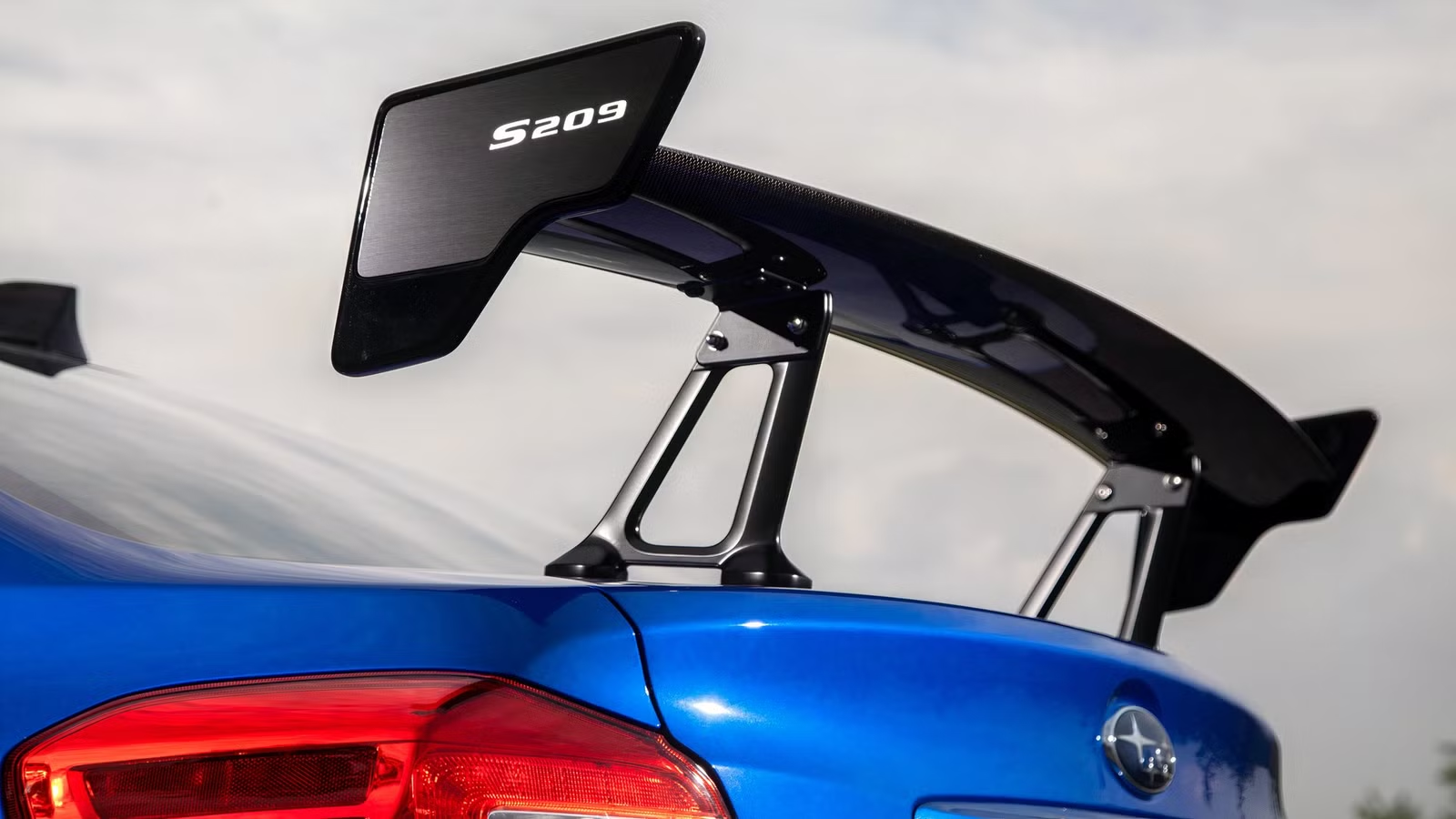
Limited to a run of just 209 units for the U.S. market, the 2019 Subaru WRX STI S209 stands as an anomaly in modern sports sedan pricing—defying conventional depreciation curves to maintain firm collector status. Carrying an original MSRP of $64,880, STI’s hand-built, 341-horsepower halo car initially saw extreme dealer markups before settling into a remarkably stable secondary market. On enthusiast auction platforms like Bring a Trailer and Cars & Bids, secondary market valuations consistently hover between $60,000 and $75,000 for well-maintained, low-mileage examples, with exceptional, ultra-low-mileage garage queens fetching well over the original sticker price.
While standard VA-generation WRX STIs have steadily depreciated, the S209’s bespoke STI-engineered widebody, forged BBS wheels, and carbon-fiber roof solidify its position as an instant modern classic. With Subaru officially sunsetting the gas-powered STI badge, collector appetite for the ultimate factory-backed EJ255/EJ257 evolution ensures the S209 remains one of the safest blue-chip automotive investments from the late analogue era.
The S209 Holds Its Value Best For A Reason
The S209 stands apart from the rest of the lineup for two key reasons. The first is outright performance: the S209 is tuned for higher top speeds, quicker 0–60 times, and more horsepower than any other STI variant sold in the US.
Engine
2.5-Liter Turbo 4-Cylinder
Power
341 hp
Torque
330 lb-ft
Transmission
6-Speed Manual
Drivetrain
All-Wheel Drive
0-60 mph
4.4 Seconds
Top Speed
162 mph
More importantly, the “209” in “S209” refers to the total number of models Subaru produced. This was the original WRX STI’s last run on the American market, and only 209 of these specially tuned performance models were ever built.
Limited editions — even those with impressive horsepower boosts — don’t necessarily retain their value over the years, let alone go up in price, and it can be difficult to predict which cars will and won’t appreciate in value.
The S209 benefits from the fact that this was the end of the line. If you bought an S209 back in 2019, there was never any risk of Subaru releasing another batch of 209 in 2020.
The Only Return You’re Guaranteed Is Fun
2019 Subaru WRX STI exteriorSubaru
Here’s the thing about treating cars as an investment: don’t.
If you buy a super-limited edition car like the WRX STI S209, there’s a chance you might see a return on your initial purchase. But that’s only likely to happen if you keep the mileage low, and the profit margin will be relatively slim compared to what you’d earn by putting that same money into almost anything else — an investment account, real estate, or reasonably stable stocks.
The only return you’re guaranteed when buying a car is the fun you’ll have behind the wheel. It’s not a bad idea to research how quickly a car depreciates before you buy, so you’ll have a realistic sense of what it’s worth when it’s time to trade it in. But the instances where a car actually gains value after you drive it off the lot are incredibly rare, and it can almost be a curse when it does happen — because it might discourage you from putting any more miles on it.
In short: it’s nice when your car actually earns you money, but don’t bet your retirement savings on it happening.
Sources: Subaru
