

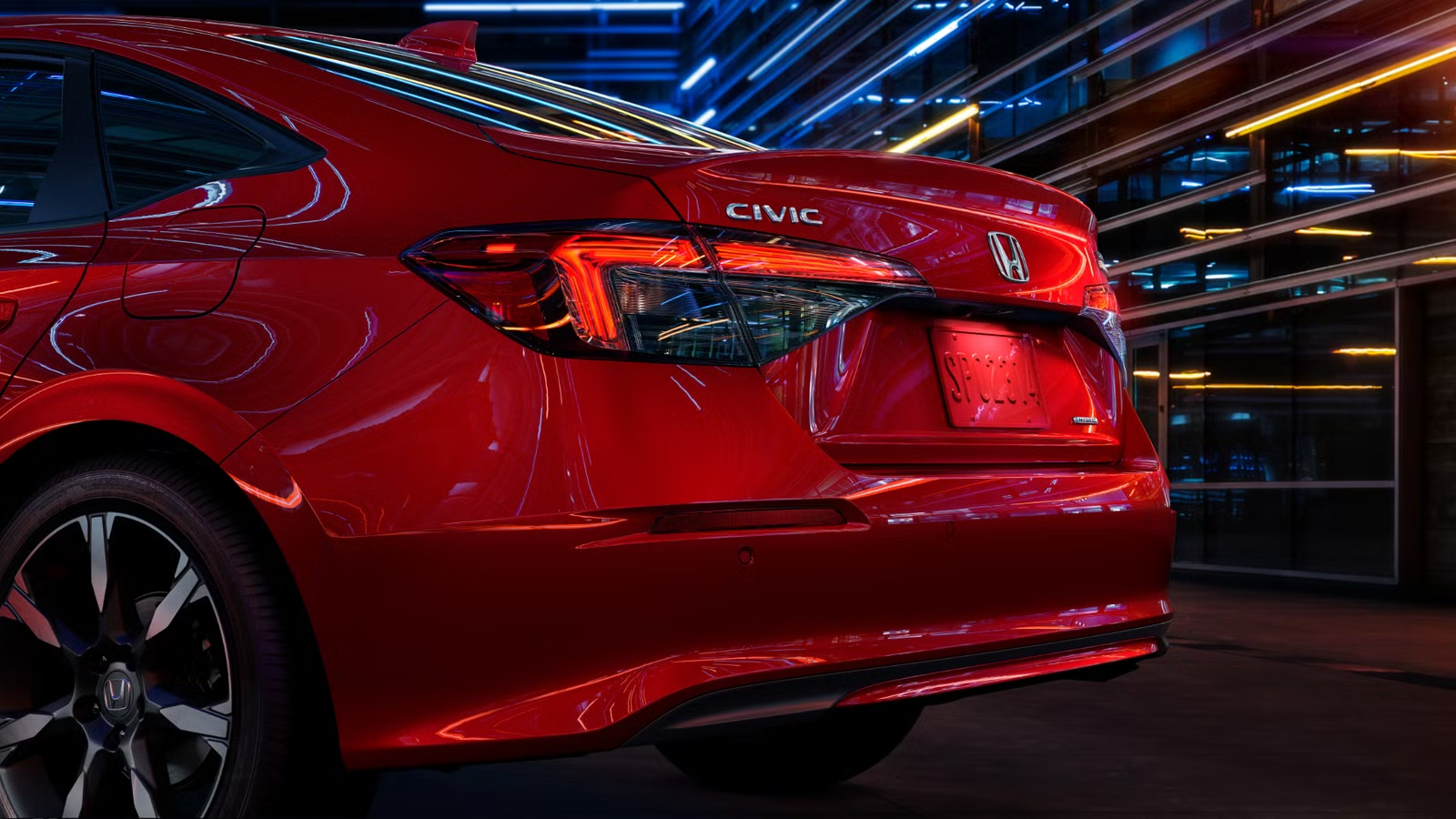
The Honda Civic has a 50+ year history of being one of the most practical cars on the road. It made its North American debut in 1973, selling for just $2,000 (around $15,678 in 2026 dollars), averaging up to 40 mpg on the highway, which made it a godsend in the recession-strapped, gas-starved malaise era.
iSeeCars recently named the little Honda as the industry’s best price-per-year-of-life value, after conducting a study of roughly 400 million used-car odometer readings, beating out every crossover on the market. In other words, the more things change, the more they stay the same.
Crossovers Cost Too Much To Be Beaten By A Compact Car
Exterior profile shot of the 2026 Honda Civic Hatchback Honda
We already knew that the Honda Civic was reliable, but the iSeeCars study exposes something worth mentioning. Your average American driver loves crossovers because they’re supposed to be the most pragmatic cars on the market. That is, they’re reliable, safe, and they last forever with routine maintenance.
But iSeeCars puts a typical new car, which has a 60% chance of being a crossover or an SUV, at around $46,699, with an 11-year life expectancy. Meanwhile, the Honda Civic hatchback starts at $27,768, and it’s expected to last an incredible 17.3 years, while the nameplate, on the whole, averages 13.5 years across all trims and body styles.
Admittedly, $46,699 is a broad average across all body styles and size classes. If we narrow it down a bit, we can use the following examples for comparison.
These are SUVs listed among iSeeCars’ 25 most reliable models, and none of them match the Civic on longevity for the price. Even the Civic’s own platform-mate, the CR-V, can’t match the hatchback’s industry-leading longevity, despite costing nearly $9,000 more.
We Can Praise The Civic Til We’re Blue In The Face, But That’s Not The Point
2026 Honda Civic Hatchback interior view of the front cabinHonda
We’ve published enough pieces praising the Civic for a lifetime and then some, but that’s not really the point we’re trying to make here. What we’re asking is why the overall average lifespan of a new vehicle is just over a decade, while outlier models like the Civic, the Toyota Tacoma (15.7 years), and the Lexus IS 350 (17 years) will outlast a new roof.
And the answer is that, well, maybe it’s the drivers who are to blame. The Zebra ran a survey earlier this year, polling 1,000 drivers and turning up the following insights.
- 65% of respondents had only owned their cars for six years or fewer.
- Over one third of respondents owned cars less than three years old.
- Only around 4% of respondents kept their car for more than 13 years.
- Around 13% of respondents reported owning their car for more than a decade.
- The average age of a car on the road today is 12.6 years, but that includes first, second, third, and tenth owners.
Ultimately, there’s only so much money to be made in producing a car that will be old enough to vote by the time it finally gives up the ghost. The automaker isn’t getting a cut when the first owner sells it to the second owner on the private market, just like Nintendo isn’t collecting any back-end revenue when you sell your old console to GameStop, and Nike’s not getting a percentage when you find a pair of sneakers at the thrift store.
There are drivers out there (about 13% of them) who want a car that will last them as long as possible, but the rest of us are hooked on that new-car smell and the peace of mind that comes with knowing you’re never out of warranty.
Brands like Honda and Toyota make a point of appealing to the drivers who value longevity. If segment-leading reliability isn’t part of your brand, though, there’s just not a lot of incentive to build an unkillable car.
The Civic Remains The King Of Daily Drivers
Exterior profile shot of the 2026 Honda Civic HatchbackHonda
Since its introduction in the Oil Crisis era, the Civic has been the cure for cost-of-ownership headaches. Affordable to buy, cheap to maintain, and ridiculously fuel-efficient, the Civic has always been a budget car that doesn’t really feel like a budget car.
Full-coverage insurance for a 2026 Honda Civic should cost around $2,405 for a 40-year-old driver with good credit and a clean record, according to CarEdge. FuelEconomy.gov estimates annual fuel costs of just $1,800 for a hatchback driven 15,000 miles per year. RepairPal puts annual maintenance costs at $428, with the following accounting for the most expensive common fixes.
- ABS control module replacement $1,597 – $1,625
- Brake pressure sensor replacement $350 – $390
- Door lock actuator replacement $321 – $465
- Radiator hose replacement $290 – $336
- Air conditioning condenser fan motor replacement $273 – $414
All told, we’re looking at an annual maintenance cost of just $4,633. The industry average, according to these same sources, adds up to $5,077 per year.
Take a look around, and 2026 is looking a lot like 1973. The price of gas is up, as is inflation, and we’re looking at slowed economic growth (even if we’re not officially in a recession at the moment). The Honda Civic made sense then, and it makes sense now.
You Almost Can’t Go Wrong With Any Version Of The Honda Civic
1973 (Japan market) Honda Civic CVCCHonda Global
If you show us just about any Honda Civic on the market and ask if you should buy it, we’ll tell you: yes, go for it. Just make sure it passes the test-drive and you’re paying a fair price.
That said, some Civics will get a higher recommendation than others. If we check in with CarComplaints, we find that 11th-gen (2022+) Civics have very few reliability concerns, but early 10th-gen (2016–2021) models had some first-year hurdles to overcome. The 2016 model alone has 457 complaints on file, with 25 being for transmission issues, pertaining to hesitation, surging, and total CVT failure.
Anything from the 2018 model year or later is going to be relatively problem-free. We would argue that a five-year-old Civic would be the sweet-spot for pricing. To be more specific, we like the 2021 Sport Manual, trending at $17,000 from a $23,300 MSRP, and the 2021 Sport Touring CVT, trending at $17,452 from a $29,400 MSRP.
Checking out our marketplace, we were able to find the following listings.
- A 98,791-mile 2018 Hatchback is selling for $18,482 in Indiana.
- A 61,889-mile 2019 Hatchback is selling for $17,995 in New Jersey.
- A 41,666-mile 2022 Hatchback is selling for $25,990 in Connecticut.
- A 66,485-mile 2020 Sedan is selling for $16,995 in New Jersey.
- A 57,050-mile 2022 Sedan is selling for $24,699 in Illinois.
Note that these listings are only to give you an idea of what’s out there. There’s no telling what will be available in your area, and in your price range, when you’re ready to buy.
You Can’t Beat A New Civic, Either
2026 Honda Civic Hatchback interior view of the moonroofHonda
It goes without saying that a brand-new Honda Civic is an easy pick for new car buyers. The 2026 hatchback Sport model starts you off with a naturally aspirated 150-horsepower 2.0-liter straight-four, averaging 34 miles to the gallon combined, and running a CVT transmission.
Pricing on a hatchback ranges from $27,895 for a Sport to $33,595 for a Sport Touring Hybrid, which packs a 2.0-liter straight-four hybridized for a total power output of 200 hp, and an incredible fuel economy of 50 mpg in the city. Even a used Honda Civic will outlast just about anything else you could buy, but a new model lets you enjoy all 17 of those years yourself.
Sources: Honda, iSeeCars, The Zebra, RepairPal, CarEdge, FuelEconomy.gov., CarComplaints.
