

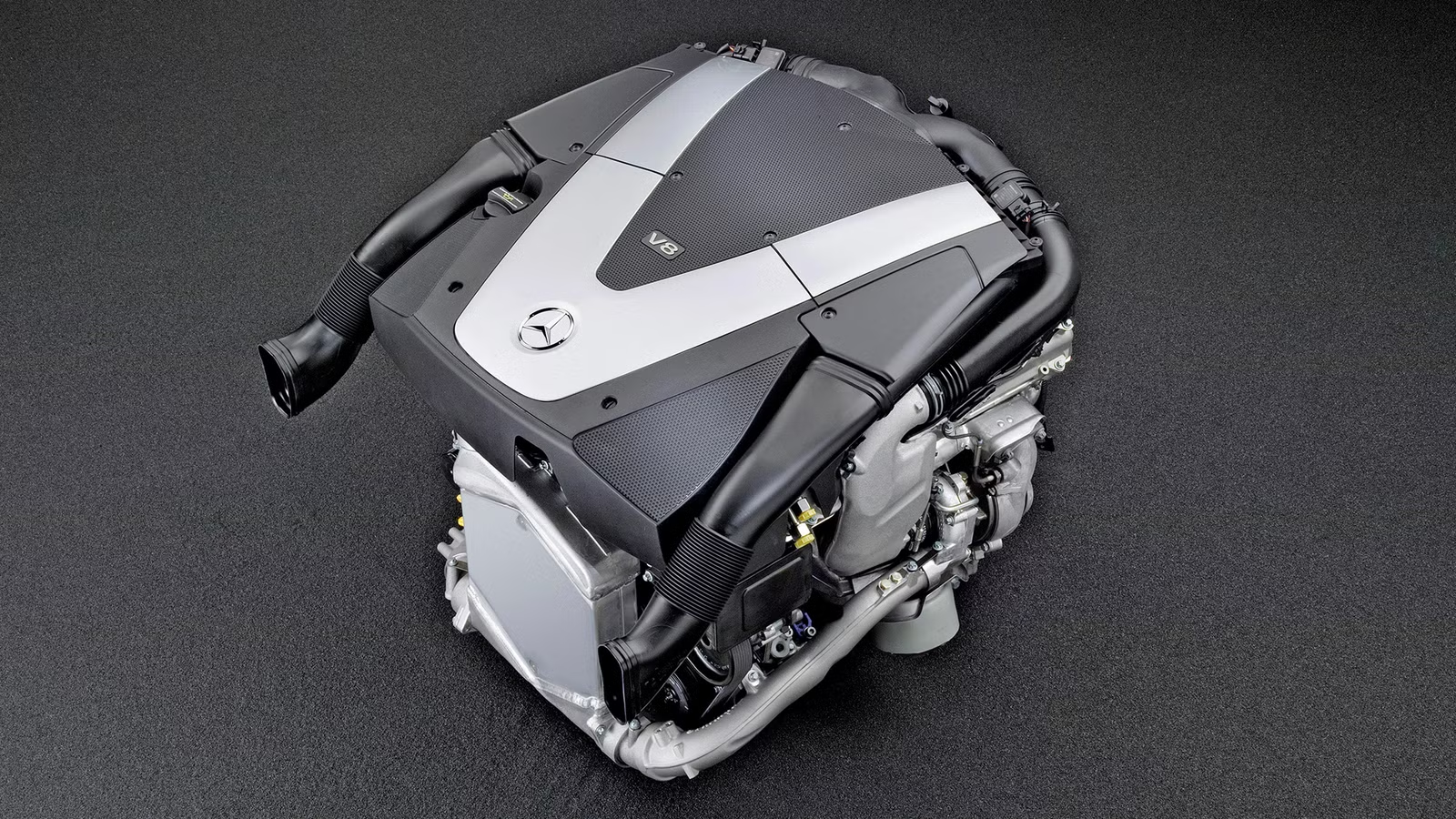
Some engines merely do their job, and some engines reach for the skies – literally. Automotive engineering has a history of crossing boundaries, with technologies developed for road vehicles sometimes finding new roles in entirely different forms of transportation. Aircraft, in particular, present an intriguing opportunity for engineers to adapt existing powertrain designs to meet very different demands.
Diesel engines are especially interesting because their high torque, fuel efficiency, and ability to deliver sustained performance make them suitable for applications where endurance matters. While most people associate diesel power with trucks, SUVs, and long-distance driving, some engines have ventured far beyond the road, taking automotive engineering into the skies. One Mercedes-Benz engine is a prime example.
The Mercedes E-Class Combined Executive Luxury With V8 Diesel Power
Introduced in 2005, the W211-generation Mercedes-Benz E420 CDI gave executive sedan buyers a distinctly different take on performance. Under the hood sat the OM 629, a 4.0-liter biturbo diesel V8 producing 314 horsepower and 538 lb-ft of torque in this application. That torque peaked at just 2,200 rpm, helping the sedan accelerate with authority without needing to be pushed hard through the rev range. Mercedes-Benz quoted a 0-62 mph time in a brisk 6.1 seconds, impressive performance for a refined four-door luxury car of its era.
The E420 CDI occupied an unusual position in the E-Class lineup. Rather than relying on a high-revving gasoline engine to deliver speed, it combined V8 power with the long-legged character of a diesel executive sedan. Its strong midrange response made highway passing feel effortless, while its understated appearance suited buyers who wanted serious performance without the visual drama of a dedicated sports sedan.
It demonstrated that diesel power could be a compelling alternative in the premium performance market, delivering muscular acceleration while retaining the comfort and practicality expected of an E-Class. Fuel consumption was also impressive at a claimed 25 MPG. But fitting a V8 diesel into a sedan was one thing – could the same engine handle the demands of a much heavier luxury SUV?
The Mercedes ML-Class Used Diesel V8 Torque To Move A Luxury SUV
The E420 CDI proved the OM 629 could make a sedan fast. Mercedes then asked whether the same engine could do the same for something considerably heavier.
The W164 Mercedes-Benz ML420 CDI brought V8 diesel performance to a midsize luxury SUV, giving buyers a more powerful alternative to the model’s mainstream engine options. Its OM 629 engine delivered 306 hp and 516 lb-ft of torque, helping the SUV build speed confidently despite its substantial curb weight. Paired with a seven-speed automatic transmission and Mercedes-Benz’s 4Matic all-wheel-drive system, the ML420 CDI was designed to handle daily commuting, long highway trips, and journeys with passengers and luggage without feeling underpowered.
The ML420 CDI also challenged the idea that diesel engines belonged primarily in work vehicles. Its upscale cabin, comfort-focused suspension, and premium equipment placed it firmly in the luxury market, while the V8’s strong pulling power suited the practical demands of SUV ownership. Rather than pursuing sports-car responses, it delivered accessible performance in a tall, versatile package. If the ML420 CDI proved diesel could power a luxury SUV, the real test was whether the same engine could hold its own at the very top of Mercedes’ lineup — in the S-Class.
The Mercedes S-Class Made The Diesel V8 A Luxury Flagship
When Mercedes-Benz introduced the W221 S420 CDI in 2006, it brought V8 biturbo diesel power to the top of its luxury sedan range. The OM 629 produced 320 hp and 538 lb-ft of torque, with peak torque available at a low 2,000 rpm. That output helped the flagship sedan accelerate from 0-62 mph in a claimed 6.6 seconds, while its electronically limited top speed reached 155 mph. Mercedes-Benz also engineered the V8 for refinement, using measures such as a counter-rotating balance shaft and acoustic insulation to reduce vibration and engine noise.
The S420 CDI showed that diesel power could serve buyers at the highest end of the luxury market. Its purpose was not to turn the S-Class into a sports sedan, but to provide discreet, readily available performance while preserving the calm, comfortable character expected of a flagship.
Compared with the ML420 CDI’s SUV-oriented role, the S420 CDI focused on delivering an unhurried, premium driving experience for executives and long-distance travelers. It also demonstrated Mercedes-Benz’s willingness to offer a powerful diesel alternative alongside the gasoline engines traditionally associated with full-size luxury sedans.Three very different vehicles, one engine. But the OM 629’s most unlikely role was still to come – and it had nothing to do with roads.
The Mercedes GL-Class Put The V8 Diesel To Work In A Full-Size SUV
2006 Mercedes-Benz GL420 CDI rear three quarterMercedes-Benz
The X164 Mercedes-Benz GL420 CDI applied the OM 629 to a vehicle built around space and carrying capacity. Unlike the midsize ML-Class, the full-size GL-Class offered three rows of seating for up to seven occupants, making it suitable for larger families and buyers who regularly traveled with passengers and luggage.
The V8 diesel produced 306 hp and 516 lb-ft of torque, giving the substantial SUV the pulling power needed for confident acceleration and loaded highway driving. Its seven-speed automatic transmission and 4Matic all-wheel-drive system helped deliver that performance across varied road conditions.
2006 Mercedes-Benz GL420 CDI engineMercedes-Benz
Although the ML-Class and GL-Class shared much of their engineering, they served different needs. The ML420 CDI offered luxury and performance in a more manageable midsize package, while the GL420 CDI prioritized passenger space and greater versatility. Its larger body and additional seating meant more weight to move, making the engine’s broad torque delivery particularly useful in everyday driving.
The result was a luxury SUV that could accommodate a family and its belongings without requiring buyers to step down to a less powerful engine. It extended the OM 629’s reach into a segment where size and practicality were central considerations.
From Mercedes Road Cars To The Thielert Centurion 4.0 Aircraft Engine
2006 Mercedes-Benz GL420 CDI badgeMercedes-Benz
The OM 629’s most unusual application came through the Thielert Centurion 4.0, an aviation derivative that transformed the Mercedes-based V8 into a dedicated aircraft power plant. The conversion involved considerably more than adapting the engine to turn a propeller. Like the road engine, the Centurion also featured common-rail direct fuel injection and twin turbochargers.
It was further fitted with a reduction gearbox to bring engine speed into a suitable range for the propeller, and a full-authority digital engine control (FADEC) system. Its liquid-cooling system and electronic controls also had to meet aviation-specific operating and safety requirements. At approximately 631 lbs dry, the engine presented a significant weight consideration when matched to an airframe.
2006 Mercedes-Benz GL420 CDI front three quarterMercedes-Benz
The Centurion 4.0 received European type certification in 2004, with additional power variants certified in 2007. New Zealand’s Civil Aviation Authority also documented a trial installation on an FU24-950 agricultural aircraft. The engine was developed with retrofit applications in mind, and certification records list installation approvals involving aircraft such as the Cirrus SR22 and Cessna 206.
However, engine certification does not automatically approve every airframe for installation; each aircraft-engine combination requires the appropriate approval. The project illustrates both the potential of adapting automotive technology for aviation and the extensive engineering and certification work needed to make that transition.
2006 Mercedes-Benz GL420 CDI off-roadMercedes-Benz
The story of the OM 629 highlights an often-overlooked connection between the automotive and aviation industries. It is far from the only road-going powerplant to make the transition to flight. Porsche-based engines have appeared in experimental aircraft, while automotive-derived powerplants from Volkswagen and other manufacturers have also found aviation applications.
These projects reflect a longstanding interest in finding alternatives to conventional aircraft engines, particularly where operating costs and fuel availability matter. However, adapting a car engine for flight remains a specialized undertaking, with certification, maintenance support, and long-term reliability all playing critical roles. Such cross-industry engineering continues to demonstrate how technology can find unexpected applications beyond its original purpose.
2007 Mercedes-Benz GL 320 CDI 4MATIC 3.0L CDI
MSRP
$52,400
Engine
3L V-6 ICE
Drivetrain
All-Wheel Drive
Transmission
7-speed automatic
Horsepower
215 HP @3800 RPM
Torque
398 lb.-ft. @ 1600 RPM
Maximum Towing Capacity
7,500 lbs.
Expand
Sources: Mercedes-Benz, EASA, Aero News, New Zealand Civil Aviation Authority
