

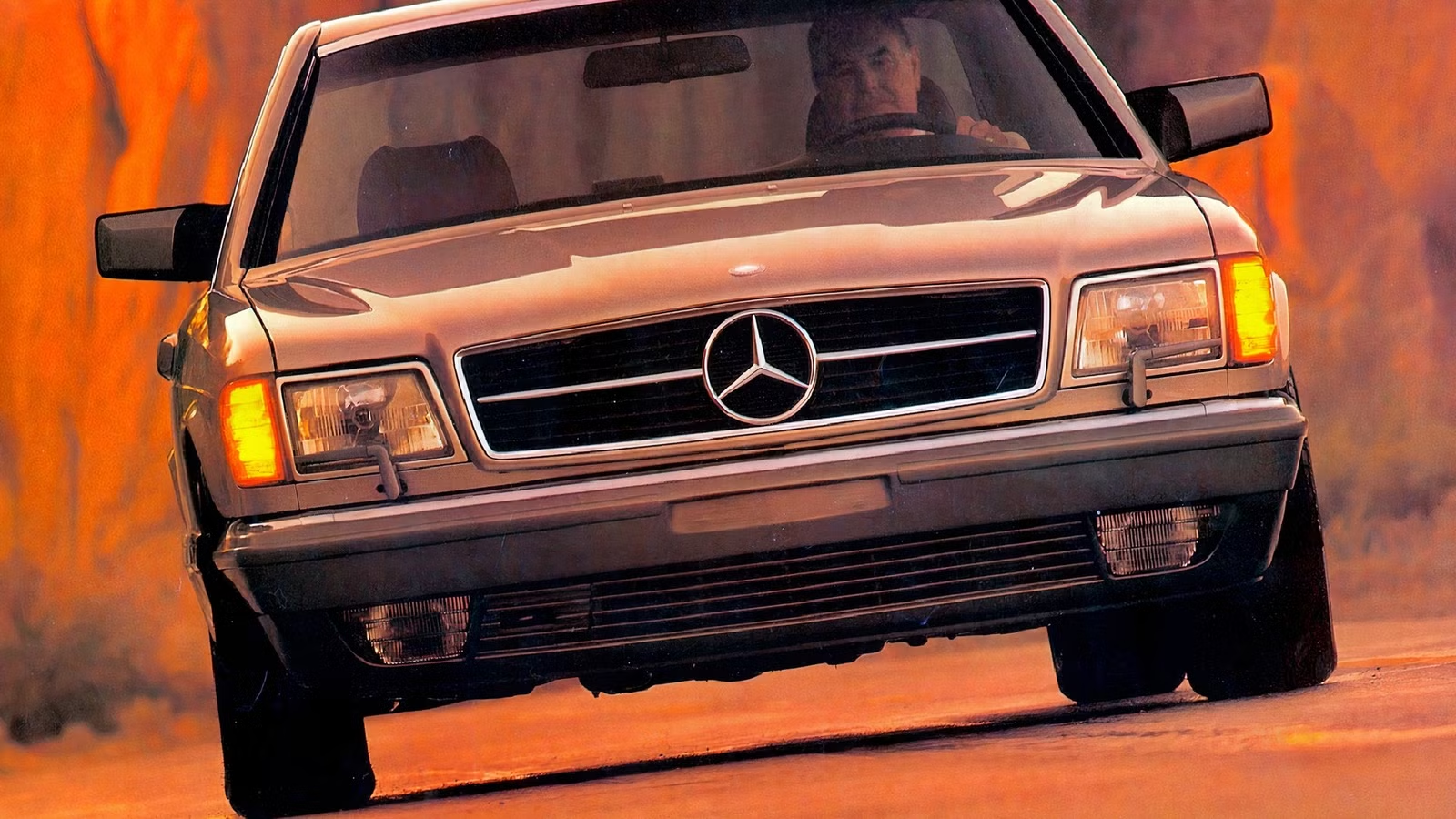
The automobile has been in development for over 140 years to get to where we are. On a global scale, we suspect a graph of development would show a gradual curve upward, even through the 1970s when things got a little rocky for the automotive industry. The reason we believe the 1980s became the most important decade for cars is because just about every technology that could be applied to a car took a big step forward in this period.
At the same time, many automakers were doing well enough financially that they could spend money on research and development, as particularly well demonstrated by Toyota and the Lexus LS400. The 1980s also saw computing taking a leap forward, particularly with computer-aided design (CAD) and computing chips becoming affordable. It was a perfect storm for the 1980s to become the most innovative decade in automotive history. These are the big game-changing innovations.
The Rise Of Turbocharging
1989 Porsche 911 (930) Turbo LECollecting Cars
Turbochargers are now a common thing to find under the hood of a car, aiding both power and efficiency. Turbochargers had been around since the early 1900s, mainly for airplane engines, but in the 1970s they were only just being proven on the racetrack for reliability and rarely appearing on consumer cars.
But a few things happened in the 1980s. First was that emissions became a big concern, and turbos could increase fuel mileage and performance on diesel-powered commercial trucks.
The second was that turbos became reliable enough for mainstream and performance cars, and could add a lot of power to a smaller engine. At the same time, the idea of a turbo grew in the car enthusiast world through motorsports, particularly through rallying and the infamous and unhinged Group B cars with no restriction on boost levels. The result was the proliferation of Turbo badged cars, and automakers competing with each other to make more and more horsepower without blowing engines up prematurely.
Anti-lock Braking System (ABS)
1978 Mercedes-Benz S-Class W116 ABS Brake TestsMercedes-Benz
Like most technology, the anti-lock-braking had a long germination period before it reached the mainstream. In 1971, Mario Palazzetti, working at the Fiat Research Center, fine-tuned modern ABS for cars as we know it. Before speed sensors and control valves, the driver of a car would need to be taught to do something incredibly counter-intuitive when the car starts sliding while braking: release the brake and put it back on again to regain traction.
Essentially, when the ABS detects a wheel has locked up while the car is moving, the control module pulses the valve for both wheels on that end of the car to prevent the wheels locking up. Mercedes, being Mercedes, put the system on its S-Class in 1978. But it was Ford in Europe that found success with the Scorpio and started researching ABS for its whole range of cars. In 1987, Mercedes made ABS standard equipment throughout its range.
Traction Control
1988 Jeep Comanche Pioneer parked in the snow.Bring A Trailer
While being similar in how they work, ABS stops people from sliding off the road while traction control helps people maintain traction under acceleration in slippery conditions. BMW is largely credited with developing traction control for cars in the 1980s, although others, including Buick and Cadillac, had more basic versions in the 1970s. Those systems modulated engine power when rear wheel spin was detected, but the big jump forward was the use of individual wheel braking as well as throttle control.
If you put ABS and traction control together, you have the nuts and bolts of what we know now as electronic stability control (ESC), which helps steer the vehicle where the driver intends to go when there’s a loss of control. In 2012, ESC became mandatory in the US and in Europe around 2014. It has saved countless lives, not just by preventing cars spinning off the road, but large SUVs and trucks rolling over.
All-Wheel-Drive
With nearly 200 hp and four-wheel traction, the Audi quattro was a peformance revelation in 1980.Audi
It’s hard to imagine a time when all-wheel-drive cars weren’t common. Subaru is recognized as delivering the first all-wheel-drive car with the niche Leone Station Wagon in the early 1970s. But, in the 1980s, Audi dropped a bombshell into rallying with the all-wheel-drive Quattro, showing the world that power to all four wheels was a performance enhancer as well as a necessity for off-roading in slippery conditions.
Audi brought its Quattro system to the mainstream as both a performance system and for practicality, and many automakers followed. Now, all-wheel-drive is baked into all sorts of vehicles, not just high-performance cars. And it’s not just about off-roading. Mazda, for example, wants all-wheel-drive in as many of its vehicles as possible, citing “a stable driving experience even in dry weather climates”.
Aerodynamics
The Ford Sierra XR8 was created specifically for the racetrack, to take the fight to the BMW’s 745i, Alfa Romeo GTV 3.0 and Mazda RX7.Ford
In the 1970s, aerodynamics was mainly for race cars and the majority of cars on the road were as aerodynamic as a brick. The 1980s saw automakers look at aerodynamics in road cars for both fuel efficiency and performance. Design started focussing on reducing drag, improving airflow, and minimizing lift, resulting in smooth body contours and integrated spoilers becoming normal.
Related
10 Common Car Technologies That Didn’t Exist 25 Years Ago
Some features that are standard on today’s cheapest cars were science fiction in 2000.
In 1982, the Audi 100 had a drag coefficient of 0.30, which was incredibly low for the time, and not only improved efficiency, but led to a quiet cabin and improved stability at speed. At the same time, Toyota pushed hard with aerodynamics for the second-generation Supra for performance, shaping the car to reduce turbulence and improve stability.
Europeans will remember the Ford Sierra, which was a sleek, revolutionary aerodynamic design compared to the car it replaced – the boxy Cortina. Or, if you were David Vivian writing for the UK publication Motor’s in 1983, “a blancmange evicted from its mold half an hour too soon”.
Airbags
2011-2013 Hyundai Equus All Airbags DeployedHyundai
Amazingly to us now, airbags were experimented with in the 1970s as a substitute for seatbelts, mainly by Ford and GM. Americans really did not want to wear seatbelts, and still don’t, but in Germany, Mercedes was being Mercedes, and introduced an airbag as an option on the S-Class. Porsche was one of the first automakers to have a driver and passenger airbag as standard equipment, putting them in the Porsche 944 Turbo.
Chrysler was one of the first US manufacturers to introduce an airbag as standard equipment, which also pushed them into public awareness by including them in its advertising.
Publicizing its airbag technology and how it saved lives created a competitive edge for Chrysler’s family cars until other brands caught on. The development competition is still running. To the point that US safety standards don’t demand side airbags, yet you would be hard-pressed to find a mainstream vehicle without one.
Fuel Injection
Rear badge shot of an E39-generation BMW 540i sedanBring A Trailer
Like most things we’re talking about here, fuel injection originated for airplanes. Fuel injection as a concept for cars started taking shape in the 1950s for racing, most famously with Jaguar using a Lucas system in the legendary Jaguar D-Type. Fuel injection gained some popularity, particularly building up in the 1970s, but they were all analogue controlled. But, in 1980, Bosch changed the game with its electronically controlled Motronic multi-point fuel injection system.
Fuel injection took a huge leap forward and quickly started to replace carburetors due to their precision, improving efficiency and consistency. Both of which can be used for performance, improving fuel economy, and improving emissions. Fuel injection was such a big deal that a lot of automakers added an “I” to model names or trims. BMW still uses the lowercase i for some of its sedan model designations, mostly out of tradition.
Sources: Toyota, HotCars / The Drive / Flying Mag / CarBuzz / National Library Of Medicine
