

Pontiac originated in 1926 as a companion brand to General Motors’ Oakland division. Positioned between Chevrolet and Oldsmobile, it entered the market as a more affordable premium brand. After Oakland folded in 1931, Pontiac emerged as a reliable manufacturer of quiet, family-oriented automobiles.
The brand redefined its identity in 1956, with a shift towards performance, motorsport competition, and more stylized design. The use of wide-track suspension layouts and high-output V‑8 engines transformed Pontiac into an iconic American muscle car brand, leaving behind a lineage of iconic models after its demise.
How The V-8 Defined The American Muscle Car
Aerial shot of a 2006 Pontiac GTO LS2 V-8 engineBring A Trailer
The evolution of the American V-8 engine remains a defining moment in the country’s automotive performance segment. Its introduction established a legacy of displacement and accessible horsepower that birthed the muscle car era. Ford championed this format with its Y-block V-8 architecture, followed by Chevrolet’s legendary small-block V-8.
Pontiac’s overhead-valve engine architecture also entered the market during this era. This engineering move launched the muscle car template, proving that shoehorning high-displacement V-8 engines into lightweight passenger cars generated massive public demand and permanently reshaped global automotive culture.
Pontiac’s Impactful Presence In The Muscle Car Era
Close-up shot of 2004 Pontiac GTO hood badgeBring A Trailer
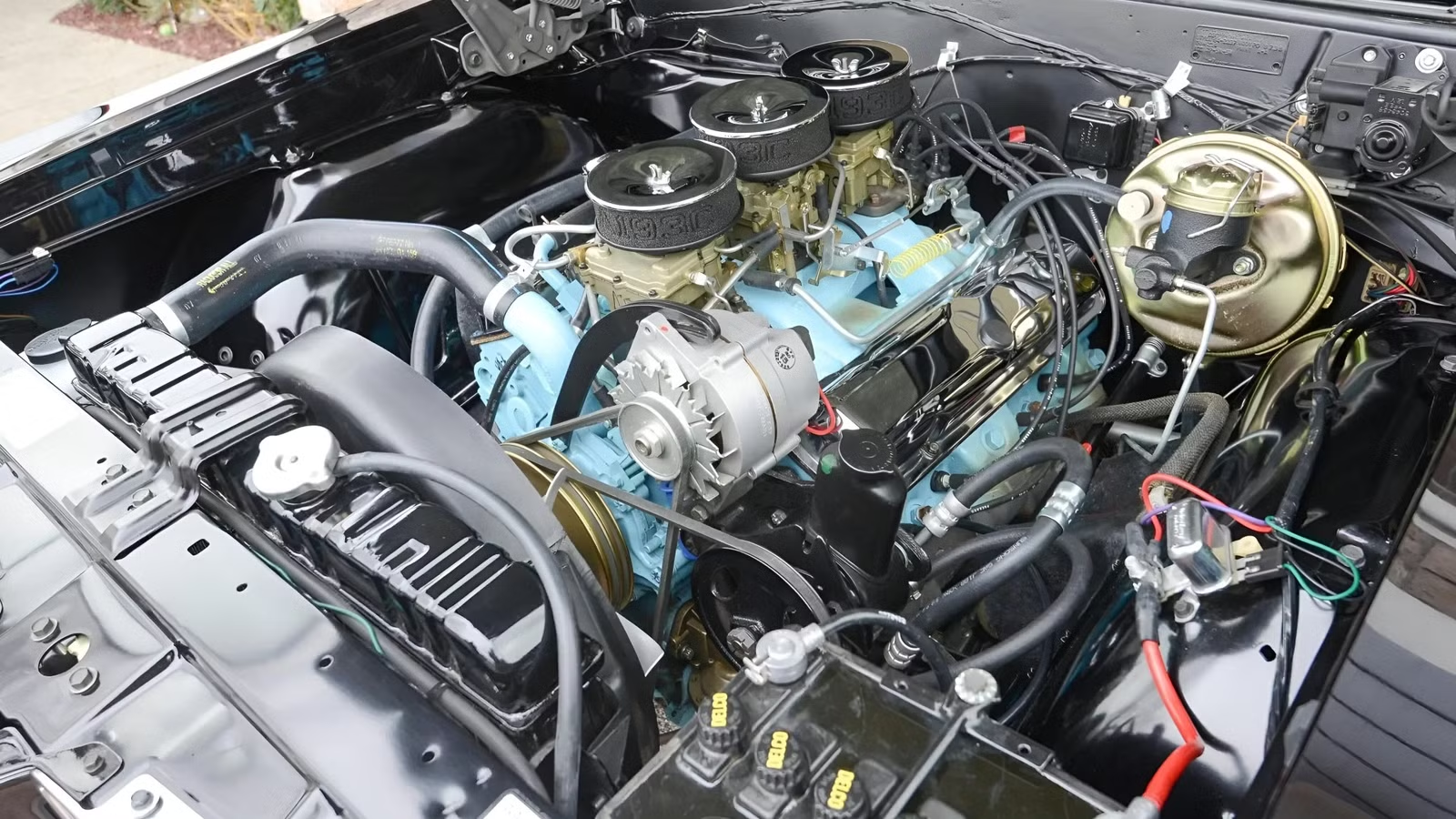
The Pontiac Tri-Power V-8 is a landmark engine design that remains one of the most identifiable performance features of the American muscle car era. Introduced in 1957 and produced through 1966, this multi-carburetor arrangement placed three Rochester two-barrel carburetors above a specialized cast-iron intake manifold. It delivered high-volume airflow, immediate throttle response, and significant horsepower gains without the extreme cost or mechanical complexity of early fuel injection systems.
Over its ten-year production run, the Tri-Power option transformed Pontiac into a performance powerhouse. The origins of the Tri-Power trace back to late 1956, when Semon Knudsen assumed control of the Pontiac Motor Division. General Motors executives wanted to revitalize Pontiac’s aging customer base and poor sales. The goal was to make the brand more dominant on the racetrack, which it achieved via the newly introduced overhead-valve V-8 engine architecture.
Solving Performance Issues With Three Carburetors
Engine of 1963 Pontiac Tempest Super DutyMecum
Single four-barrel carburetors provided good air volume for standard highway driving, but they restricted secondary airflow at high engine speeds. Dual four-barrel carburetor setups offered high flow, but they created severe clearance issues under low hood lines and produced poor low-speed vacuum. The system also caused poor fuel economy during normal operation. Mechanical fuel injection systems provided precise fuel metering, but they carried massive manufacturing costs, high failure rates, and difficult adjustment procedures for average mechanics.
Pontiac engineers solved this induction challenge by using off-the-shelf components from GM’s Rochester Products division. Rochester manufactured the Model 2G two-barrel carburetor, a compact, durable unit installed on millions of passenger cars. The engineering team designed a cast-iron intake manifold that mounted three Rochester 2G series carburetors in-line over the engine valley. The layout provided six distinct throttle bores. This resulted in better air distribution across the cylinders compared to a central four-barrel unit, while costing a fraction of Rochester’s experimental mechanical fuel injection setup.
How The Tri-Power Layout Perfected Daily Performance
Bring a Trailer
Pontiac’s Tri-Power system adopted a progressive throttle linkage that prevented the engine from operating on all three carburetors simultaneously during routine driving. Under normal cruising conditions, light acceleration, or idle, the front and rear carburetors remained fully closed. The engine drew air and fuel exclusively through the center carburetor. This center unit contained a complete idle circuit, power valve, accelerator pump, and automatic choke mechanism. Driving on the center carburetor preserved good low-speed engine vacuum, smooth idle quality, and reasonable fuel consumption.
The mechanical progressive linkage actuated the throttle shafts of the outer carburetors with more throttle input. These outboard units operated as slave carburetors. They lacked power valves, idle circuits, and chokes, containing only main metering circuits, throttle plates, and accelerator pumps. When wide-open throttle was applied, all six barrels opened simultaneously. This sudden transition delivered a large volume of air and atomized gasoline directly into the intake runners, producing an instant rise in manifold pressure and a distinctive intake roar.
Advancing The System Through Vacuum Power
Mecum
In 1965, Pontiac refined the system by replacing the purely mechanical linkage on certain automatic transmission models with a vacuum-actuated arrangement. This system connected to a manifold vacuum source to sense engine load. It delayed the opening of the end carburetors until more air was required, preventing bogging or hesitation caused by a sudden drop in intake vacuum. However, performance enthusiasts favored the direct feel and instantaneous response of the fully mechanical linkage, which remained the preferred configuration for manual transmission vehicles and street racing.
The physical dimensions and airflow ratings of the carburetors evolved throughout the production lifespan of the system. Early 1957 to 1965 Tri-Power setups utilized smaller Rochester 2GC units. The center carburetor flowed 250 CFM, while the outer units flowed 275 CFM each, producing a total combined airflow rating of 800 CFM. For the final 1966 model year, Pontiac engineers enlarged the throttle bores and venturi sizes of the outer carburetors. This upgrade pushed total system airflow to over 925 CFM, making the 1966 version the highest-flowing factory Tri-Power system ever installed on a Pontiac V-8.
Pontiac’s Impressive Performance Outputs
Bring A Trailer
The Tri-Power setup debuted on the 1957 Pontiac line, fitted to the 347 cubic-inch V-8. In base single two-barrel form, the 347 produced 227 horsepower. Equipping the engine with the factory Tri-Power package bumped compression to 10.75:1 and raised output to 290 hp and 375 pound-feet of torque. Over-the-counter racing camshafts from Pontiac dealers pushed output to 317 hp.
For 1958, Pontiac increased engine displacement to 370 cubic inches by enlarging the cylinder bore to 4.0625 inches. The Tri-Power option returned on the 370 V-8, carrying a power rating of 300 hp in street trim. Pontiac offered mechanical fuel injection that same year, but the option cost nearly $500, equal to 15 percent of the car’s base price. The Tri-Power system provided identical acceleration figures on the drag strip for a fraction of the cost, prompting Pontiac to drop fuel injection permanently at the end of the 1958 model year.
Adapting The Engine For NASCAR Performance
Bring a Trailer
In 1959, Pontiac introduced the 389 cubic-inch V-8 by extending the engine stroke to 3.75 inches. The 389 became the backbone of Pontiac’s performance image for the next decade. The brand then expanded its performance engineering in 1962 with the introduction of the 421 cubic-inch Super Duty V-8. Built specifically for NHRA drag racing and NASCAR competition, early 421 Super Duty engines featured dual four-barrel intake manifolds. However, in 1963, Pontiac offered a street-legal 421 High Output engine equipped with the Tri-Power setup. Featuring 10.75:1 compression, heavy-duty main bearing caps, a forged steel crankshaft, and high-lift camshafts, the 421 Tri-Power engine delivered 370 hp and 460 lb-ft of torque, turning full-size Pontiac coupes into formidable performance cars.
The GTO Took Tri-Power To The Next Level
1964 Pontiac GTO Hardtop 389 Tri-Power 4-Speed engine bayBring a Trailer
The standard 1964 GTO 389 V-8 came with a Carter four-barrel carburetor, producing 325 hp. Option code 382 designated the 389 Tri-Power engine, which increased output to 348 hp at 4,900 RPM and 428 lb-ft of torque at 3,600 RPM. Car and Driver magazine tested a Tri-Power GTO in early 1964, recording a 0 to 60 mph acceleration time of 4.6 seconds and a quarter-mile run of 13.1 seconds at 115 MPH. Although the test car contained non-standard tuning modifications, the published figures established the Tri-Power GTO as a dominant muscle car.
Sales of the Tri-Power package surged alongside the success of the GTO. In 1964, Pontiac sold 32,450 GTOs, with 8,250 buyers selecting the optional Tri-Power engine. For 1965, Pontiac redesigned the GTO’s exterior styling and revised the 389 engine cylinder heads, fitting larger intake valves and improved manifold porting. Output for the base four-barrel 389 rose to 335 hp, while the 1965 389 Tri-Power engine reached 360 hp at 5,200 RPM. More than 20,000 buyers ordered the Tri-Power option on their 1965 GTOs.
An Unfortunate End To An Innovative System
1964 Pontiac GTO Sport Coupe Tri-PowerBring a Trailer
The demise of the Tri-Power setup resulted from corporate policy rather than mechanical deficiencies. In 1966, General Motors management issued an executive mandate banning multi-carburetor induction setups on all GM passenger vehicles, with the sole exception of the Chevrolet Corvette. Corporate executives sought to standardize engine components across divisions, cut manufacturing complexity, and prepare for upcoming federal exhaust emission standards. Multi-carburetor systems proved difficult to tune for stringent hydrocarbon and carbon monoxide limits during cold-start testing protocols.
Today, original factory-equipped Tri-Power Pontiacs command high prices among classic car collectors and automotive historians. Beyond its visual impact when the air cleaners are removed, the Tri-Power V-8 represents a monument to mid-century American automotive engineering. It represented a mechanical solution that balanced daily drivability with wide-open performance, defining the golden age of Pontiac muscle.
Available Models
Select Available Models
Pontiac
Production Status
Discontinued
Sources: Car and Driver, Hemmings, and Chevy Hardcore.
